


RIYADH: As the inaugural Art Week Riyadh unfolds across the city, it signals more than just a new entry on the cultural calendar — it marks a shift in how contemporary art is being framed, experienced, and contextualized in the Kingdom. Running until Apr. 13, the weeklong event resists the format of the conventional art fair, instead offering an expansive experience that speaks to Saudi Arabia’s evolving cultural identity.
The flagship exhibition of the event, “At The Edge,” brings together over 30 galleries from Saudi Arabia and beyond. Their curated presentations do not merely showcase work — they provoke dialogue, challenge assumptions, and reflect the complex, often contrasting, cultural currents that define both the local and global contemporary art landscapes.
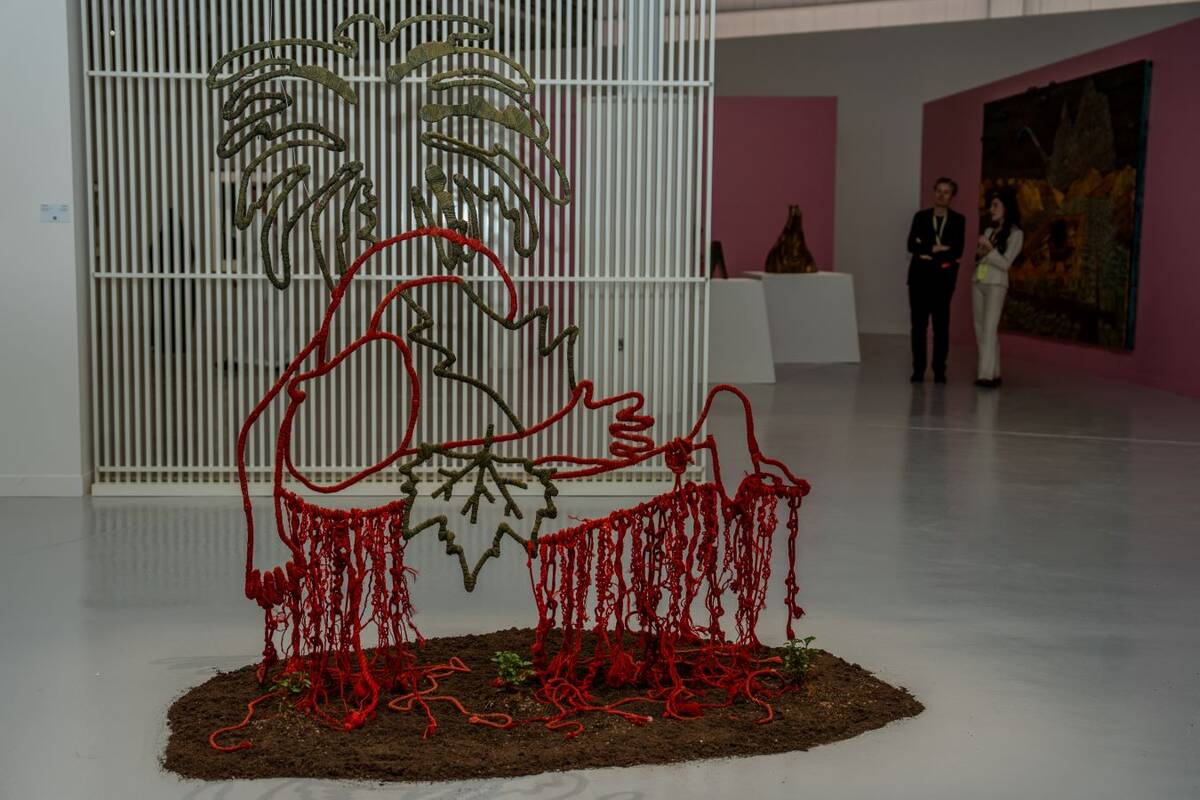
Artist Joud Fahmy’s piece at the exhibition. (AN Photo/Huda Bashatah)
The full art exhibition, organized by the Visual Arts Commission, has been curated by Vittoria Matarrese, along with associate curators Basma Harasani and Victoria Gandit-Lelandais.
Upon entering the dedicated space at JAX district in Diriyah, one of the first major pieces you will encounter is “Le grand miroir du monde” (2017) by French-Algerian artist Kader Attia. Presented in collaboration with Galleria Continua, it marks Attia’s first time exhibiting the work in the Kingdom.
Attia, whose multidisciplinary practice spans installation, sculpture, photography and video, draws on his dual heritage to explore the lasting impact of colonialism. His work confronts historical and contemporary trauma by examining cultural identity, collective memory and the process of repair — both physical and symbolic.
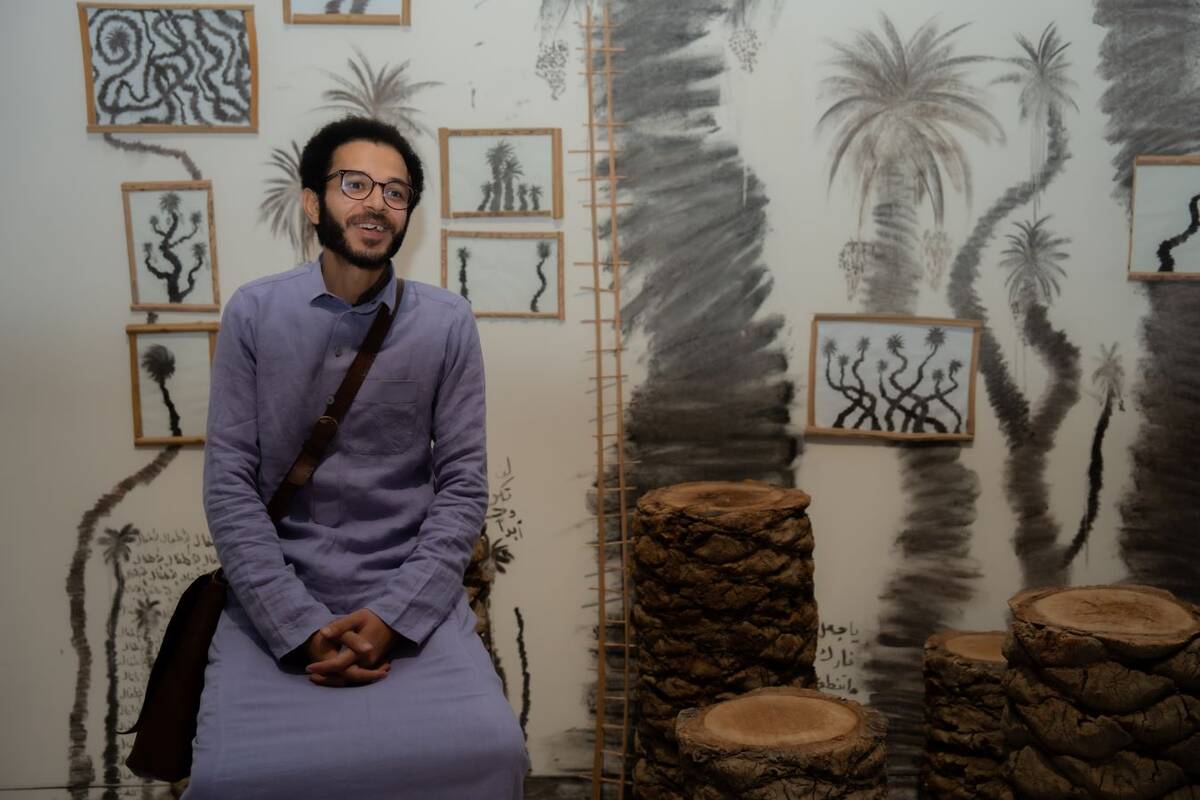
Artist Mohammad Alfaraj with his work. (AN Photo/Huda Bashatah)
The site-specific installation features fragmented mirrors, layered atop each other, forming a grand, almost puddle-like surface of shards. It reflects the ceiling, the light — and even the viewer. Meant to be seen from a slightly elevated vantage point, the work occupies a large space, reminiscent of a shattered ice-skating rink, gliding — and guiding — visitors into the rest of the exhibition.
This leads into an organic labyrinth of treasures, each work nestled in a contained place yet arranged to be in dialogue with its neighbors. Artists, works, moods, materials and voices from across generations and more than 25 countries interact.
Joud Fahmy’s “Trapped Emotions: Nostalgia” (2025) — a tactile piece made of dyed wool and rope intertwined with metal — strikes a powerful emotional chord. Fahmy, a Saudi artist represented by Hunna Art, often explores gender, family and cultural identity through mixed media and audiovisual installations.
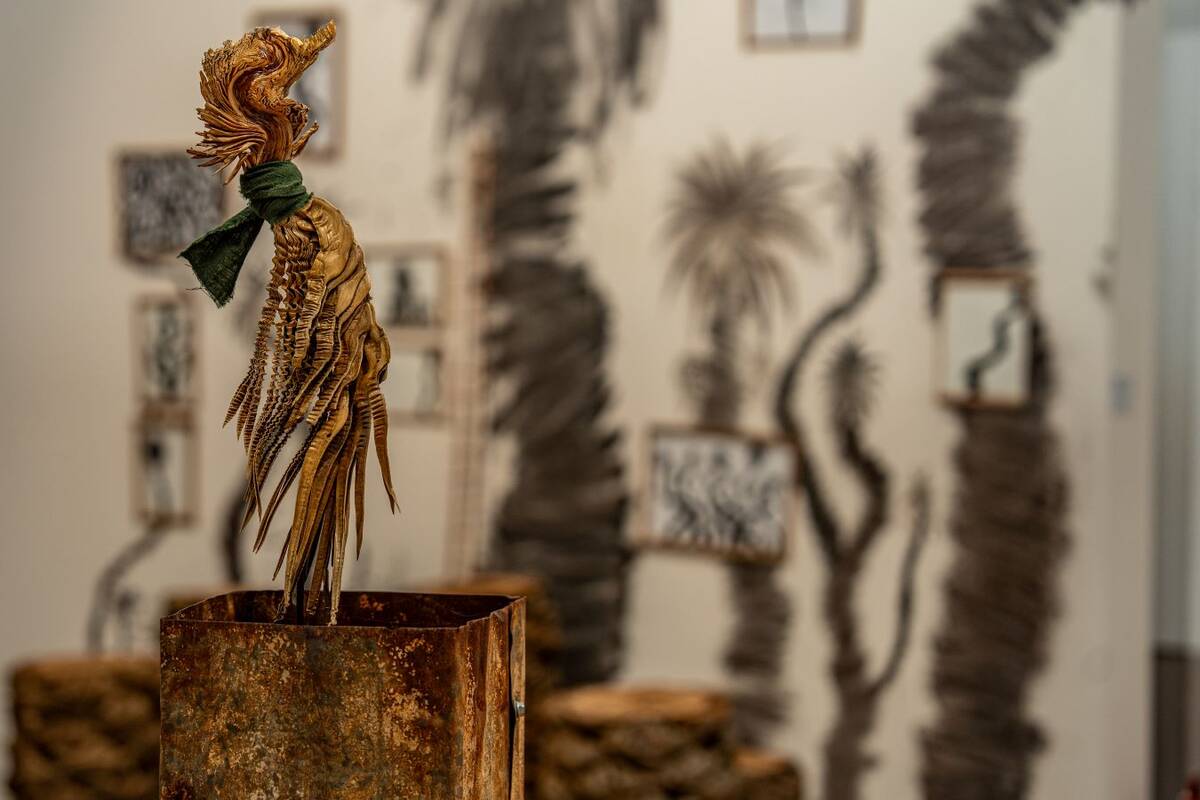
Work by artist Mohammad Alfaraj. (AN Photo/Huda Bashatah)
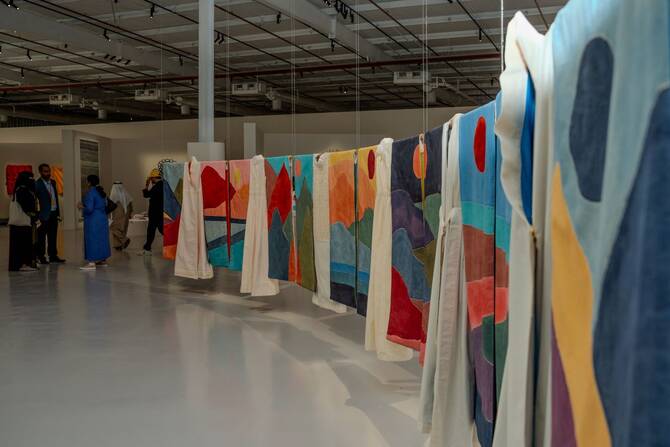
Another notable work is “Dream Coat” (2024) by Greek artist Nefeli Papadimouli, composed of cotton garments and a wooden structure. Based in Paris, Papadimouli blends sculpture, drawing, performance and participatory action. Often working with fabric and soft materials, her architectural, abstract forms echo the visual language of the late Etel Adnan. Her work reflects on how we move through and shape shared environments, investigating belonging, intimacy and collective memory.
Riyadh-based artist Maisa Sheldan, who also maintains a studio at JAX, presents a standout installation. A Saudi artist of Palestinian origin, Sheldan explores human issues and collective memory by reconstructing raw materials into symbolic forms that reflect the impact of time. Her work, represented by Hafez Gallery, blends authenticity with contrasts between the visible and the invisible. The seemingly feathered cocoon chair invites you to immerse yourself in the space and swing along. The army of animals, all made from organic materials, is a striking image and one of my favorite works on display. It is playful and tells a story.
Representing Al-Ahsa, Mohammad Alfaraj is exhibiting with Mennour Gallery. As always, the use of palms is central to his work. A son and grandson of date farmers, Alfaraj grew up in the world’s largest desert oasis. Though he studied applied mechanical engineering at university, he describes himself as “a poet of visuals.” His upbringing on a farm instilled in him a deep commitment to reuse all materials and to prioritize sustainability.
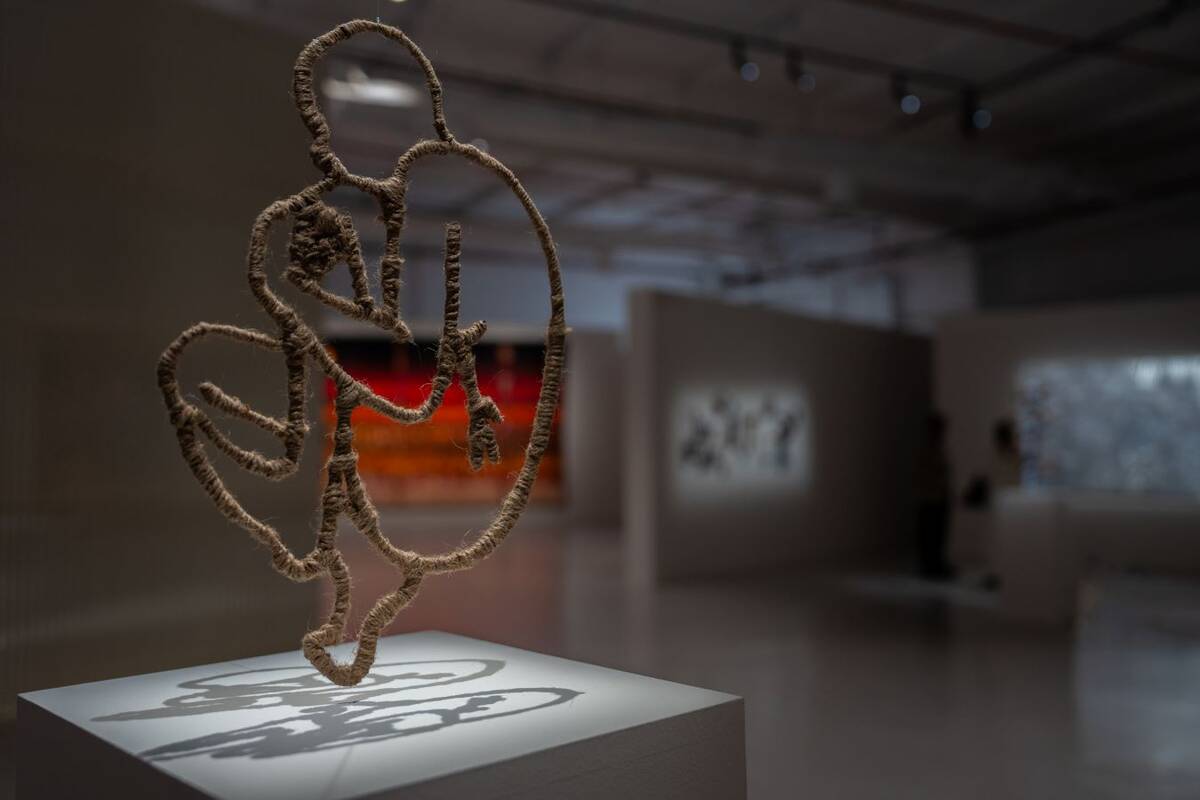
Joud Fahmy’s “Trapped Emotions: Nostalgia” (2025) — a tactile piece made of dyed wool and rope intertwined with metal — strikes a powerful emotional chord. (AN Photo/Huda Bashatah)
Nestled within a smaller area is “From Earth: Historic Diriyah Materials Lab,” presented by the Diriyah Gate Development Authority. A small but powerful space invites viewers to explore the raw materials that shaped Diriyah: mud, limestone, palm fronds, wool and pigments. These natural elements, drawn from the land, speak to centuries of resilience, adaptation and environmental knowledge. The exhibition forces one to separate the materials and highlights them, both in their pure state and their crafted forms: mud transformed into bricks, palm fronds woven into objects, plants used to create vibrant pigments. Far from being relics, these materials remain living resources that breathe life into the works that they are used for.
“I’m absolutely thrilled to be able to be a part of an initiative that really is creating a platform that will give voice to practitioners from Saudi Arabia,” Dina Amin, CEO of VAC, told Arab News regarding the activations.
“Art Week Riyadh is creating a wonderful moment for the people of Saudi Arabia to really be able to engage in many ways through the exhibitions: through the different locations, through the talks, through the workshops, through the open studios,” she added.
Amin also shared a personal experience: “The other day, I was walking around and popping into the studios, and it’s just absolutely wonderful to see the variety of language that each of the artists uses in his or her own work.
“For us, Art Week Riyadh is really about creating a moment of gravitational pull where we can bring all of the different practitioners together. What we really are celebrating here is everybody’s voice. We want to share our creativity, our culture, our engagement with art with the world, but we also want to invite everyone to come and discover it.”


