ASEAN economic ministers: No ‘retaliatory measures’ against US

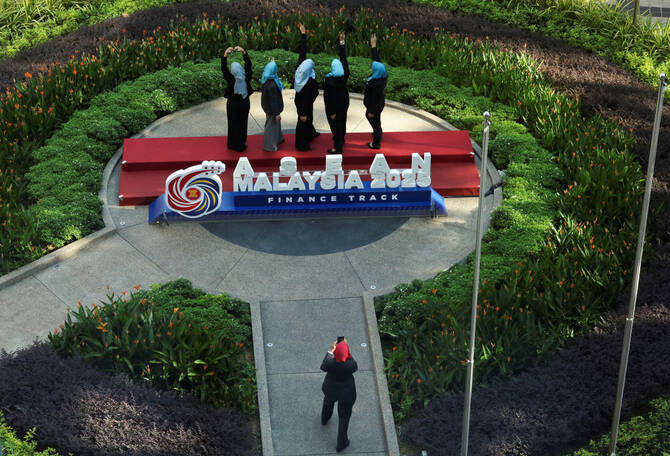
Economic ministers of the ASEAN regional bloc committed on Thursday ‘to not impose any retaliatory measures’ against the US. (Reuters)
Short Url
Updated 10 April 2025
Follow

ASEAN economic ministers: No ‘retaliatory measures’ against US

  • ASEAN ministers ready ‘to engage in a frank and constructive dialogue with the US to address trade-related concerns’
  • Manufacturing powerhouse Vietnam was hit with a 46 percent tariff on exports to the United States

KUALA LUMPUR: Economic ministers of the ASEAN regional bloc committed on Thursday “to not impose any retaliatory measures” against the United States over sweeping tariffs and said they were ready to engage in talks.
“ASEAN, being the fifth largest economy in the world, is deeply concerned over the recent introduction of unilateral tariffs by the US, including the tariffs announced on 2 April 2025 and subsequently the most recent suspension on 9 April 2025,” the Association of Southeast Asian ministers said in a statement issued after a video conference meeting.
Despite their concern, the ministers said they were ready “to engage in a frank and constructive dialogue with the US to address trade-related concerns.”
“Open communication and collaboration will be crucial to ensuring a balanced and sustainable relationship. In that spirit, ASEAN commits to not impose any retaliatory measures in response to the US tariffs,” they said.
The special meeting was chaired by Malaysia’s Minister of Investment, Trade and Industry Tengku Zafrul Aziz. Malaysia holds the rotating chair of the 10-member regional bloc.
Its members, which count on the United States as their main export market, were among those hit with the toughest levies by US President Donald Trump.
Manufacturing powerhouse Vietnam was hit with a 46 percent tariff on exports to the United States while neighboring Cambodia – a major producer of low-cost clothing for big Western brands – was slapped with a 49 percent duty.
The other ASEAN members hit with hefty tariffs are Laos (48 percent), Myanmar (44 percent), Thailand (36 percent) and Indonesia (32 percent).
Malaysia, Southeast Asia’s third-largest economy, was hit with a lower tariff of 24 percent.
Brunei also faces a 24 percent tariff, while the Philippines was hit with 17 percent and Singapore 10 percent.


Scores killed in militant attacks in northwest Nigeria

Updated 2 sec ago
Follow

Scores killed in militant attacks in northwest Nigeria

  • The attacks came days after the state hosted the UNESCO-listed Argungu fishing festival
  • The Lakurawa group has been blamed for many of the attacks on communities
LAGOS: Militant fighters have killed scores of people and destroyed seven villages in raids in northwestern Nigeria’s Kebbi state, the police said Thursday.
Members of the Lakurawa group attacked villages in the Bui district of Arewa northern region at around 1:15 p.m. (1215 GMT) Wednesday, said Kebbi state police spokesman Bashir Usman.
A security report seen by AFP said the militants had killed “more than 30 villagers.”
Usman said: “Scores of people were killed as residents from Mamunu, Awasaka, Tungan Tsoho, Makangara, Kanzo, Gorun Naidal, and Dan Mai Ago mobilized to resist the attackers.”
The attackers had also rustled “some cattle” in the raids, he added. Police, soldiers and local militia were immediately sent to the area.
The attacks came days after the state hosted the UNESCO-listed Argungu fishing festival, about 60 kilometers (38 miles) from the Arewa region, where the attacks took place.
The Lakurawa group has been blamed for many of the attacks on communities in the northern part of the state and in neighboring Sokoto state.
Its members stage deadly attacks from their forest base, rustling livestock and imposing “taxes” on locals.
The Nigerian government said the Christmas day air strikes by the US military in Sokoto had targeted members of the group and “bandit” gangs.
Some researchers have linked the group to the Islamic State Sahel Province, which is active mainly in neighboring Niger and Mali, though others remain doubtful.
The activities of the group have compounded Nigeria’s insecurity.
The West African nation is grappling with a more than 16-year militant insurgency in the northeast, as well as a farmer-herder conflict in the north central region.
They also have to contend with a violent secessionist agitation in the southeast, and kidnappings for ransom plague the northwest.
Nigeria is now looking to the United States for technical and training support for its troops fighting the militants after a resurgence of violence strained relationships between the two countries.
The US Africa Command said 200 troops were expected to join the deployment overall.
US President Donald Trump has said the violence there amounts to the “persecution” of Christians — a framing long used by the US religious and political right wing.
Nigeria’s government and many independent experts say Christians and Muslims alike are the victims of the country’s security crises.