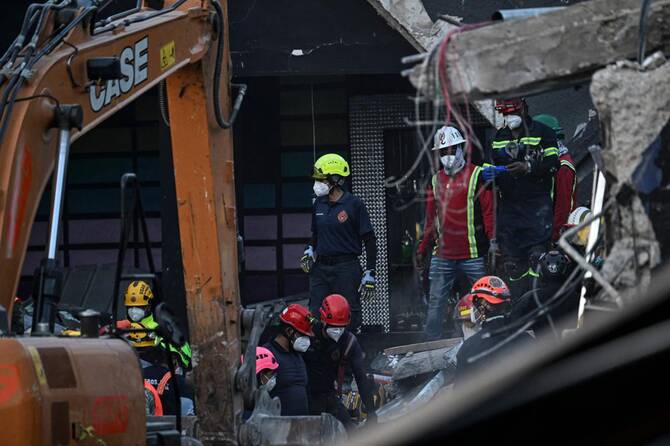
SANTO DOMINGO, Dominican Republic: Rescue crews in the Dominican Republic on Thursday dug through the remains of a legendary nightclub whose roof collapsed earlier this week, killing at least 184 people, but hope of finding survivors was slim.
Meanwhile, dozens of people in the capital of Santo Domingo still searched for their loved ones, growing frustrated upon getting no answers after visiting hospitals and the country’s forensic institute.
Doctors warned that some of the two dozen patients who remained hospitalized were still not in the clear, especially the eight who were in critical condition.
“If the trauma is too great, there’s not a lot of time” left to save patients in that condition, said Health Minister Dr. Víctor Atallah.
He and other doctors said that injuries include fractures in the skull, femur and pelvis caused by slabs of cement falling on those attending a merengue concert at the Jet Set nightclub in Santo Domingo, where more than 200 were injured.
The government said Wednesday night that it was moving to a recovery phase focused on finding bodies, but Juan Manuel Mendez, director of the Center of Emergency Operations, said crews at the scene were still looking for victims and potential survivors although no one has been found alive since Tuesday afternoon.
“We’re not going to abandon anyone. Our work will continue,” he said.
The legendary club was packed with musicians, professional athletes and government officials when dust began falling from the ceiling and into people’s drinks early Tuesday. Minutes later, the roof collapsed.
Victims include merengue icon Rubby Pérez, who had been singing to the crowd before the roof fell; former MLB players Octavio Dotel and Tony Enrique Blanco Cabrera; and Nelsy Cruz, the governor of the northwestern province of Montecristi whose brother is seven-time Major League Baseball All-Star Nelson Cruz.
Also killed was a retired United Nations official; saxophonist Luis Solis, who was playing onstage when the roof fell; New York-based fashion designer Martin Polanco; the son and daughter-in-law of the minister of public works; the brother of the vice minister of the Ministry of Youth; and three employees of Grupo Popular, a financial services company, including the president of AFP Popular Bank and his wife.
Randolfo Rijo Gomez, director of the country’s 911 system, said it received more than 100 calls, with several of those made by people buried under the rubble. He noted that police arrived at the scene in 90 seconds, followed minutes later by first response units. In less than half an hour, 25 soldiers, seven fire brigades and 77 ambulances were activated, he said.
Crews used dogs and thermal cameras to search for victims, rescuing 145 survivors from the rubble, authorities said.
It wasn’t immediately clear what caused the roof to collapse, or when the Jet Set building was last inspected.
The government said late Wednesday that once the recovery phase ends, it will launch a thorough investigation.
The club issued a statement saying it was cooperating with authorities. A spokesperson for the family that owns the club told said that she passed along questions about potential inspections.
Meanwhile, a spokesperson for the Ministry of Public Works referred questions to the mayor’s office. A spokesperson for the mayor’s office did not respond to a request for comment.

Hope of finding survivors fades in aftermath of Dominican club roof collapse
https://arab.news/4zjvm
Hope of finding survivors fades in aftermath of Dominican club roof collapse
- Roof of legendary nightclub Jet Set collapsed earlier this week, killing at least 184 people
- Doctors warned that some of the two dozen patients who remained hospitalized were still not in the clear
Israel is risking global security, warns Somali Information Minister
- Tel Aviv’s actions boost terror groups he tells Arab News in exclusive interview
- Jama accuses Tel Aviv of wanting to relocate Palestinians from Gaza to region
RIYADH: Israel’s recognition of Somaliland and its presence in the region risks inflaming the situation there, allowing terrorist groups to undermine regional security and stability, according to Somali Information, Culture and Tourism Minister Daud Aweis Jama.
In a special interview with Arab News, Jama insisted that Israel’s unprecedented Dec. 26 move to recognize Somaliland as a sovereign state represents a major setback for Mogadishu’s fight against terrorist organizations like Al-Shabab and Daesh.
“The presence of Israel will be used by the terrorist groups to expand their operations in the region. (They will) have a pretext to spread their ideologies in the region,” he said.
“That is another factor that is also risking global security and regional stability, because we have been in the last stage of overcoming the challenges of the terrorist groups Al-Shabab and ISIS,” he added, using another term for Daesh.
Jama added: “We have been putting all our resources and all our time into making sure that we finalize the final stages of the fight against Al-Shabab. So, if something else interrupts us, that means that we are not going to focus fully on the operations against Al-Shabab. And that means we are giving more opportunities to Al-Shabab or other organizations.”
The consequences of this hit to Somalia’s ability to fight terror will not be restricted to the country’s borders, according to Jama, but will spread across the region and beyond.
“This might invite other, external terrorist groups to the region, because they will take advantage of this crisis and will make sure that they take over all the areas that have been defeated before,” the minister said.
“We believe this has come at a time that is going to affect our security as a Somali government, the security of the Horn of Africa, the security of the Gulf of Aden, the security of the Red Sea, the security of the Middle East and global stability. This is a very important location that holds the trade of the world.”
The minister underlined that Israel’s recognition and larger presence in the region are leading to more challenges, “putting more fuel on the ongoing challenges that exist in the region, especially in Somalia.” He added: “And at this time, it is not only limited to Somalia, but it’s going to be a challenge that is going to spread like a fire all over the region and all over the world.”
Jama told Arab News that Israel has other strategic motives for its recognition of Somaliland — including the forced resettlement of Palestinians from Gaza.
“According to reliable sources that our intelligence gathered, one of the conditions that Israel put forward (for recognizing Somaliland) was to have a place that they can settle the people from Gaza,” he said.
“We find that it is a violation also of the people of Palestine, because we believe that the people of Palestine have the right to self-determination. The two-state solution that has been the call of the international community has to be adhered to and implemented.”
Israel’s coalition government, the most right-wing and religiously conservative in its history, includes far-right politicians who advocate the annexation of both Gaza and the West Bank and encouraging Palestinians to leave their homeland.
Somalia’s UN Ambassador Abukar Dahir Osman said Security Council members Algeria, Guyana, Sierra Leone and Somalia “unequivocally reject any steps aimed at advancing this objective, including any attempt by Israel to relocate the Palestinian population from Gaza to the northwestern region of Somalia.”
Israel last month became the first country to recognize Somaliland as an independent nation. In the three-plus decades since its self-declaration of independence in 1991, no state had recognized the northwestern territory as being separate from Somalia.
Mogadishu immediately rejected the Israeli move, alongside countries all over the world.
Saudi Arabia affirmed its rejection of any attempts to impose parallel entities that conflict with the unity of Somalia. It also affirmed its support for the legitimate institutions of the Somali state and its keenness to preserve the stability of Somalia and its people.
A group of foreign ministers from Arab and Islamic countries, alongside the Organization of Islamic Cooperation, also firmly rejected Israel’s announcement. In a joint statement, the ministers warned that the move carries “serious repercussions for peace and security in the Horn of Africa and the Red Sea region” and undermines international peace and security.
The 22-member Arab League rejected “any measures arising from this illegitimate recognition aimed at facilitating forced displacement of the Palestinian people or exploiting northern Somali ports to establish military bases,” the organization’s UN Ambassador Maged Abdelfattah Abdelaziz told the UN Security Council.
In the most recent development in Israel-Somaliland relations, less than two weeks after Tel Aviv’s recognition, Israeli Foreign Minister Gideon Saar visited the region on Tuesday to publicly formalize diplomatic relations.
“It was a blatant violation of Somalia’s sovereignty that Israel recognized a region within the Somali Federal Republic as an independent state,” Jama underlined. “That was a total violation of international laws. It was a violation of the territorial integrity and sovereignty of Somalia.
“From the beginning, our path was to follow diplomatic efforts. And we kind of started with a successful UN Security Council meeting that supported Somalia’s territorial integrity and sovereignty. (This was) followed by other international actors like the Arab League, the Organization of Islamic Cooperation, the African Union and regional bodies like the East African Community and IGAD.
“Also, the Peace and Security Council of the African Union has reiterated the importance of supporting Somali sovereignty and territorial integrity.”


