

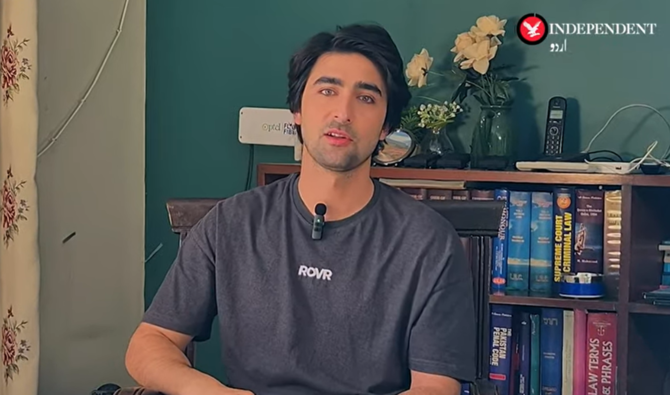
Want to share screen with Mahira Khan, upcoming Pakistani actor Khaqan Shahnawaz says
Want to share screen with Mahira Khan, upcoming Pakistani actor Khaqan Shahnawaz says/node/2596504/pakistan
Want to share screen with Mahira Khan, upcoming Pakistani actor Khaqan Shahnawaz says
The screengrab taken from a video shows Pakistani actor and Internet personality Khaqan Shahnawaz speaking during an interview with Independent Urdu in Karachi, Pakistan, on April 9, 2025. (Independent Urdu/ YouTube)
ISLAMABAD: Upcoming actor and Internet personality Khaqan Shahnawaz has said he is a fan of Mahira Khan, one of the most popular and highest-paid actresses in Pakistan, and looked forward to sharing the screen with her in the future.
Shahnawaz, a law graduate who is in his late twenties, gained fame with dramas like “Accident,” “Barhwaan Khiladi,” “Yunhi” and “College Gate.” He most recently played the role of a Pashtun boy in the drama series, “My Dear Cinderella,” which started airing on Hum TV during Ramadan and concluded with its final episode over the Eid holiday.
“Who wouldn’t want to? I still want to share the screen with Mahira Khan and be in her presence,” he told Independent Urdu in an interview last week. “Mahira Khan is a star and I have always been a fan of hers, still am.”
Shahnawaz recalled catching a glimpse of Khan from a distance at a wedding but unfortunately wasn’t able to meet her.
“I couldn’t meet her because she came for a very short time,” he said. “But I saw her from a distance and I said, ‘That’s a star,’ because she had an aura when she was walking.”
When asked about future projects and if would like to work in an action project, Shahnawaz said action was not a preferred genre on Pakistani TV, long known for romantic comedies and family dramas.
“I think we don’t make that many dramas that fall under the action genre but definitely, if I had the option to choose between an action drama or a romantic comedy, it would have been a tough decision,” the actor said.
“But right now I had the option of a family tragedy or a romantic comedy and I went for the romantic comedy [My Dear Cinderella] because the character was very different from my real life character so I thought I should experiment and I should check if I can step into this character.”
Shahnawaz, who rose to fame as a social media star, said he still identified largely as a content creator.
“If you look at my Instagram profile or TikTok profile, I have uploaded content recently and I keep posting regularly,” he said. “My entry into acting was a lot easier because of content creation, I will say this.”
ISLAMABAD: Muzaffar Hussain Shah bends down, picks up a brick from the rubble and cleans it with a hammer. Until a few weeks ago, the brick had been part of a home where Shah had lived for nearly five decades, since his birth.
The house in an informal settlement in Islamabad, which came to be known as Muslim Colony, was demolished in an anti-encroachment drive. Shah said he has spent past three weeks sleeping under the open sky and has been collecting the last remaining bricks to get by for a few more days.
Shah, 48, is one of nearly 15,000 people evicted by the Capital Development Authority (CDA) from the settlement, which was established in the 1960s to house laborers who built Pakistan’s capital of Islamabad, during a drive that began in November.
The decades-old settlement, located near the prime minister’s official residence and the Diplomatic Enclave, a specially designated area within the city that houses foreign embassies, high commissions and international missions, has now been reduced to a 712-kanal (89-acre) stretch of dust and debris.
“It feels as if there is neither a sky over our heads nor anyone behind our backs,” Shah told Arab News on Tuesday, surrounded by the rubble of his demolished home. “Nor is there anything ahead of us. We cannot see anything at all.”
Man collecting rubble from a demolished colony in Islamabad, Pakistan, on December 30, 2025. (AN photo)
While evacuated residents recount a tale of what they described as broken political promises and affiliation with the place, authorities say there were “obviously security concerns”, and that claims to the land were settled two decades ago.
During an interview with Arab News, Dr. Anam Fatima, director of municipal administration at the Islamabad Metropolitan Corporation, showed satellite images of the “informal settlement” from 2002.
The images showed significant population growth over the years, which she said indicated that most current residents arrived after 2002, when the government negotiated the resettlement of original residents in return for compensation.
“In 2002, it was decided that these people will be compensated, and they were accordingly compensated,” Fatima said.
“Seven hundred and fifty [residents] were found eligible. They were given plots in Farash Town,” she said about a neighborhood on Islamabad’s outskirts. “Some of them moved, some of them did not, but the original settlement was not removed, unfortunately.”
Man cutting tree trunk in Islamabad, Pakistan, on December 30, 2025. (AN photo)
The official attributed the survival of the settlement and its subsequent growth to “enforcement failure” and “changing policies” over the years, insisting that all legal formalities were met before the latest operation.
“Notices were given first to vacate and then after the evacuations had been done... people had completely moved their belongings, only then bulldozers were sent into the area,” Fatima said.
For the evacuated residents, the historical and emotional costs outweigh the legal arguments, they say. Many claim their families moved there more than six decades ago and were promised permanent housing in exchange for their labor.
Muhammad Hafeez, whose father arrived in 1972, lamented that the ones who had helped built Islamabad were being rewarded in the form of eviction from the same city.
“Allah will definitely question you about this,” he said.
Man collecting rubble from a demolished colony in Islamabad, Pakistan, on December 30, 2025. (AN photo)
Muhammad Khalil, 62, another evictee, blamed CDA officials for allowing the settlement not just to exist but also to grow over the years.
“We did not bring these houses down from space and place them here. CDA officials were present here, they were aware of the developments taking place every single minute, every moment,” he said.
“Their vehicles would come daily. We built these houses right in front of them.”
As bulldozers cleared the land this month, many residents of Muslim Colony said they felt abandoned by the city they once helped build.
“All of this Islamabad that has been built was built by our elders,” Shah said. “Laborers used to live here. And today, after having built Islamabad, today, we have become illegal.”
Authorities, however, say the evictees had been residing illegally and had been compensated, maintaining that they had to be relocated.
“It was entirely illegal because whatever right that they had, it was already compensated in 2003 by the authority,” Dr. Fatima said.