

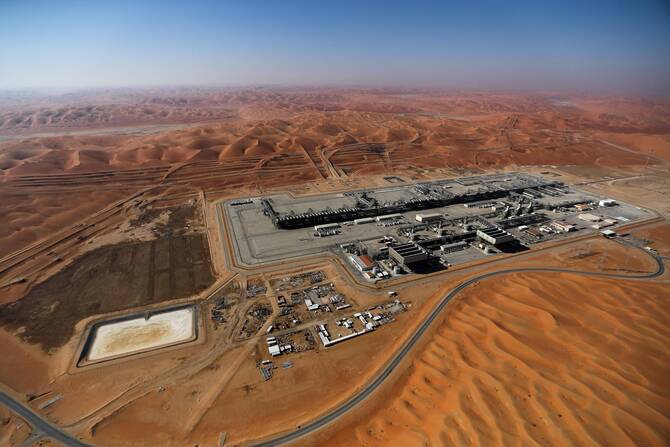
Saudi Aramco discovers 14 new oil, gas fields

The discoveries include six oil fields, two oil reservoirs, two natural gas fields, and four natural gas reservoirs. Reuters
Short Url
Updated 10 April 2025
Follow

Saudi Aramco discovers 14 new oil, gas fields

  • Further cements Saudi Arabia’s position as a global energy leader

RIYADH: Saudi Aramco has made a series of groundbreaking oil and gas discoveries in the Eastern Province and the Empty Quarter, further cementing Saudi Arabia’s position as a global energy leader.

Announced by Energy Minister Prince Abdulaziz bin Salman on Wednesday, the discoveries include six oil fields, two oil reservoirs, two natural gas fields, and four natural gas reservoirs—highlighting the Kingdom’s vast and growing hydrocarbon potential.

In the Eastern Province, the Jabu oil field was identified after very light Arab crude oil flowed at a rate of 800 barrels per day from well Jabu-1.

Another notable find was in the Sayahid field, where very light crude flowed from well Sayahid-2 at a rate of 630 bpd. The Ayfan field also showed promising results, with well Ayfan-2 producing 2,840 bpd of very light crude and approximately 0.44 million standard cubic feet of gas per day.

Further exploration confirmed the Jubaila reservoir in the Berri field, where light crude flowed from well Berri-907 at a rate of 520 bpd, along with 0.2 MMscf of gas daily. Additionally, the Unayzah-A reservoir in the Mazalij field yielded premium light crude from well Mazalij-64 at 1,011 bpd, coupled with 0.92 MMscf of gas per day.

In the Empty Quarter, the Nuwayr field produced medium Arabian crude at 1,800 bpd from well Nuwayr-1, along with 0.55 MMscf of gas daily. The Damdah field, tapped via well Damda-1, showed medium crude flow from the Mishrif-C reservoir at 200 bpd, and very light crude from the Mishrif-D reservoir at 115 bpd. The Qurqas field also produced medium crude at 210 bpd from well Qurqas-1.

Regarding natural gas, notable discoveries were made in the Eastern Province. Gas was found in the Unayzah B/C reservoir of the Ghizlan field, with well Ghizlan-1 yielding 32 MMscf of gas per day and 2,525 barrels of condensate. In the Araam field, well Araam-1 produced 24 MMscf of gas per day along with 3,000 barrels of condensate. Unconventional gas was also discovered in the Qusaiba reservoir of the Mihwaz field, where well Mihwaz-193101 produced 3.5 MMscf per day and 485 barrels of condensate.

In the Empty Quarter, significant natural gas flows were recorded in the Marzouq field, with 9.5 MMscf per day from the Arab-C reservoir and 10 MMscf from the Arab-D reservoir. Additionally, the Upper Jubaila reservoir yielded 1.5 MMscf of gas per day from the same well.

Prince Abdulaziz emphasized the importance of these discoveries, noting their contribution to solidifying Saudi Arabia’s leadership in the global energy sector and enhancing the Kingdom’s hydrocarbon potential.

These findings are expected to drive economic growth, strengthen Saudi Arabia’s ability to meet both domestic and international energy demand efficiently, and support the country’s long-term sustainability goals. They align with the objectives of Vision 2030, which aims to maximize the value of natural resources and ensure global energy security.


Saudi tourism employment surpasses 1m as hospitality sector expands 

Updated 5 sec ago
Follow

Saudi tourism employment surpasses 1m as hospitality sector expands 

RIYADH: Saudi Arabia’s tourism workforce surpassed 1 million in the third quarter of 2025, underscoring the sector’s rapid expansion as the Kingdom continues to develop its hospitality infrastructure and visitor economy. 

According to the latest Tourism Establishments Statistics report released by the General Authority for Statistics, the total number of employees in tourism activities reached approximately 1,009,691 in the third quarter of 2025, marking a 6.4 percent increase compared to the same period in 2024, when employment stood at 948,629. 

The growth in employment comes alongside a significant rise in the number of licensed tourism hospitality facilities, which increased by 40.6 percent year on year to reach 5,622 in the third quarter. Of these, serviced apartments and other hospitality facilities accounted for 52.6 percent, while hotels represented 47.4 percent. 

The robust growth reflected in the latest tourism statistics aligns directly with the goals of Vision 2030, as the Kingdom aims to double tourism’s gross domestic product contribution to 10 percent. The sector is also seeking to create 1.6 million jobs, and attract 150 million visitors annually by 2030.

The report showed that non-Saudi employees made up the majority of the tourism workforce, numbering 764,520 and accounting for 75.7 percent of the total. Saudi nationals employed in the sector reached 245,171, representing 24.3 percent of all tourism workers. 

In terms of gender distribution, male employees dominated the sector with 875,658 workers, while female employees totaled 134,033, making up just 13.3 percent of the workforce. 

Hotel performance showed positive momentum, with the average room occupancy rate rising to 49.1 percent during the quarter, an increase of 2.9 percentage points from 46.1 percent in the same period a year earlier. 

In contrast, serviced apartments and other hospitality facilities experienced a slight dip in occupancy, recording 57.4 percent compared to 58 percent in the same quarter of 2024. 

The average daily room rate in hotels decreased by 3.6 percent to SR341 ($90.9), down from SR354 in the third quarter of 2024. Meanwhile, serviced apartments and similar facilities saw their average daily rate rise by 4.1 percent to SR208, up from SR200 a year earlier. 

The average length of stay in hotels was 4.1 nights, down 1 percent from 4.2 nights in the third quarter of 2024. For serviced apartments and other hospitality facilities, the average stay was 2.1 nights, reflecting a marginal decrease of 0.2 percent year-on-year. 

The statistics draw on administrative records, surveys and secondary data to capture activity across the Kingdom’s tourism sector, GASTAT said.