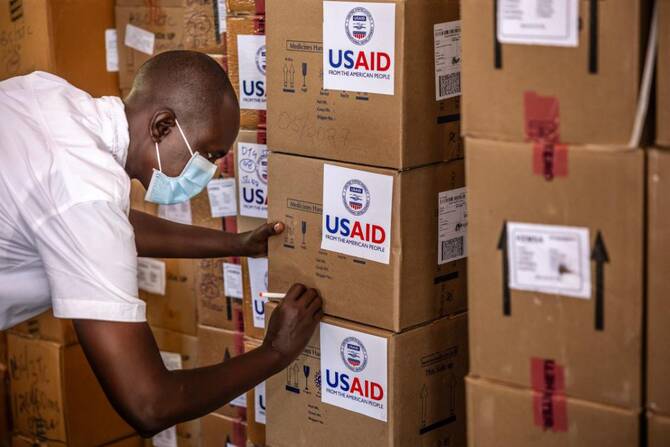

LODWAR: In Kenya’s largest and poorest county, the despair of a beleaguered hospital director is palpable as he explains that the dismantling of American-funded aid means his facility will run out of USAID drugs next month.
“From then on, I don’t know,” Ekiru Kidalio said, worried about the lack of treatment for measles and HIV among other things.
Northernmost Turkana county borders Ethiopia, South Sudan and Uganda and is home to just under a million people, according to a 2019 census, a third of them refugees, many dependent on foreign assistance.
President Donald Trump’s administration has announced dramatic cuts to USAID whose annual budget was close to $43 billion, more than 40 percent of the world’s humanitarian aid.
The decisions, taken thousands of kilometers (miles) away in Washington, are already being felt in Turkana’s Lodwar County Referral Hospital, Kidalio, its acting director, said.
USAID employed 64 staff, including nurses and clinical officers, out of around 400 employees at the hospital.
“All those workers were laid off,” he said.
“Everything was stopped... and then the commodities (drugs) were not received,” Kidalio added, voicing particular concern over shortages of measles vaccines.
Kidalio said he was “not aware” of any plans by the Kenyan government to tackle the shortfall.
The local governor publicly urged the restoration of USAID-funded programs when US charge d’affaires Marc Dillard visited last week.
The destabilising shift has also created a lot of concern in the dusty town, dominated by UN-emblazoned white landcruisers and signs urging an end to gender-based violence or promoting aid groups.
“There is a lot of worry because the US has ended their support,” resident Lydia Muya, 32, told AFP.
The mother-of-three said residents — in a region where roughly 77 percent of the population live below the poverty line, according to 2021 government statistics — were particularly concerned about their access to medication.
“We see that is now a very big risk to us, because we depend on those medicines, so most of the people will suffer,” said Muya.
“It is difficult.”
The picture is increasingly grim in Kakuma refugee camp, which hosts more than 300,000 people mostly from South Sudan, Somalia, Burundi and Rwanda.
Protests broke out last month after news that rations, already lowered last year, would be further reduced because of the cuts to US foreign aid spending.
“It was tense,” said one humanitarian worker, based in Kakuma for almost five years, who spoke on condition of anonymity as he was not permitted to speak to the media.
When asked if supplies were arriving, his response was blunt: “No. With what money? No funding, no stuff.
“It’s operating on hand-to-mouth basis on this point.”
He estimated as much as 40 percent of the workforce had already been laid off as a result of the US cuts.
The situation could still worsen.
The World Food Programme (WFP), which supports just under 200,000 Kakuma refugees, told AFP they had cut rations, delivered as food and cash, to 40 percent of their previous level.
A mother-of-four, who had lived in the camp for almost two decades, told AFP she was worried.
“How many days will I eat? The food can end so fast,” she said, asking to remain anonymous as she was unsure if she was allowed to speak to journalists.
She is also worried about the coming rainy season when malaria cases soar.
“If you go now to the hospital there is no medicine, they just check you,” she said.
“Trump has stopped everything, and it’s closed now, there is nothing coming in and nothing coming out.”
Aid workers privately say that the situation is not just down to the US cuts and point to a lack of planning by NGOs.
“The camp has been managed as an emergency, so they were not preparing people” to become less dependent on aid, a second aid worker in Kakuma told AFP by telephone.
“If refugees were treated like people not in an emergency set-up anymore... these fund (shortfalls) could not affect them,” he said, suggesting more should have been done on longer-term programs.
The first aid worker also voiced his frustration, saying budgets were eaten up by operational costs such as staffing overheads, transport and bureaucracy.
“The aid, the majority of it goes to the operational bit of it, not the actual work,” he said. “It’s madness.”
Like other aid workers, he worries their program sometimes creates dependency without offering a future.
“As a person who has worked in multiple areas, sometimes you wonder if you are really helping or if you are enabling,” he said.