Pakistan warns of surging global military spending, arms race fueled by AI

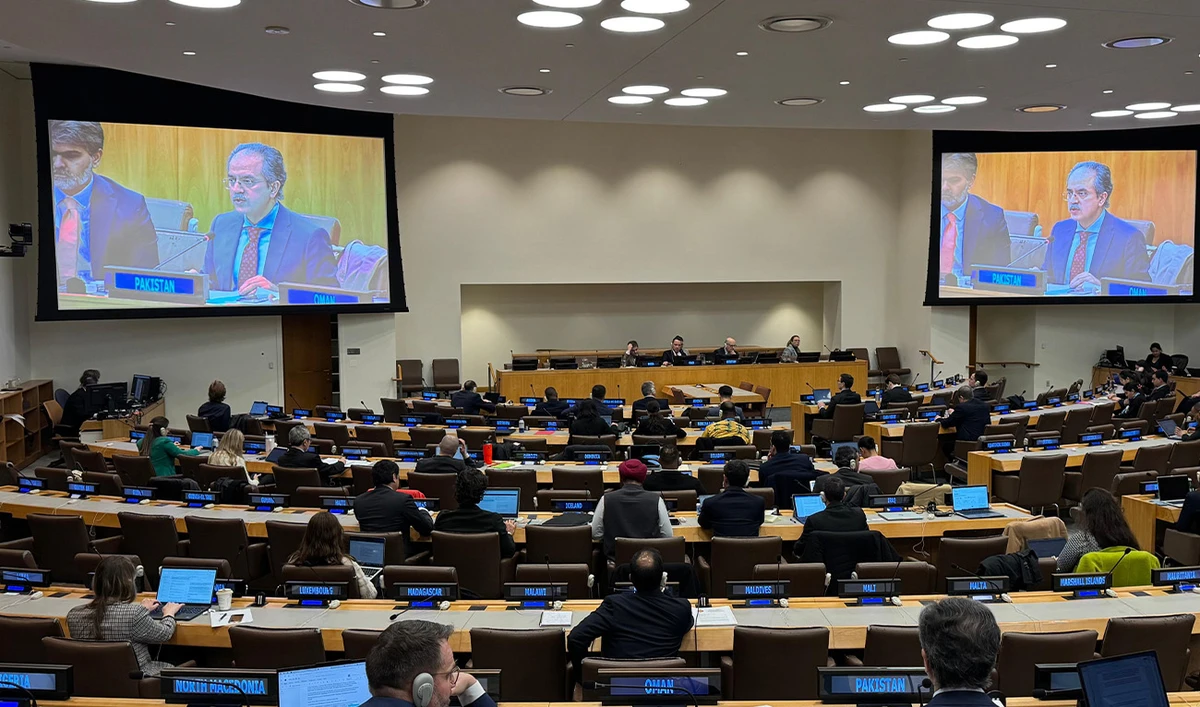
Pakistan’s Permanent Representative to the United Nations, Ambassador Asim Iftikhar Ahmad (on screens), addresses General Debate of the UN Disarmament Commission’s 2025 session in New York, US, on April 8, 2025. (@PakistanUN_NY/X)
Short Url
Updated 09 April 2025
Follow

Pakistan warns of surging global military spending, arms race fueled by AI

  • Pakistan’s envoy at the UN calls for a halt to the development, use of advanced weapons technologies
  • Ambassador Asim Iftikhar Ahmad urges safeguards to prevent AI from fueling a new global arms race

ISLAMABAD: Pakistan on Tuesday warned that a sharp rise in global military spending, driven by emerging technologies such as artificial intelligence (AI), is accelerating a new arms race internationally with potentially grave consequences for global security.
The remarks were delivered by Pakistan’s Permanent Representative to the United Nations, Ambassador Asim Iftikhar Ahmad, during the General Debate of the UN Disarmament Commission’s 2025 session.
Established in 1978 following the First Special Session of the UN General Assembly devoted to disarmament, the commission was tasked with formulating proposals on nuclear disarmament and preventing the proliferation of weapons of mass destruction. However, it has made little tangible progress over the decades and has often been criticized for its inability to produce concrete results.
“We are witnessing unprecedented increase in military spending in recent memory, fueling ever-increasing arms race now turbocharged by technological advancements,” Ahmad said, according to an official statement. “The relentless pursuit of power and geopolitical competition has intensified in recent years, taking us further away from this important international priority.”
The Pakistani envoy emphasized the urgent need for effective international measures to halt the development and use of advanced weapons technologies that could further destabilize global security.
He warned that such advancements were extending the arms race into new frontiers, including outer space, cyberspace and the world’s oceans.
“Artificial intelligence is fast becoming a pervasive feature of our daily lives with profound impact on international peace and security,” Ahmad continued, adding that the military application of AI posed a range of challenges – security, operational, ethical and legal – particularly regarding compliance with international humanitarian law.
The Pakistani diplomat cautioned the unchecked spread of AI-powered autonomous weapons could spark fresh arms races and destabilize both regional and global security environments.
“It is imperative to ensure that AI does not become another area of ongoing arms race with huge implications for global peace and security,” he said, calling for a “multifaceted, holistic and multilateral response.”
Ahmad said the UN should play a central role in shaping a coordinated global approach to the challenges posed by military AI technologies, and expressed Pakistan’s readiness to cooperate with it over the issue.
Arif Habib-led group plans to buy remaining 25% stake in Pakistan International Airlines

Updated 58 min 52 sec ago
Follow

Arif Habib-led group plans to buy remaining 25% stake in Pakistan International Airlines

  • Consortium bought 75 percent stake in Pakistan International Airlines in December 2025 for $482 million
  • Group will have to pay government $161 million by April 2027 for 25 percent stakes, says Arif Habib Ltd. CEO

ISLAMABAD: The Pakistani consortium led by Arif Habib Ltd. which bought a 75 percent stake in the Pakistan International Airlines (PIA) plans to secure full control of the airline, a senior official of the firm confirmed on Sunday. 

In December 2025, the consortium headed by Arif Habib Group secured a 75 percent stake in the PIA for Rs135 billion ($482 million) after several rounds of bidding, valuing the airline at Rs180 billion ($643 million). Pakistan had previously attempted to reform the debt-ridden airline, which had accumulated more than $2.8 billion in financial losses over the years. 

Arif Habib Ltd. CEO Shahid Habib told Arab News that since the PIA’s privatization documents were signed in January, the group will formally take over the airline at the end of April. He said as per the by-laws, the group will have to notify the government whether it intends to buy the remaining 25 percent stake in the airline or “leave it with the government.”

“At present, their [Arif Habib-led group’s] stated position is that they intend to acquire the 25 percent from the government,” Habib said.

He said once the group conveys its decision to buy the remaining 25 percent stakes in the airline, it will have 12 months to complete the payment.

“This means that from April to the following April [in 2027], they must pay the Government of Pakistan Rs45 billion [$161 million] more for the additional stake,” Habib said. 

Habib said beyond ownership, the group intends to improve service for customers. This would include strengthening overall safety and security standards, enhancing staff performance and upgrading the airline’s ticketing system. 

He said the group intends to increase the frequency of flights on commercially viable routes.

“For example, routes that currently operate only two flights every two weeks could be expanded to as many as six flights per week,” Habib said.

“This would significantly improve passenger convenience and availability.”

Habib said currently, PIA has 18 operational aircraft, adding that some of them require capital expenditure (CAPEX) for upgrades and improvements. He said six to seven aircraft could be made operational with additional CAPEX.

“The medium-term goal is to expand the fleet from 18 to 38 aircraft over the coming years,” Habib said.

“While the exact timeline has not been specified, the intention is to achieve this within a defined multi-year framework.”

Habib shared leasing brand new aircraft would require time, adding that current delivery slots that are being offered for them are for 2030, 2031 and 2032.

He said that as an interim solution, relatively newer aircraft — around eight to ten years old — can be acquired for the airline.

“If orders are placed now, Boeing or comparable models, as well as Airbus aircraft in the seven-to-ten-year range, could be secured to stabilize and expand short-term operations,” he said. 

Once considered among Asia’s leading airlines, PIA struggled with chronic mismanagement, political interference, overstaffing, mounting debt and operational issues that led to a 2020 ban on flights to the European Union, UK and the US after a pilot licensing scandal.

The EU and the UK lifted the bans, providing fresh momentum to the carrier.