CAIRO: The Trump administration has reversed sweeping cuts in emergency food aid to several nations but maintained them in Afghanistan and Yemen, two of the world’s poorest and most war-ravaged countries, officials said Wednesday.
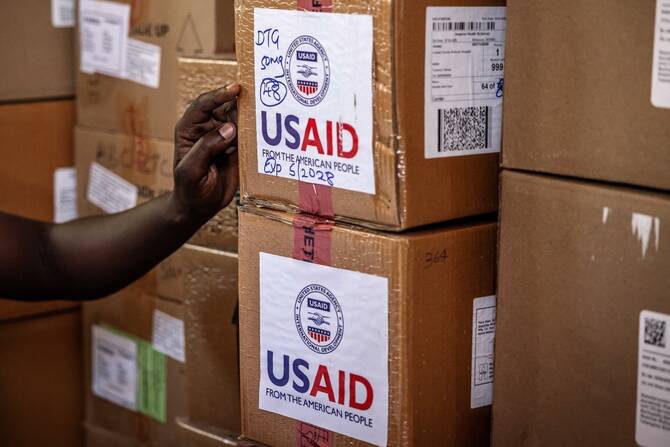
The United States had initially cut funding for projects in more than a dozen countries, part of a dramatic reduction of foreign aid led by billionaire Elon Musk’s Department of Government Efficiency. Aid officials warned the cuts would deny food to millions of people and end health programs for women and children.
The administration informed the World Food Program of its reversal on Tuesday, according to two UN officials. Two officials with the US Agency for International Development confirmed that Jeremy Lewin, the Musk associate overseeing the dismantling of USAID, ordered the reversal of some of his weekend contract terminations after The Associated Press reported them. The officials spoke on condition of anonymity because they were not authorized to brief media.
The WFP said Monday it had been notified that USAID was cutting funding to the UN agency’s emergency food program in 14 countries.
Funding has been restored for programs in Somalia, Syria, Lebanon, Jordan, Iraq and Ecuador, according to the USAID officials and one of the UN officials. The status of funding for six other unidentified countries was not immediately clear.
Cuts could still be disastrous
The USAID officials said Lewin sent a note internally expressing regret at what he described as a miscommunication. One of the UN officials said the decision to restore funding came after intense behind-the-scenes lobbying of members of Congress by senior UN officials.
US officials did not immediately respond to requests for comment. State Department spokeswoman Tammy Bruce acknowledged on Tuesday that some of the programs had been cut by mistake and said funding had been restored, without providing details.
“I don’t know how much they know about the system they are dismantling. I don’t know how much they care,” said Nathaniel Raymond, executive director of the Humanitarian Research Lab at the Yale School of Public Health.
“The damage they’ve already done is a potential extinction-level event for two generations of transformational improvements in how we prevent people from dying from a lack of food,” Raymond added.
The cuts could prove disastrous for millions in Afghanistan and Yemen, reeling from decades of war and US-led campaigns against militants.
The US had been the largest funder of the WFP, providing $4.5 billion of the $9.8 billion in donations to the world’s largest food aid provider last year. Previous administrations had viewed such aid as a way of alleviating conflict and combating poverty and extremism while curbing migration.
The Trump administration has accused USAID of advancing liberal causes, and has criticized foreign aid more broadly as a waste of resources.
Afghanistan is scarred by decades of war
More than half of Afghanistan’s population — some 23 million people — need humanitarian assistance. It’s a crisis caused by decades of conflict — including the 20-year US war with the Taliban — as well as entrenched poverty and climate shocks.
Last year, the United States provided 43 percent of all international humanitarian funding to Afghanistan.
Some $560 million in humanitarian aid has been cut, including for emergency food assistance, treatment of malnourished babies, medical care, safe drinking water and mental health treatment for survivors of sexual and physical violence, according to an assessment by current and former USAID officials and partner organizations. The figure has not been confirmed by the US government.
A separate WFP assessment obtained by the AP showed that food assistance to 2 million people in Afghanistan would be terminated later this year. More than 650,000 malnourished children, mothers and pregnant women would would lose nutritional support.
The United Nations Population Fund said the US had cut $100 million in support for maternal health services for millions of women, as well as gender-based violence services.
The International Rescue Committee said the cuts would affect nearly 1 million people. Its programs include nutritional assistance for tens of thousands of children under 5, as well as counseling services.
“Kids who have seen great violence, who benefit from social work and psychosocial care that we provide, will be cut off,” said Bob Kitchen, head of global emergencies for the aid group.
Some in Yemen have been at risk of famine
The poorest Arab country was plunged into civil war in 2014 when the Iranian-backed Houthis seized much of the north, including the capital, Sanaa. The US supported the Coalition to Restore Legitimacy in Yemen that intervened the following year on behalf of the government. The conflict has been at a stalemate in recent years.
The war has led to widespread hunger, and experts warned as recently as 2024 that parts of Yemen were at risk of famine.
The US cuts would end life-saving food assistance to 2.4 million people and halt nutritional care for 100,000 children, according to the WFP assessment.
The US is carrying out a campaign of airstrikes against the Houthis in retaliation for their attacks on international shipping linked to the war in the Gaza Strip.
The WFP had already suspended its programs in Houthi-ruled northern Yemen, where the militia has detained dozens of UN staffers as well as people associated with aid groups, civil society and the now-shuttered US Embassy.
The latest cuts would affect southern Yemen, where the internationally recognized government opposed to the Houthis is based. The WFP assessment warned that halting aid there “carries significant political and security implications and risks deepening the economic crisis and exacerbating instability.”
Last year, the WFP assisted 8.6 million people in Yemen, more than a quarter of its population, including more than 330,000 internally displaced people and 1.2 million with disabilities. Half were women and children.
Kitchen with the IRC said water, sanitation and health support for nearly 2 million people would end, and that while his group and others are seeking alternative sources of funding, there is no real substitute.
“I am fearful that we are going to turn around in months to come and just see the numbers of people who are perishing because there’s just not enough funding to keep them alive anymore,” he said.


![]()

US restores urgent food aid but not in Afghanistan and Yemen
Short Url
https://arab.news/9jak8
US restores urgent food aid but not in Afghanistan and Yemen
- Funding has been restored for programs in Somalia, Syria, Lebanon, Jordan, Iraq and Ecuador, according to the USAID officials and one of the UN officials
- WFP had already suspended its programs in Houthi-ruled northern Yemen


Latest updates


© 2026 SAUDI RESEARCH & PUBLISHING COMPANY, All Rights Reserved And subject to Terms of Use Agreement.