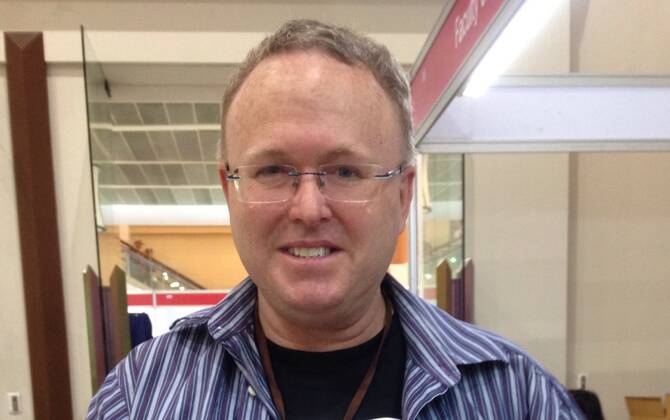
BANGKOK: A US political science scholar accused by the Thai military of insulting the Southeast Asian nation’s monarchy — an offense punishable by up to 15 years in prison — was jailed on Tuesday pending trial.
Paul Chambers, a lecturer at Naresuan University in the northern province of Phitsanulok, was first summoned by police last week to hear the charges against him, including violating the Computer Crime Act, which covers online activity.
Chambers, a 58-year-old Oklahoma native with a doctorate in political science from Northern Illinois University, has studied the power and influence of the Thai military, which plays a major role in politics. It has staged 13 coups since Thailand became a constitutional monarchy in 1932, most recently 11 years ago.
Chambers reported to the police on Tuesday to formally acknowledge the charges and was then taken to a provincial court for a pretrial detention hearing, according to Thai Lawyers for Human Rights, a legal advocacy group.
The court denied Chambers release on bail, allegedly because of “the severity of potential punishment,” his status as a foreigner and the police’s objection to granting it, the lawyers group said.
The group said another request to allow bail would be filed to an appeals court on Wednesday. No trial date has been set.
The officer who answered the phone at the police station handling the case said he could not comment, and referred the matter to his chief, who did not answer a call to his phone.
It is not unusual for Thai courts to deny bail in cases of insulting the monarchy, popularly known as “112” after its article number in the criminal code.
The US-based academic freedom project Scholars at Risk said in a statement that Chambers in late 2024 made comments in a webinar about a restructuring of the military that could have been the cause of the complaint made against him by the 3rd Army Area, covering Thailand’s northern region.
However, Chambers’ wife, Napisa Waitoolkiat, dean of the faculty of social sciences at Naresuan University, said the evidence presented by the authorities was not the words of her husband but came from the website operated by ISEAS–Yusof Ishak Institute, a think tank in Singapore that broadcast the webinar.
Thai Lawyers for Human Right said the charges stemmed from the text of the invitation to the October 2024 webinar, titled “Thailand’s 2024 Military and Police Reshuffles: What Do They Mean?” and that the charge sheet contained the Thai translation of the invitation’s description of the event.
Napisa also said her husband was not summoned for questioning by police before he was presented with the warrant for his arrest, as is typical in such cases.
“It just feels like they wanted to deter Paul from doing his work and research, which often touches on topics like the economics of the Thai army,” she told The Associated Press over the phone.
Thai law envisages 3-15 years imprisonment for anyone who defames, insults or threatens the king, the queen, the heir apparent or the regent. Critics say it is among the harshest such laws anywhere and has also been used to punish critics of the government and the military.
The monarchy has long been considered a pillar of Thai society and criticizing it used to be strictly taboo. Conservative Thais, especially in the military and courts, still consider it untouchable.
However, public debate on the topic has in the past decade grown louder, particularly among young people, and student-led pro-democracy protests starting in 2020, began openly criticizing the institution. That led to vigorous prosecutions under the previously little-used law.
Thai Lawyers for Human Rights has said that since early 2020, more than 270 people — many of them student activists — have been charged with violating the law.

US scholar in Thailand jailed pending trial on charges of insulting the monarchy
Short Url
https://arab.news/yz5xq
US scholar in Thailand jailed pending trial on charges of insulting the monarchy
- Paul Chambers, a lecturer at Naresuan University in northern Thailand, has specialized in studying the power and influence of the military
- Insulting the monarchy in Thailand is an offense punishable by up to 15 years in prison
Faced with Trump, Greenlanders try to reassure their children
NUUK: In a coffee shop in Greenland’s capital Nuuk, Lykke Lynge looked fondly at her four kids as they sipped their hot chocolate, seemingly oblivious to the world’s convulsions.
Since Donald Trump returned to the White House last year with a renewed ambition to seize Greenland, international politics has intruded into the Arctic island’s households.
Dictated by the more or less threatening pronouncements of the US president, it has been an unsettling experience for some people here — but everyone is trying to reassure their children.
Lynge, a 42-year-old lawyer, relied on her Christian faith.
“There’s a lot of turmoil in the world,” she said. “But even if we love our country, we have even higher values that allow us to sleep soundly and not be afraid,” she said.
As early as January 27, 2025, one week after Donald Trump’s inauguration, the Greenlandic authorities published a guide entitled “How to talk to children in times of uncertainty?“
“When somebody says they will come to take our country or they will bomb us or something, then of course children will get very scared because they cannot navigate for themselves in all this news,” said Tina Dam, chief program officer for Unicef in the Danish territory.
- Unanswerable questions -
This guide — to which the UN agency for children contributed — recommends parents remain calm and open, listen to their children and be sensitive to their feelings, and limit their own news consumption.
As in many parts of the world, social media, particularly TikTok, has become the primary source of information for young people.
Today, children have access to a lot of information not meant for them, said Dam — “and definitely not appropriate for their age,” she added.
“So that’s why we need to be aware of that as adults and be protective about our children and be able to talk with our children about the things they hear — because the rhetoric is quite aggressive.”
But reassuring children is difficult when you do not have the answers to many of the questions yourself.
Arnakkuluk Jo Kleist, a 41-year-old consultant, said she talked a lot with her 13-year-old daughter, Manumina.
The teenager is also immersed in TikTok videos but “doesn’t seem very nervous, luckily, as much as maybe we are,” she added.
“Sometimes there are questions she’s asking — about what if this happens — that I don’t have any answers to” — because no one actually has the answer to such questions, she said.
- ‘Dear Donald Trump’ -
The Arctic territory’s Inuit culture also helped, said Kleist.
“We have a history and we have conditions in our country where sometimes things happen and we are used to being in situations that are out of our control,” said Kleist.
“We try to adapt to it and say, well, what can I do in this situation?“
Some Greenlandic children and teenagers are also using social media to get their message out to the world.
Seven-year-old Marley and his 14-year-old sister Mila were behind a viral video viewed more than two million times on Instagram — the equivalent of 35 times the population of Greenland.
Serious in subject but lighthearted in tone, the boy addresses the American president.
“Dear Donald Trump, I have a message for you: you are making Greenlandic kids scared.”
Accompanied by hard stares, some serious finger-wagging and mostly straight faces, he and his sister go on to tell Trump: “Greenland is not for sale.”
“It’s a way to cope,” his mother, Paninnguaq Heilmann-Sigurdsen, told AFP of the video. “It’s kid-friendly, but also serious.
“I think it’s a balance between this is very serious, but also, this is with kids.”
Since Donald Trump returned to the White House last year with a renewed ambition to seize Greenland, international politics has intruded into the Arctic island’s households.
Dictated by the more or less threatening pronouncements of the US president, it has been an unsettling experience for some people here — but everyone is trying to reassure their children.
Lynge, a 42-year-old lawyer, relied on her Christian faith.
“There’s a lot of turmoil in the world,” she said. “But even if we love our country, we have even higher values that allow us to sleep soundly and not be afraid,” she said.
As early as January 27, 2025, one week after Donald Trump’s inauguration, the Greenlandic authorities published a guide entitled “How to talk to children in times of uncertainty?“
“When somebody says they will come to take our country or they will bomb us or something, then of course children will get very scared because they cannot navigate for themselves in all this news,” said Tina Dam, chief program officer for Unicef in the Danish territory.
- Unanswerable questions -
This guide — to which the UN agency for children contributed — recommends parents remain calm and open, listen to their children and be sensitive to their feelings, and limit their own news consumption.
As in many parts of the world, social media, particularly TikTok, has become the primary source of information for young people.
Today, children have access to a lot of information not meant for them, said Dam — “and definitely not appropriate for their age,” she added.
“So that’s why we need to be aware of that as adults and be protective about our children and be able to talk with our children about the things they hear — because the rhetoric is quite aggressive.”
But reassuring children is difficult when you do not have the answers to many of the questions yourself.
Arnakkuluk Jo Kleist, a 41-year-old consultant, said she talked a lot with her 13-year-old daughter, Manumina.
The teenager is also immersed in TikTok videos but “doesn’t seem very nervous, luckily, as much as maybe we are,” she added.
“Sometimes there are questions she’s asking — about what if this happens — that I don’t have any answers to” — because no one actually has the answer to such questions, she said.
- ‘Dear Donald Trump’ -
The Arctic territory’s Inuit culture also helped, said Kleist.
“We have a history and we have conditions in our country where sometimes things happen and we are used to being in situations that are out of our control,” said Kleist.
“We try to adapt to it and say, well, what can I do in this situation?“
Some Greenlandic children and teenagers are also using social media to get their message out to the world.
Seven-year-old Marley and his 14-year-old sister Mila were behind a viral video viewed more than two million times on Instagram — the equivalent of 35 times the population of Greenland.
Serious in subject but lighthearted in tone, the boy addresses the American president.
“Dear Donald Trump, I have a message for you: you are making Greenlandic kids scared.”
Accompanied by hard stares, some serious finger-wagging and mostly straight faces, he and his sister go on to tell Trump: “Greenland is not for sale.”
“It’s a way to cope,” his mother, Paninnguaq Heilmann-Sigurdsen, told AFP of the video. “It’s kid-friendly, but also serious.
“I think it’s a balance between this is very serious, but also, this is with kids.”
© 2026 SAUDI RESEARCH & PUBLISHING COMPANY, All Rights Reserved And subject to Terms of Use Agreement.


