

Taliban deny reports of American airbase takeover

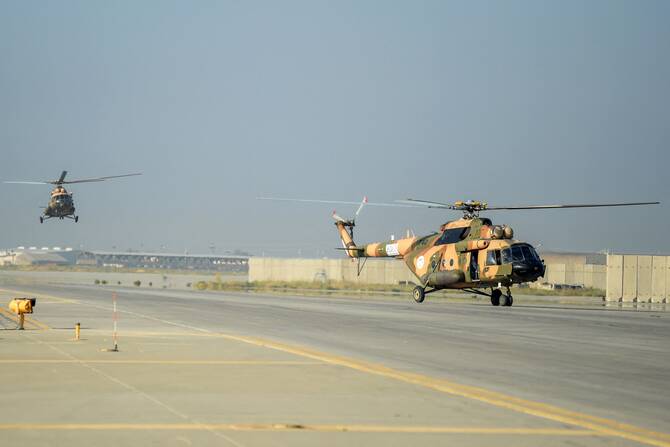
Taliban military helicopters fly to celebrate the third anniversary of Taliban's takeover of Afghanistan, at the Bagram Air Base, in Bagram, Parwan province on August 14, 2024. (AFP/File Photo)
Short Url
Updated 08 April 2025
Follow

Taliban deny reports of American airbase takeover

  • Chief spokesman: ‘The Islamic Emirate will not allow such an action’
  • Rumors spread after US military flight landed at Bagram reportedly carrying top intelligence officials

LONDON: The Taliban have denied rumors that Afghanistan’s Bagram airbase has been handed back to the US, The Independent reported on Tuesday.

The denial followed the flight of a US military cargo plane into Afghanistan over the weekend.

The C-17 aircraft took off from Al-Udeid in Qatar and arrived in Afghanistan via Pakistan, landing at Bagram on Sunday, local media reported.

Khaama Press reported that the flight was carrying top US intelligence officials, including Michael Ellis, the CIA’s deputy chief.

It added that the Taliban handed the base to the US in the wake of comments by President Donald Trump expressing an interest in the facility, located north of Kabul.

However, the Taliban’s chief spokesman Zabiullah Mujahid dismissed the reports as “propaganda” and said the government maintains full control of the base.

“There is no need for any country’s military presence in Afghanistan at present and the Islamic Emirate will not allow such an action,” he added, describing an American takeover of the base as “impossible.”

Zia Ahmad Takal, deputy spokesman for Afghanistan’s Foreign Ministry, told The Independent: “This news (of the takeover) is not correct.”

Bagram, the size of a small city, served as the command node for coalition forces during the 20-year war against the Taliban before the group recaptured Afghanistan in 2021.

It has two runways, 100 parking spaces for jets, a passenger lounge, a 50-bed hospital, and numerous hangar-sized tents housing equipment.


China foreign minister blasts Middle East war, urges US to manage ties

Updated 57 min 3 sec ago
Follow

China foreign minister blasts Middle East war, urges US to manage ties

  • Wang Yi: ‘A strong fist does not mean strong reason. The world cannot return to the law of the jungle’

BEIJING: China’s top diplomat condemned on Sunday the war in the Middle East and urged the United States to iron out its differences with Beijing.
Foreign Minister Wang Yi told a press conference in the Chinese capital that the war, which was sparked by US and Israeli strikes on Iran, “should never have happened.”
“A strong fist does not mean strong reason. The world cannot return to the law of the jungle,” he told reporters.
He was speaking during China’s annual political gathering, which began this week, known as the “Two Sessions.”
The parallel meetings of China’s parliament and political consultative body are closely watched for clues as to the priorities of top leaders, in the face of a precarious geopolitical landscape
Wang addressed a range of issues, including a trade war with the United States, regional tensions in the South China Sea, as well as wars in the Middle East and Ukraine.
“This year is indeed a big year for Sino-US relations,” Wang said.
‘Manage differences’
Ties between China and the United States have been strained since US President Donald Trump returned to the White House last year, followed by a trade war that saw the two countries impose tit-for-tat tariffs on each other’s products.
“We observe certain country erecting tariff barriers and pursuing decoupling and supply chain disruption,” Wang said on Sunday.
“These actions are akin to trying to extinguish a fire with fuel. Ultimately, they will backfire and harm itself.”
While China and the United States “cannot change each other,” he said, “we can change the way we interact with each other.”
Wang urged both sides to “create a suitable environment, manage existing differences, and eliminate unnecessary interference.”
But a wide range of disagreements remain.
Beijing has blasted US and Israeli military strikes on Iran, with which it has diplomatic and trade ties.
It has in particular condemned the killing of the country’s supreme leader Ayatollah Ali Khamenei.
Wang also maintained that China’s relations with Moscow, which have been criticized by Western countries for sustaining the war in Ukraine, remained “steadfast and unshakeable.”
China ‘gym’
China has sought to profit off Trump’s volatile foreign policies, positioning itself as a reliable alternative to once traditional US allies.
Leaders from France, Canada, Finland and the United Kingdom, among others, have flocked to Beijing, recoiling from Trump’s bid to seize Greenland and tariff threats against fellow NATO members.
Wang welcomed the visits on Sunday, saying “we have noticed that more and more insightful Europeans agree that China is not a competitor, but a global partner.”
“We welcome our European friends to step out of the ‘small attic’ of protectionism and come to the ‘gym’ of the Chinese market, where they can strengthen their muscles and enhance their competitiveness,” he said.
In the spirit of warming relations, China has doled out visa-free travel agreements to around 50 countries including France, Germany, and the United Kingdom.
Beijing has also agreed to reduced tariffs with Ottawa and London in their exports to China.
Wang also addressed relations between China and Japan, which have been locked in a spat after comments by Prime Minister Sanae Takaichi in November that Tokyo could intervene militarily in any attack on self-ruled Taiwan.
Takaichi’s comments enraged Beijing, which views Taiwan as its territory and has not ruled out taking by force.
Wang emphasized on Sunday that Beijing “will never allow anyone or any force to separate Taiwan … from China once again.”
He warned Japan against “repeating the same disastrous mistakes,” adding that China “will never allow anyone to stand up for colonialism,” in an apparent reference to Tokyo’s actions during World War II.
The issue of Taiwan, he insisted, is “at the heart of China’s core interests” and “a red line that must not be crossed or trampled on.”