

Philippines’ first hijabi anchor redefines Muslim representation, one newscast at a time

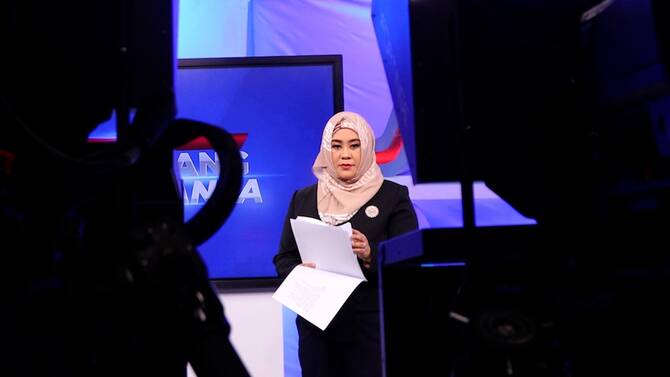
Princess Habibah Sarip-Paduac prepares to go on air at the PTV studio in Manila, Feb. 28, 2025. (AN Photo)
Short Url
Updated 09 April 2025
Follow

Philippines’ first hijabi anchor redefines Muslim representation, one newscast at a time

  • Princess Habibah Sarip-Paudac became first Muslim in state broadcaster’s newsroom
  • A news anchor at PTV, she also became Salaam TV and Salaam Radio host

MANILA: When Princess Habibah Sarip-Paudac first appeared on national television in 2012, she made history — not only as the Philippines’ first presenter to wear a hijab, but also as the first person from the country’s Muslim south to deliver the national news.

A native of Marawi, one of the main cities in the Bangsamoro Autonomous Region in Muslim Mindanao, home to much of the Philippines’ minority Muslim community, Paudac traveled to Manila to audition at the People’s Television Network.

She won the contest and on Aug. 8, 2012, the flagship state broadcaster took her on air. Everyone back home was glued to their TVs.

“It was the first time. Everyone was so happy. Everyone was like cheering for me that day. And I feel that it was a big responsibility,” Paudac told Arab News.

“A lot of people were so surprised that I was able to pave the way for Muslim women in the national mainstream media. So, for its impact, for the people, of course, it was so big.”

Paudac, a college teacher and community worker, had no training in broadcast news but from the very first day at PTV was thrown in at the deep end.

“I really made (sure to) see to it that I would be learning day by day through this job,” she said. “I think the love for journalism started from there.”

Paudac quickly picked up the rules of journalism and reporting, studied the current news, and learnt how to read and deliver it perfectly. But as time went by, she realized there was also another task in front of her — one that was not related to her job.

As the only Muslim in the newsroom, her colleagues would often ask her about her religion and background, and to explain to them the things they did not know about Islam and about her homeland in Mindanao.

“For them, it came s a surprise that I was able to speak Tagalog, that I was able to speak English ... And I was like, no, people in Bangsamoro are well educated, and we have good education there, and I’m just one of the many successful women out there. We have lawyers, we have doctors, we have teachers. Now we have a news anchor,” she said.

“It became like an eye-opener for me. I was like: ‘I think this is my purpose. This is what Allah wants me to do.”

As her career advanced, besides being a news anchor, Paudac also became a host at Salaam TV and Salaam Radio — PTV’s channels focused on Filipino Muslims.

She also grew increasingly active in her role of challenging stereotypes about Muslim women and has managed to make them be seen and recognized as professionals.

Now she hopes that more of them will feel encouraged and empowered to pursue high-profile careers.

“I hope that they can get something from me, from my representation. And this job is very noble. You can learn a lot from it. You can give more into your community through this, you are a representative not just of your community, but your faith as well. And you can educate a lot of people,” Paudac said.

Her message to fellow Muslim women is clear — that they can excel and redefine spaces while staying true to their faith and identity.

And for that, she has some advice: “Please, take care of your hijabs. Take care of yourselves. Make yourself a resourceful person. Learn a lot ... most importantly, never ever leave behind your faith, your identity.”


Israel says ban on Gaza media access should stay: court document

Updated 05 January 2026
Follow

Israel says ban on Gaza media access should stay: court document

  • Israeli authorities have told the Supreme Court that a ban on international media access to Gaza should remain in place, arguing it is necessary for security reasons

JERUSALEM: Israeli authorities have told the Supreme Court that a ban on international media access to Gaza should remain in place, arguing it is necessary for security reasons, according to a government submission filed by the public prosecutor.
Since the outbreak of the Gaza war in October 2023, Israeli authorities have barred foreign journalists from independently entering the devastated territory.
Instead, Israel has allowed only a limited number of reporters to enter Gaza on a case-by-case basis, embedded with its military forces inside the blockaded territory.
The Foreign Press Association (FPA), which represents hundreds of foreign journalists working in Israel and the Palestinian territories, filed a petition with the Supreme Court in 2024 seeking immediate and unrestricted access for international media to the Gaza Strip.
Since then the court has given several extensions to the Israeli authorities to come up with a plan, but at a hearing last month it set January 4 as a final deadline.
Late on Sunday, the Israeli authorities filed their response with the court, a copy of which was obtained by AFP.
In the submission, the government said the ban on media access to Gaza should continue, citing security risks in the territory.
“Even at this time, entry of journalists into the Gaza Strip without escort, as requested in the petition, should not be permitted,” said the government submission.
“This is for security reasons, based on the position of the defense establishment, which maintains that a security risk associated with such entry still exists.”
The Israeli authorities said the ceasefire in Gaza, which came into effect on October 10, continues to face regular threats.
At least 420 Palestinians have been killed in Gaza by Israeli forces since the ceasefire took effect, according to Gaza’s health ministry.
The Israeli military said three of its soldiers have also been killed by militants during the same period.
The Israeli authorities said in their submission that the search for the remains of the last hostage held in Gaza is ongoing, suggesting that allowing journalists into the territory at this stage could hinder the operation.
The remains of Ran Gvili, whose body was taken to Gaza after he was killed during the Hamas attack on October 7, 2023, have still not been recovered despite the ceasefire.
All other 250 hostages seized on that day — both the living and the deceased — have been returned to Israel.
The Supreme Court is expected to issue a ruling on the matter, though it is unclear when a decision will be handed down.
An AFP journalist sits on the board of the FPA.