

Thousands of Afghan refugees return to Afghanistan via Torkham as Pakistan intensifies deportations

1 / 2
An Afghan refugee boy stands in front of a registration centre in Takhta Pul district of Kandahar Province, Afghanistan, on April 7, 2025, upon his arrival from Pakistan. (AFP)
2 / 2
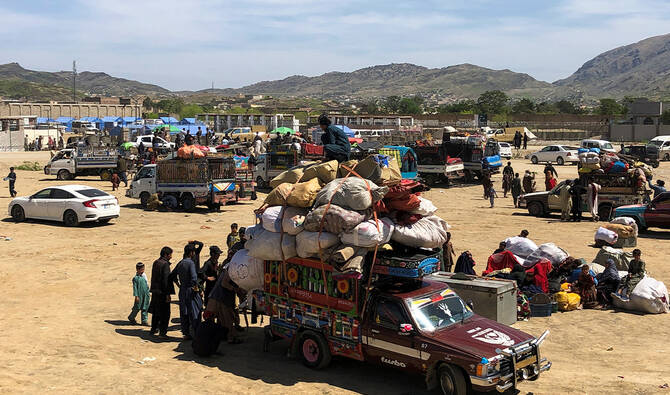
Afghan nationals with their belongings gathered at the Torkham border, Pakistan, on April 7, 2025. (Reuters)
Short Url
Updated 08 April 2025
Follow

Thousands of Afghan refugees return to Afghanistan via Torkham as Pakistan intensifies deportations

  • Islamabad last month set deadline for some 800,000 Afghans carrying citizen cards to leave Pakistan
  • A total of 488,187 “illegal immigrants” sent to Afghanistan via Torkham since September 2023, says KP

PESHAWAR: Thousands of Afghan refugees are being repatriated through the Torkham border pass in northwestern Pakistan, the Khyber Pakhtunkhwa (KP) Home and Tribal Affairs department said on Tuesday, as Islamabad intensifies its campaign to deport what it says are illegal immigrants. 
Pakistani officials told Arab News on Monday that Islamabad has repatriated more than 13,500 Afghan nationals since the expiry of a Mar. 31 expulsion deadline for Afghan Citizen Card (ACC) holders, an identity card issued by Islamabad. 
The latest deportation exercise is another phase in Islamabad’s campaign in recent years to return foreigners, mostly Afghans, living in Pakistan. The move is part of a larger repatriation drive of foreign citizens that began in 2023, with over 800,000 Afghans expelled from Pakistan since. The government initially said it was first focusing on expelling foreigners with no legal documentation and other categories such as ACC holders, would be included later. 

“Since Apr.1, 5,568 refugees holding Afghan Citizen Cards have been sent to Afghanistan via Torkham,” the tribal affairs department said in a statement. 
The department said 2,355 ACC holders and 3,042 illegal immigrants were sent via Torkham border on Monday. Since Apr. 1,160 ACC holders from Islamabad, 4,227 from Punjab and one from Gilgit-Baltistan were sent to Afghanistan via Torkham border.
It added that a total of 488,187 illegal immigrants have been sent to Afghanistan through Torkham since September 2023. 
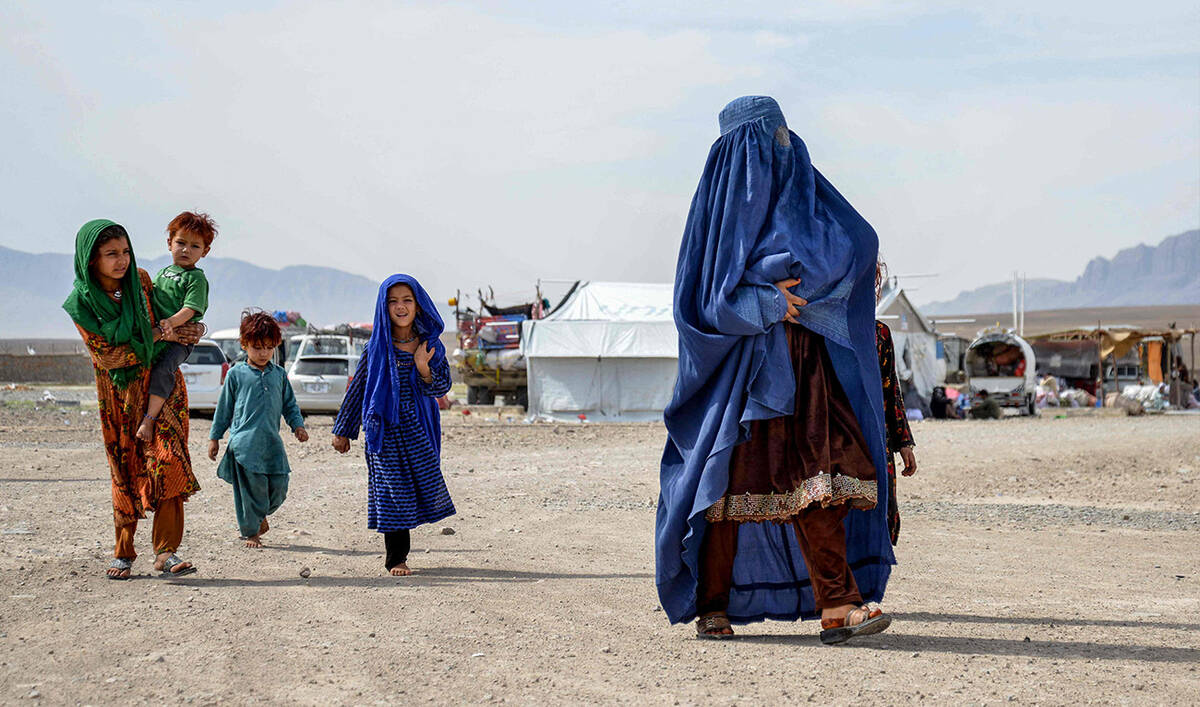


An Afghan burqa-clad refugee along with her children arrives at a registration centre in Takhta Pul district of Kandahar Province, Afghanistan, on April 7, 2025, upon their arrival from Pakistan. (AFP)

According to the United Nations (UN) data, Pakistan has hosted more than 2.8 million Afghan nationals who crossed the border in a desperate attempt to escape decades of war and instability in their home country. Around 1.3 million of them are formally registered as refugees and hold Proof of Registration (PoR) cards, which grant them legal protection while another 800,000 Afghans possess ACC.
Pakistan took the decision in 2023 to deport Afghan nationals from the country following a surge in suicide attacks in the country, particularly in KP. Islamabad blames Afghan nationals for being involved in attacks on its soil and accuses the Taliban-led government in Afghanistan of providing shelter to anti-Pakistan militants. Kabul denies the allegation and says Pakistan’s security matter is its internal responsibility. 
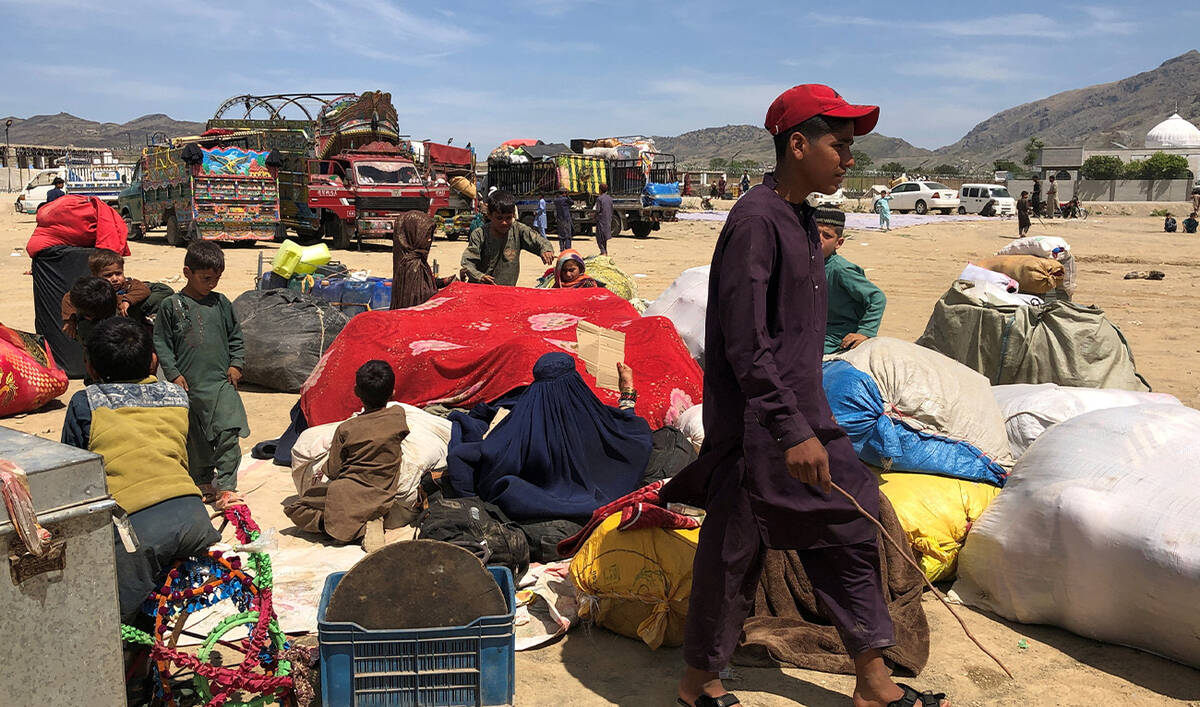


Afghan nationals with their belongings gather as they head back to Afghanistan at the Torkham border crossing, Pakistan on April 7, 2025. (Reuters) 

International rights groups allege Afghan refugees face harassment and intimidation by Pakistani police and authorities in the forced expulsion drive. Pakistani officials deny the charges and say Afghan nationals are being sent to their homeland in a dignified manner. 
“We faced terrible situations there,” Lal Saeed, an Afghan man recently deported from Pakistan, told Reuters on Monday. “The Pakistani police raided our home during the night. My two sons were taken away — and they’re still in prison. I have the proof.”
With belongings packed, Lal said he left a loaded car waiting outside and rushed to the prison, hoping for one last chance to bring his sons with him. 
“When I got there, the police asked, ‘Where are you going?’ I said, ‘I’m going to Afghanistan.’ They replied, ‘Then go — we’ll deport your sons after you.’“


Islamabad steps up vehicle checks to boost security as 166,000 cars get electronic tags

Updated 4 sec ago
Follow

Islamabad steps up vehicle checks to boost security as 166,000 cars get electronic tags

  • Authorities say over 3,000 vehicles registered in past 24 hours as enforcement intensifies
  • Extended service hours introduced to push full compliance with digital monitoring system

ISLAMABAD: Authorities in the Pakistani capital have intensified enforcement against vehicles without mandatory electronic tags with more than 166,000 cars now registered, according to data released on Sunday evening, as Islamabad moves to strengthen security and digital monitoring at key entry and exit points.

The Islamabad Capital Territory (ICT) administration introduced the electronic tagging system late last year as part of a broader effort to regulate traffic, improve record-keeping and enhance surveillance in a city that hosts the country’s main government institutions, foreign missions and diplomatic enclaves.

Under the system, vehicles are fitted with electronic tags that can be read automatically by scanners installed at checkpoints across the capital, allowing authorities to identify unregistered vehicles without manual inspections. Vehicles already equipped with a motorway tag, or m-tag, are exempt from the requirement.

“A total of 166,888 vehicles have successfully been issued M-Tags so far, including 3,130 vehicles in the last 24 hours,” the ICT administration said, according to the Excise Department.

Officials said readers installed at checkpoints across Islamabad are fully operational and are being used to stop vehicles still without tags, as enforcement teams carry out checks across the city.

To facilitate compliance, authorities have expanded installation facilities and extended operating hours. The Excise Department said m-tag installation is currently available at 17 booth locations, while select centers have begun operating beyond normal working hours.

According to Director General Excise Irfan Memon, m-tag centers at 26 Number Chungi and 18 Meel are providing services round the clock, while counters at Kachnar Park and F-9 Park remain open until midnight to accommodate motorists unable to visit during daytime hours.

Officials said the combination of enforcement and facilitation was aimed at achieving full compliance with minimal disruption, adding that operations would continue until all vehicles operating in the capital are brought into the system.

The enforcement drive builds on a wider push by the federal government to integrate traffic management, emergency response and security monitoring through technology-driven “safe city” initiatives. Last month, Interior Minister Mohsin Naqvi reviewed Islamabad’s surveillance infrastructure and said reforms in monitoring systems and the effective use of technology were the “need of the hour.”

Authorities have urged motorists to obtain electronic tags promptly to avoid delays and penalties at checkpoints as enforcement continues across the capital.