

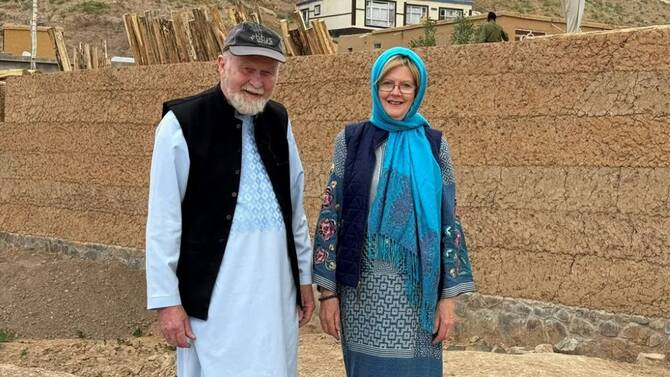
Son of elderly British couple held by Taliban asks for US help

Peter Reynolds, 79, and wife Barbie, 75, have been in prison since the start of February. (Supplied)
Short Url
Updated 07 April 2025
Follow

Son of elderly British couple held by Taliban asks for US help

  • Peter, Barbie Reynolds have been jailed for 9 weeks despite having ‘never heard one accusation or one charge’
  • Couple have lived in Afghanistan for 18 years running education, training programs for locals

LONDON: The son of a British couple currently detained in Afghanistan has asked the US for assistance in obtaining their release, saying they have “never heard one accusation or one charge.”

Peter Reynolds, 79, and his wife Barbie, 75, who have lived in Afghanistan for 18 years, were arrested on Feb. 1 by the Taliban in Bamiyan province over what they believed was a flight permit issue.

However, despite being initially told it was a minor problem and that they would be released, the pair, along with Chinese-American friend Faye Hall and their translator, had their phones confiscated and were later transferred to a Kabul jail by the Interior Ministry.

Their son Jonathan Reynolds, who lives in Chicago, told Sky News that the pair and their family had not been given an explanation by the authorities for their nine-week detention. 

“Originally they (authorities) said they didn’t have the right paperwork to have a chartered plane, which was incorrect and it was all produced,” he said.

“They took a short flight (to Bamiyan from Kabul) to pick up a Chinese-American friend who has visited multiple times,” he added.

“I believe there have been 29 investigative interviews with staff members — people they have served and supported — and everything has come up as no credible charges.”

In February, the Taliban said the pair were arrested because it was believed their Afghan passports were fake.

Peter Reynolds has said he was told books “against Islam” had been confiscated at their house in Afghanistan, but officials had not followed up on these claims.

“They’ve been in and out of court, which is infuriating for them because there’s no charges and they are told every single time: yes, they are innocent, it’s just a formality, we’ve made a mistake,” Jonathan Reynolds said.

In February, the BBC reported that a Taliban official had said the government was keen for the couple to be released. 

Interior Ministry spokesman Abdul Mateen Qani was quoted by The Independent as having said: “A series of considerations is being taken into account, and after evaluation, we will endeavor to release them as soon as possible.”

Hall was released on March 29 after bounties placed on the heads of various Taliban figures, including the interior minister, were dropped by the US. The Taliban said her release was “a goodwill gesture.”

Peter Reynolds told the BBC: “Anybody who has the ability to unlock that key and let them out, whether it be the Taliban, whether it be the British government or whether it be the American government, I would ask — do it now, please.”

The family previously appealed to the Taliban to show clemency for Eid Al-Fitr, when the regime handed out amnesties to several thousand detainees in its prisons.

The couple, who married in Kabul in 1970, run the Rebuild organization, which provides training and educational programs for local people.

“I think anyone who goes in their 60s and 70s to live and become Afghan citizens is probably not naive to the dangers of it,” Jonathan Reynolds told Sky.

“If they wanted to live a quiet, retired life and be around their grandkids they could have done that.

“They are under a deep conviction from back in the late 60s when they married in Afghanistan in 1970 that they were going to give their life for a bright future for Afghanistan.”

He said he is extremely concerned for his parents’ welfare, especially as food and medicine are limited in the Taliban’s prison system.

EU and Qatari officials have been able to get essentials to the couple, who are being held separately, and Jonathan Reynolds expressed gratitude to Qatar for aiding his parents.

However, contact with them has been limited to the use of a pay phone in the jail — and the couple have had no direct contact with each other since being jailed.


DR Congo’s amputees bear scars of years of conflict

Updated 2 sec ago
Follow

DR Congo’s amputees bear scars of years of conflict

GOMA: They survived the bombs and bullets, but many lost an arm or a leg when M23 fighters seized the city of Goma in the eastern Democratic Republic of Congo nearly a year ago.
Lying on a rug, David Muhire arduously lifted his thigh as a carer in a white uniform placed weights on it to increase the effort and work the muscles.
The 25-year-old’s leg was amputated at the knee — he’s one of the many whose bodies bear the scars of the Rwanda-backed M23’s violent offensive.
Muhire was grazing his cows in the village of Bwiza in Rutshuru territory, North Kivu province, when an explosive device went off.
He lost his right arm and right leg in the blast, which killed another farmer who was with him.
Fighting had flared at the time in a dramatic escalation of a decade-long conflict in the mineral-rich region that had seen the M23 seize swathes of land.
The anti-government M23 is one of a string of armed groups in the eastern DRC that has been plagued by internal and cross-border violence for three decades, partly traced back to the 1994 Rwanda genocide.
Early this year, clashes between M23 fighters and Congolese armed forces raged after the M23 launched a lightning offensive to capture two key provincial capitals.
The fighting reached outlying areas of Muhire’s village — within a few weeks, both cities of Goma and Bukavu had fallen to the M23 after a campaign which left thousands dead and wounded.
Despite the signing in Washington of a US-brokered peace deal between the leaders of Rwanda and the DRC on December 4, clashes have continued in the region.
Just days after the signing, the M23 group launched a new offensive, targeting the strategic city of Uvira on the border with the DRC’s military ally Burundi.
More than 800 people with wounds from weapons, mines or unexploded ordnance have been treated in centers supported by the International Committee of the Red Cross (ICRC) in the eastern DRC this year.
More than 400 of them were taken to the Shirika la Umoja center in Goma, which specializes in treating amputees, the ICRC said.
“We will be receiving prosthetics and we hope to resume a normal life soon,” Muhire, who is a patient at the center, told AFP.


- ‘Living with the war’ -


In a next-door room, other victims of the conflict, including children, pedalled bikes or passed around a ball.
Some limped on one foot, while others tried to get used to a new plastic leg.
“An amputation is never easy to accept,” ortho-prosthetist Wivine Mukata said.
The center was set up around 60 years ago by a Belgian Catholic association and has a workshop for producing prostheses, splints and braces.
Feet, hands, metal bars and pins — entire limbs are reconstructed.
Plastic sheets are softened in an oven before being shaped and cooled. But too often the center lacks the materials needed, as well as qualified technicians.
Each new flare-up in fighting sees patients pouring into the center, according to Sylvain Syahana, its administrative official.
“We’ve been living with the war for a long time,” he added.
Some 80 percent of the patients at the center now undergo amputation due to bullet wounds, compared to half around 20 years ago, he said.
“This clearly shows that the longer the war goes on, the more victims there are,” Syahana said.