

Baha exhibition highlights Saudi maritime legacy

1 / 2
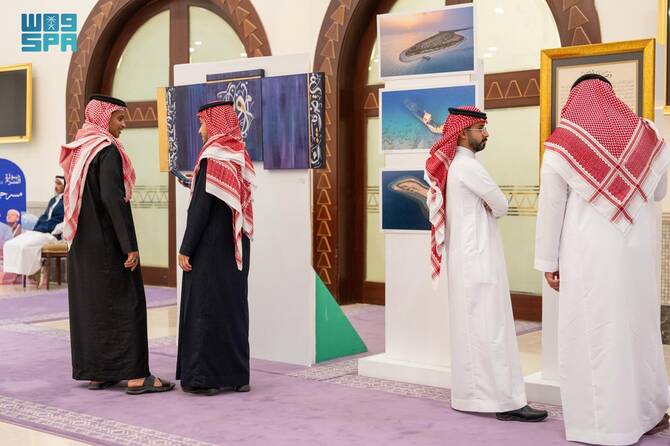
Accompanying the Theater Tour initiative in Baha, the exhibition saw a strong turnout from residents and visitors. (SPA)
2 / 2
Accompanying the Theater Tour initiative in Baha, the exhibition saw a strong turnout from residents and visitors. (SPA)
Short Url
Updated 06 April 2025
Follow

Baha exhibition highlights Saudi maritime legacy

RIYADH: An exhibition in Baha celebrated Saudi Arabia’s rich cultural and environmental heritage while showcasing its maritime traditions through diverse artworks.

Accompanying the Theater Tour initiative in Baha, the exhibition saw a strong turnout from residents and visitors, the Saudi Press Agency reported.

Those attending praised the exhibition’s diverse artistic content, reflecting the Kingdom’s cultural richness, especially its maritime heritage central to the project, as well as the mountainous and cultural identity of Baha.

The event featured 16 paintings in contemporary styles inspired by the Saudi environment; three photographs capturing nature, agriculture, and harvest; and three Arabic calligraphy artworks highlighting the beauty and authenticity of scripts.

The exhibition also showcased two key elements of national identity: the marine environment, symbolized by fishing, boats, and sea chants, and the natural landscapes and traditional crafts of Baha.

The strong attendance reflected the growing interest in cultural initiatives that preserve heritage and strengthen ties between younger generations and the Kingdom’s artistic legacy.

Those attending also witnessed the craftsmanship behind fishing cages and nets and gained insight into the ancient profession of pearl diving, the SPA reported.

Craftsmen demonstrated the use of natural tools in diving, and the manual weaving of fishing nets, offering a nostalgic connection to the past and the lives of coastal communities.

Organized by the Theater and Performing Arts Commission, the three-day Theater Tour initiative in Baha also attracted crowds to the award-winning play “Bahr.”

The initiative takes performances to cities, governorates and villages throughout the Kingdom, and the first phase features “Bahr.”

The production now moves to Jubail from April 17-19, Dammam (April 24-26), and Al-Ahsa (May 1-3).

Inspired by maritime heritage, “Bahr” explores the traditions of sailors’ lives, particularly diving and pearl hunting.

The production is part of the commission’s strategy to promote culture across the Kingdom.


Japanese researchers hope to restore coral from Saudi-made structures

Updated 10 sec ago
Follow

Japanese researchers hope to restore coral from Saudi-made structures

  • Coral skeletons made for Saudi Pavilion at Japan expo last year
  • Results of Japanese study to be revealed at Riyadh Expo 2030

TOKYO: Japanese universities are seeking to restore coral reefs and marine ecosystems after receiving artificial structures that Saudi Arabia made and showcased at last year’s Osaka-Kansai Expo.

The coral skeletons were donated to the University of the Ryukyus in Okinawa and Kansai University in Osaka Prefecture, Kyodo News reported at the weekend.

The structures are made from calcium carbonate, a material on which corals are believed to grow more easily compared to artificial alternatives such as concrete or metal.

The skeletal structures were created using 3-D printers, with one piece produced a day during the expo, and displayed across an entire wall in the Saudi Arabia Pavilion, which had an area focusing on sustainable marine environments.

Coral reefs serve as habitats for much marine life, but over 40 percent of the world’s 892 species face possible extinction, according to the International Union for Conservation of Nature.

The University of the Ryukyus, which received about 150 of the artificial coral skeletons, will place them in waters off the eastern coast of Okinawa’s main island and then examine their impact on the ecosystem.

Kansai University has placed theirs in the sea around Kagoshima Prefecture’s Yoron Island to observe their growth after transplanting coral polyps onto the structures.

The results of the research are expected to be revealed at the Riyadh Expo in 2030.

“I had never imagined that Japan and Saudi Arabia would cooperate on coral research,” said Masato Ueda, a professor specializing in regenerative medicine at Kansai University.

Ueda said he wants to demonstrate to children that “humanity is attempting to restore the environment.”