

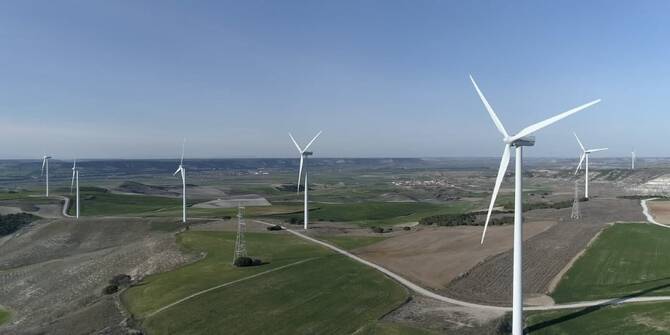
ACWA Power begins commercial operations at 2 major wind projects in Uzbekistan 

Uzbekistan aims to generate 40 percent of its electricity from renewable sources by 2030.
Short Url
Updated 06 April 2025
Follow

ACWA Power begins commercial operations at 2 major wind projects in Uzbekistan 

RIYADH: Saudi utility giant ACWA Power has commenced commercial operations at two major wind power plants in Uzbekistan.

ACWA Power holds a 65 percent stake in both projects, having sold a 35 percent share to China Southern Power Grid International in July.

According to the company’s statement on Tadawul, both the 500-megawatt Dzhankeldy Wind Power Plant, which began commercial operations on April 1, and the 500-MW Bash Wind Power Plant, which started operations on April 6, are now fully operational.

Uzbekistan aims to generate 40 percent of its electricity from renewable sources by 2030, a critical milestone in its plan to achieve 20 gigawatts of clean energy capacity by the decade’s end. The nation is prioritizing the expansion of solar, wind, and hydroelectric energy, leveraging its natural resources to decrease reliance on fossil fuels, cut carbon emissions, and enhance energy security.

In December, Mohammad Abunayyan, chairman of ACWA Power’s board of directors and head of the Saudi-Uzbek Business Council, highlighted the progress in his firm’s partnership with the Uzbek government. He emphasized ACWA Power’s role as a major strategic investor in the nation’s rapidly growing clean energy sector.

Abunayyan said: “Today’s groundbreaking highlights the multitude of large-scale foreign direct investments and commendable efforts by Uzbekistan to strengthen the potential of the country’s energy system and capacity. It also paves the way for the commencement of ACWA Power projects that are expected to yield widespread benefits for Uzbekistan’s key regions and communities.”

During the December inauguration of the projects, Saudi Energy Minister Prince Abdulaziz bin Salman joined virtually and praised the strong relationship between the Kingdom and Uzbekistan.

He highlighted the collaborative efforts across various sectors, particularly energy, which have delivered mutual benefits to both nations, according to a statement from the company.

The Saudi minister also praised the economic cooperation between the two countries, particularly in the context of Saudi Vision 2030 and Uzbekistan Strategy 2030.

He stressed their shared goals of economic development, diversification, renewable energy, and sustainable growth, as well as Saudi Arabia’s growing investment in Uzbekistan’s electricity sector amid the country’s energy transition.

Uzbekistan is a key foreign market for ACWA Power, which has been significantly involved in the country’s renewable energy sector in recent years.

The company stated that the financial impact of both projects will be included in its statements starting in the second quarter of 2025.


‘The future is renewables,’ Indian energy minister tells World Economic Forum

Updated 22 January 2026
Follow

‘The future is renewables,’ Indian energy minister tells World Economic Forum

  • ‘In India, I can very confidently say, affordability (of renewables) is better than fossil fuel energy,’ says Pralhad Venkatesh Joshi during panel discussion
  • Renewables are an increasingly important part of the energy mix and the technology is evolving rapidly, another expert says at session titled ‘Unstoppable March of Renewables?’

BEIRUT: “The future is renewables,” India’s minister of new and renewable energy told the World Economic Forum in Davos on Wednesday.
“In India, I can very confidently say, affordability (of renewables) is better than fossil fuel energy,” Pralhad Venkatesh Joshi said during a panel discussion titled “Unstoppable March of Renewables?”
The cost of solar power has has fallen steeply in recent years compared with fossil fuels, Joshi said, adding: “The unstoppable march of renewables is perfectly right, and the future is renewables.”
Indian authorities have launched a major initiative to install rooftop solar panels on 10 million homes, he said. As a result, people are not only saving money on their electricity bills, “they are also selling (electricity) and earning money.”
He said that this represents a “success story” in India in terms of affordability and “that is what we planned.”
He acknowledged that more work needs to be done to improve reliability and consistency of supplies, and plans were being made to address this, including improved storage.
The other panelists in the discussion, which was moderated by Godfrey Mutizwa, the chief editor of CNBC Africa, included Marco Arcelli, CEO of ACWA Power; Catherine MacGregor, CEO of electricity company ENGIE Group; and Pan Jian, co-chair of lithium-ion battery manufacturer Contemporary Amperex Technology.
Asked by the moderator whether she believes “renewables are unstoppable,” MacGregor said: “Yes. I think some of the numbers that we are now facing are just proof points in terms of their magnitude.
“In 2024, I think it was 600 gigawatts that were installed across the globe … in Europe, close to 50 percent of the energy was produced from renewables in 2024. That has tripled since 2004.”
Renewables are an increasingly important and prominent part of the energy mix, she added, and the technology is evolving rapidly.
“It’s not small projects; it’s the magnitude of projects that strikes me the most, the scale-up that we are able to deliver,” MacGregor said.
“We are just starting construction in the UAE, for example. In terms of solar size it’s 1.5 gigawatts, just pure solar technology. So when I see in the Middle East a round-the-clock project with just solar and battery, it’s coming within reach.
“The technology advance, the cost, the competitiveness, the size, the R&D, the technology behind it and the pace is very impressive, which makes me, indeed, really say (renewables) is real. It plays a key role in, obviously, the energy demand that we see growing in most of the countries.
“You know, we talk a lot about energy transition, but for a lot of regions now it is more about energy additions. And renewables are indeed the fastest to come to market, and also in terms of scale are really impressive.”
Mutizwa asked Pan: “Are we there yet, in terms of beginning to declare mission accomplished? Are renewables here to stay?”
“I think we are on the road but (its is) very promising,” Pan replied. There is “great potential for future growth,” he added, and “the technology is ready, despite the fact that there are still a lot of challenges to overcome … it is all engineering questions. And from our perspective, we have been putting in a lot of resources and we are confident all these engineering challenges will be tackled along the way.”
Responding to the same question, Arcelli said: “Yes, I think we are beyond there on power, but on other sectors we are way behind … I would argue today that the technology you install by default is renewables.
“Is it a universal truth nowadays that renewables are the cheapest?” asked Mutizwa.
“It’s the cheapest everywhere,” Arcelli said.