

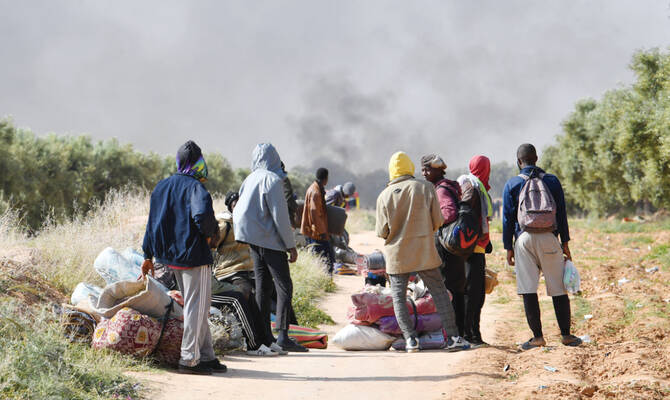

EI AMRA, Tunisia: Tunisia has dismantled camps housing thousands of undocumented migrants from sub-Saharan Africa, police said, following a campaign against them on social media.
Around 20,000 migrants had set up tents in fields in the eastern regions of El-Amra and Jebeniana, said national guard spokesman Houcem Eddine Jebabli.
He said around 4,000 people of various nationalities had left one of the camps cleared by authorities, and operations would continue over the coming days.
Some of the migrants had “dispersed into the countryside,” with pregnant women and the infirm taken care of by the health authorities, he added.
The camps had prompted anger from residents in nearby villages, raising pressure on the authorities.
Jebabli said locals had taken legal action over the occupation of their olive groves by the migrants.
“It was our duty to end all the disorder,” he said.
Tunisian President Kais Saied on March 25 called on the International Organization for Migration to accelerate voluntary returns for irregular migrants to their home countries.
In recent years, Tunisia has become a key departure point in North Africa for migrants crossing the perilous Mediterranean Sea in hopes of reaching Europe.
Italy has agreements with Tunisia and Libya to provide funding in exchange for help stemming departures.
Italy plans to invest €20 million ($22 million) in a new project to help Algeria, Libya, and Tunisia send irregular migrants from their territories back to the migrants’ countries of origin.
The government of Prime Minister Giorgia Meloni has vowed to cut irregular migration to Italy’s shores from North Africa — the majority of whom depart from Libya and Tunisia.
But many of the migrants who depart hail from other countries, especially sub-Saharan African countries.
Italy’s new plan “focuses on strengthening the institutional and administrative-managerial capacities of the partner countries,” with the involvement of 400 officials, Italy’s Foreign Affairs Ministry said in a recent statement.
Irregular migration would be better addressed “through the improvement and development of assisted voluntary repatriations from Algeria, Libya and Tunisia to the countries of origin,” it said.
It said the project would collaborate with the IOM to ensure migrants’ rights.
The ministry said the plan would benefit “around 3,300 of the most vulnerable migrants, carrying out their repatriation to their countries of origin sustainably and effectively.”
It said Italy’s Agency for Development Cooperation, which helps carry out development activities, would provide technical support.
The agency has also been charged with another plan targeted at the “socio-economic reintegration of returning migrants,” tapping Italian companies and civil society groups, it said.
On Wednesday, Libyan authorities said they would suspend the work of 10 international humanitarian groups, including Doctors Without Borders, accusing them of a plan to “settle migrants” from other parts of Africa in the country.


