President Zardari expected to leave hospital soon after COVID treatment, doctor says

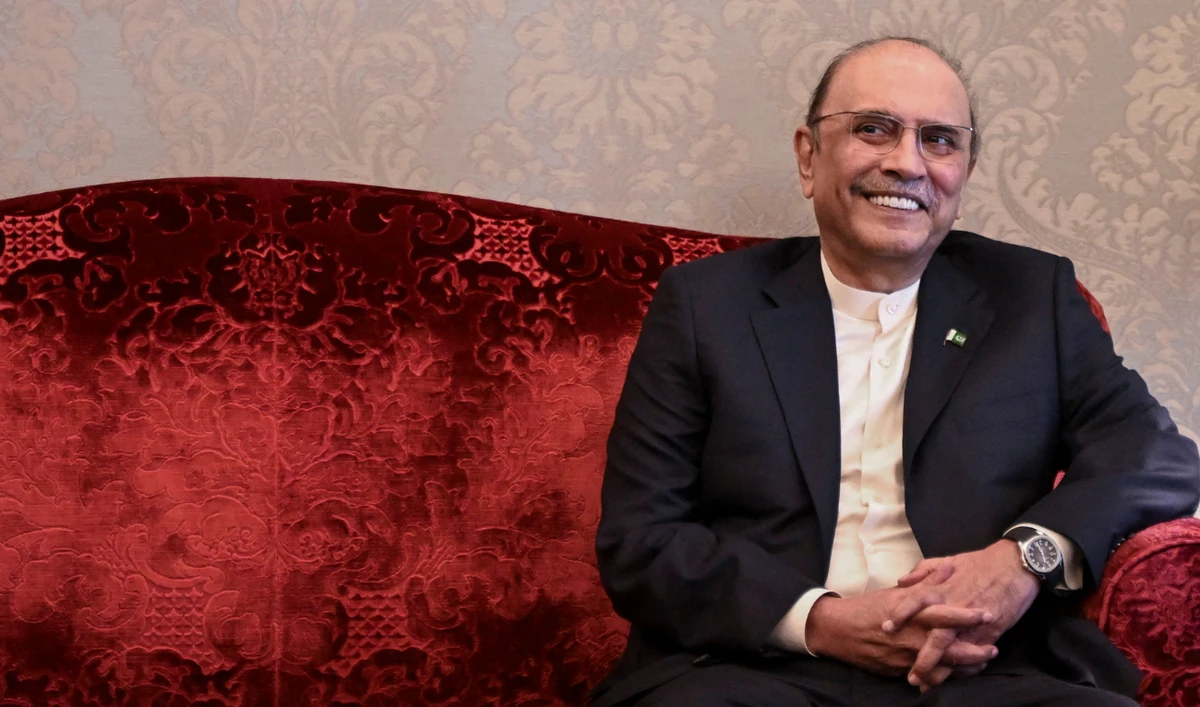
Pakistani President Asif Ali Zardari is pictured during his meeting with Portuguese President, in Lisbon on February 11, 2025. (AFP/File)
Short Url
Updated 06 April 2025
Follow

President Zardari expected to leave hospital soon after COVID treatment, doctor says

  • Asif Ali Zardari was brought to a hospital on Tuesday after he complained of suffering from fever, breathing problems
  • Dr. Asim Hussain refutes rumors about President Zardari’s ‘serious’ health condition and says it is gradually improving

KARACHI: Pakistan’s President Asif Ali Zardari, who tested positive for coronavirus this week, is likely to be discharged from hospital in next two days, his personal physician said on Saturday.
Zardari was brought to a private hospital in Karachi from Sindh’s Nawabshah city on Tuesday after he complained about suffering from fever and breathing problems, local media outlets reported.
On Wednesday, his personal physician, Dr. Asim Hussain, confirmed the president had tested positive for coronavirus and a team of medical experts was looking after him.
Speaking at a press conference on Saturday, Hussain refutes rumors about President Zardari’s ‘serious’ health condition and said it was gradually improving.
“At present, a low-risk variant of the coronavirus is still spreading in Pakistan. No matter what political opponents say or exaggerate anything, the health of the president is very good,” Hussain said.
“Asif Zardari’s meetings are restricted, only doctors have access to him. A panel of expert doctors is monitoring his health.”
Zardari, the widower of Pakistan’s slain first woman prime minister Benazir Bhutto, was appointed president for a second term in March last year. He previously served on the same post from 2008-2013.
Zardari, a landowner from Sindh and co-chairman of the Pakistan Peoples Party (PPP), a key member of Prime Minister Shehbaz Sharif’s ruling coalition, rose to prominence after his marriage to Bhutto in 1987.
He was widely criticized for corruption scandals that led to the collapse of Bhutto’s government in 1990.


Pakistan issues over $7 billion sukuk in 2025, nears 20 percent Shariah-compliant debt target

Updated 29 December 2025
Follow

Pakistan issues over $7 billion sukuk in 2025, nears 20 percent Shariah-compliant debt target

  • Finance Adviser Khurram Schehzad says this was the highest-ever Sukuk issuance in a single calendar year since 2008
  • Pakistan’s Federal Shariat Court ordered in 2022 the entire banking system to transition to Islamic principles by 2027

ISLAMABAD: Pakistan’s Finance Adviser Khurram Schehzad on Monday said the country achieved a landmark breakthrough in Islamic finance by issuing over Rs2 trillion ($7 billion) sukuk this year, bringing it closer to its 20 percent Shariah-compliant debt target by Fiscal Year 2027-28.

A sukuk is an Islamic financial certificate, similar to a bond, but it complies with Shariah law, which forbids interest. Pakistan’s Federal Shariat Court (FSC) had directed the government in April 2022 to eliminate interest and align the country’s entire banking system with Islamic principles by 2027.

Following the ruling, the government and the State Bank of Pakistan (SBP) have undertaken a series of measures, including legal reforms and the issuance of sukuk to replace interest-based treasury bills and investment bonds.

“In 2025, the Ministry of Finance (MoF) through its Debt Management Office, together with its Joint Financial Advisers (JFAs), successfully issued over PKR 2 trillion in Sukuk,” Schehzad said on X, describing it as “the highest-ever Sukuk issuance in a single calendar year since 2008 by Pakistan.”

Pakistan made a total of 61 issuances across one-, three-, five- and 10-year tenors, according to the finance adviser. The country also successfully launched its first Green Sukuk, a Shariah-compliant bond designed to fund environment-friendly projects.

He said the Green Sukuk was 5.4 times oversubscribed, indicating investor demand was more than five times higher than the amount the government planned to raise, which showed strong market confidence.

“The rising share of Islamic instruments in the government’s domestic securities portfolio (domestic debt) underscores strong momentum, growing from 12.6 percent in June 2025 to around 14.5 percent by December 2025, clearly positioning the MoF to achieve its 20 percent Shariah-compliant debt target by FY28,” Schehzad said.

“This milestone also reflects the structural deepening of Pakistan’s Islamic capital market, sustained investor confidence, and the strengthening of sovereign debt management.”

He said Pakistan was strengthening its government securities market by making it more resilient, diversified, and future-ready, supported by a stabilizing macroeconomic environment, a disciplined debt strategy, and a clear roadmap for Islamic finance.