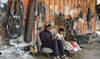
GAZA: Hundreds of thousands of fleeing Gazans sought shelter on Thursday in one of the biggest mass displacements of the war, as Israeli forces advanced into the ruins of the city of Rafah, part of a newly announced “security zone” they intend to seize.
A day after declaring their intention to capture large swaths of the crowded enclave, Israeli forces pushed into the city on Gaza’s southern edge, which had served as a last refuge for people fleeing other areas for much of the war.
Gaza’s Health Ministry reported at least 97 people killed in Israeli strikes in the past 24 hours, including at least 20 killed in an airstrike around dawn in Shejaia, a suburb of Gaza City in the north.
FASTFACT
The assault to capture Rafah is a significant escalation in the war, which Israel restarted last month after effectively abandoning a ceasefire in place since January.
Later on Thursday, an Israeli airstrike killed at least 27 Palestinians, including women and children, inside a school building that served as a shelter for displaced families in Gaza City, local health authorities said.
The Israeli military claimed the attack hit key Palestinian “terrorists.”
Medics said three missiles slammed into the Dar Al-Arqam school building in Tuffah neighborhood in Gaza City, and the Israeli military said it struck a command center that militants had used to plan and execute attacks against Israeli civilians and army troops.
Rafah “is gone, it is being wiped out,” a father of seven among the hundreds of thousands who had fled from Rafah to neighboring Khan Younis, said via a chat app.
“They are knocking down what is left standing of houses and property,” said the man.
The assault to capture Rafah is a significant escalation in the war, which Israel restarted last month after effectively abandoning a ceasefire in place since January.
In Shejaia in the north, one of the districts where Israel has ordered the population to leave, hundreds of residents streamed out on Thursday, some carrying their belongings as they walked, others on donkey carts and bikes or in vans.
“I want to die. Let them kill us and free us from this life. We’re not living, we’re dead,” said Umm Aaed Bardaa.
In Khan Younis, where a strike killed several people, Adel Abu Fakher was checking the damage to his tent: “There’s nothing left for us. We’re being killed while asleep,” he said.
Israel has not spelled out its long-term aims for the security zone its troops are now seizing.
Prime Minister Benjamin Netanyahu said troops were taking an area he called the “Morag Axis,” a reference to an abandoned former Israeli settlement between Rafah and Khan Younis.
Gazans who had returned to homes in the ruins during the ceasefire have now been ordered to flee communities on the northern and southern edges of the strip.
They fear Israel intends to depopulate those areas indefinitely, leaving many hundreds of thousands of people permanently homeless while Israel seizes some of Gaza’s last agricultural land and critical water infrastructure.
Since the first phase of the ceasefire expired at the start of March with no agreement to prolong it, Israel has imposed a total blockade on all goods for Gaza’s 2.3 million residents, recreating what international organizations call a humanitarian catastrophe.
Israel’s military said on Thursday it was investigating the deaths of 15 Palestinian aid workers found buried in a shallow grave in March near Red Crescent vehicles, an incident that caused global alarm.
The military said troops fired on the cars, believing they carried fighters.
Israel’s stated goal since the start of the war has been the destruction of the Hamas militant group, which ran Gaza for nearly two decades.
But with no effort made to establish an alternative administration, Hamas returned to control during the ceasefire.
Fighters still hold 59 dead and living hostages Israel says must be handed over to extend the truce temporarily; Hamas says it will free them only under a deal that permanently ends the war.
Israeli leaders say they have been encouraged by signs of protest in Gaza against Hamas, with hundreds of people demonstrating in north Gaza’s Beit Lahiya on Wednesday. Hamas calls the protesters collaborators and says Israel is behind them.
The war began with an attack on Israeli communities on Oct. 7, 2023 with gunmen taking more than 250 hostages, according to Israeli tallies.
Israel’s campaign has so far killed more than 50,000 Palestinians, Gaza health authorities say.
Rafah residents said most of the local population had followed Israel’s order to leave as Israeli strikes toppled buildings there.
However, a strike on the main road between Khan Younis and Rafah stopped most movement between the cities.
The movement of people and traffic along the western coastal road near Morag was also limited by bombardment.
“Others stayed because they don’t know where to go, or got fed up of being displaced several times. We are afraid they might be killed or at best detained,” said Basem, a resident of Rafah who declined to give a second name.