

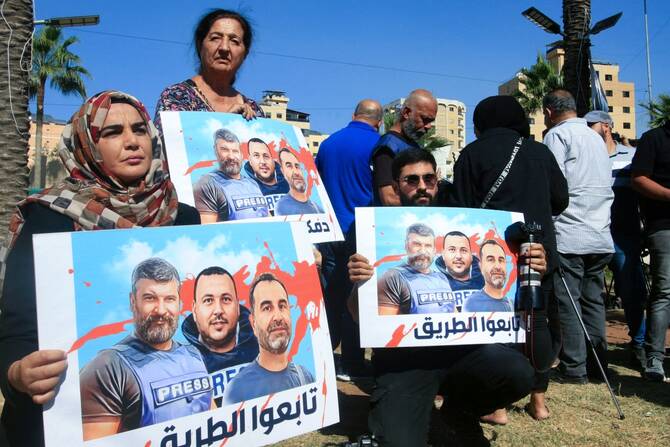

LONDON: A report released Tuesday by the Costs of War project at the Watson Institute for International Studies in the US has found that Israel’s war on Gaza is the “worst ever conflict” for journalists, with at least 208 Palestinian media workers killed since October 2023.
Titled “News Graveyards: How Dangers to War Reporters Endanger the World,” the study examines the toll of war on journalists, as well as broader trends in the US news industry that have weakened international coverage. It highlights how Gaza has seen an unprecedented death toll among journalists, far exceeding that of other conflicts in history.
“Attacks on journalists have exacerbated long term socio-economic shifts that have crippled the global news industry over decades and led to the de-prioritization of international news coverage and the closure of foreign news bureaus,” noted the report.
“Across the globe, the economics of the industry, the violence of war, and coordinated censorship campaigns threaten to turn an increasing number of conflict zones into news graveyards, with Gaza being the most extreme example.”
The Brown University-based nonpartisan research project, which analyzes the human, financial, and political costs of post-9/11 wars, found that “since Oct. 7, 2023, the war in Gaza has killed more journalists than the US Civil War, World War I, World War II, the Korean War, the Vietnam War, and the post-9/11 war in Afghanistan combined.”
The report also revealed that in 2024, a media worker was killed or murdered every three days worldwide — an increase from 2023’s rate of one every four days—attributed largely to the war in Gaza.
“Most reporters harmed or killed, as is the case in Gaza, are local journalists,” it added.
BREAKING: More journalists have died in Gaza since Oct. 7, 2023 than in both World Wars and other major wars, combined.
Our new report outlines the costs of war to journalists – and the journalism we all rely on. [THREAD, 1/8] https://t.co/oeeqPqw5i2 pic.twitter.com/gSXWYjtXSl
— The Costs of War Project (@CostsOfWar) April 1, 2025
Late in March, Palestinian journalists Mohammad Mansour, a correspondent for Palestine Today, and Hossam Shabat, a journalist for Al-Jazeera Mubasher, became the latest media workers to be killed in Gaza in Israeli attacks. The Israeli military admitted to killing Shabat, accusing him of being “a terrorist” it had “eliminated.”
The report accuses Israel of mounting “a full-spectrum effort to undermine the free flow of information,” citing the “near-total destruction” of media infrastructure, internet blackouts, misinformation campaigns, and restrictions preventing local journalists from leaving Gaza while barring foreign reporters from entering.
It also underscores the vital role local journalists play in conflict zones, describing them as bearing witness to “the realities and horrors of wars.
“Journalists serve as the eyes and ears of the world, seeking out solid, verifiable information amid a vortex of violence and a welter of rumor, manipulation, misinformation, disinformation, and propaganda,” the report continued.
The study also references Syria’s civil war, where hundreds of journalists were killed by government forces and armed groups. The Syrian Network for Human Rights estimates that 700 journalists and media activists have been killed since the conflict began in 2011.
The Watson Institute report warns that increasing threats against journalists not only endanger individuals but also undermine global news coverage and the “worldwide information ecosystem.”
“The decreasing number of experienced foreign correspondents in conflict zones, due to long term shifts in the global news industry that have led to the de-prioritization of international news coverage and the closure of foreign news bureaus, has likewise crippled critical knowledge and helped facilitate the creation of news graveyards,” said the report.


