

Jordan welcomes EU’s approved €500m financial aid package

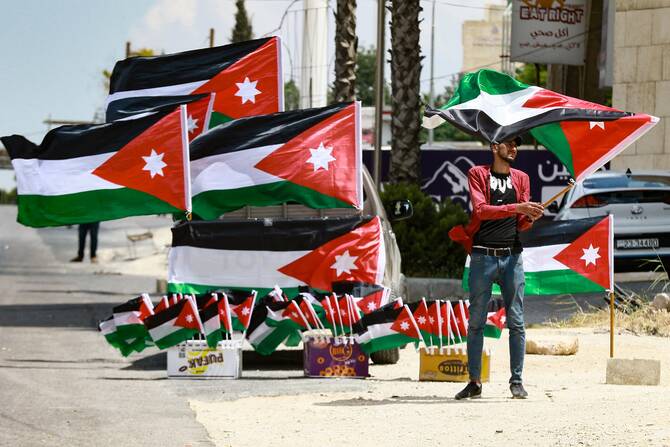
A street vendor displays Jordanian flags for sale as the country marks its 78th Independence Day, in Amman, May 25, 2024. (AFP)
Short Url
Updated 02 April 2025
Follow

Jordan welcomes EU’s approved €500m financial aid package

  • European Parliament approved the aid package with 571 votes during a plenary session in Strasbourg
  • Ministry of Foreign Affairs thanked the EU for its support, which enhances cooperation between Amman and Brussels

LONDON: Jordan’s Ministry of Foreign Affairs welcomed the EU’s decision to allocate a €500 million ($541 million) financial aid package to the Hashemite Kingdom on Wednesday.

During a plenary session in Strasbourg, the European Parliament approved an aid package for Jordan with 571 votes as part of a macro-financial assistance initiative.

Sufian Qudah, the ministry’s spokesperson, announced that the European Commission plans to propose an extra €500 million for Jordan, increasing the total funding under the MFA initiative to €1 billion for 2025–2027.

Qudah thanked the EU for its support, which enhances cooperation between Amman and Brussels and acknowledges Jordan’s role in regional peace and stability, the Petra news agency reported.

In January, King Abdullah II of Jordan and European Commission President Ursula von der Leyen signed the Comprehensive Strategic Partnership Agreement in Brussels.

The agreement includes a €1 billion financial aid package and a €3 billion aid package for Jordan for 2025–2027, which comprises €1.4 billion for investment support and €640 million in grants, Petra added.


Election of new Iraqi president delayed by Kurds

Updated 10 sec ago
Follow

Election of new Iraqi president delayed by Kurds

BAGHDAD: Iraq’s parliament postponed the election of a president on Tuesday to allow Kurdish rivals time to agree on a candidate.
Parliamentary Speaker Haibat Al-Halbussi received requests from Iraq's two main Kurdish parties, the Kurdistan Democratic Party and the Patriotic Union of Kurdistan, to postpone the vote to allow both parties more time to reach a deal.
By convention, a Shi’ite holds the powerful post of prime minister, the parliamentary Speaker is a Sunni and the largely ceremonial presidency goes to a Kurd.
Under a tacit agreement between the two main Kurdish parties, a PUK member holds the Iraqi presidency, while the president and regional premier of the semi-autonomous Kurdish region is selected from the KDP. But this time the KDP has named Foreign Minister Fuad Hussein as its own candidate for the presidency.
Once elected, the president will then have 15 days to appoint a prime minister, widely expected to be Nouri Al-Maliki, who held the post from 2006 to 2014. The shrewd 75-year-old politician is Iraq’s only two-term premier since the 2003 US-led invasion.
The Coordination Framework, an alliance of Shi’ite parties that holds a parliamentary majority, has already endorsed Maliki.