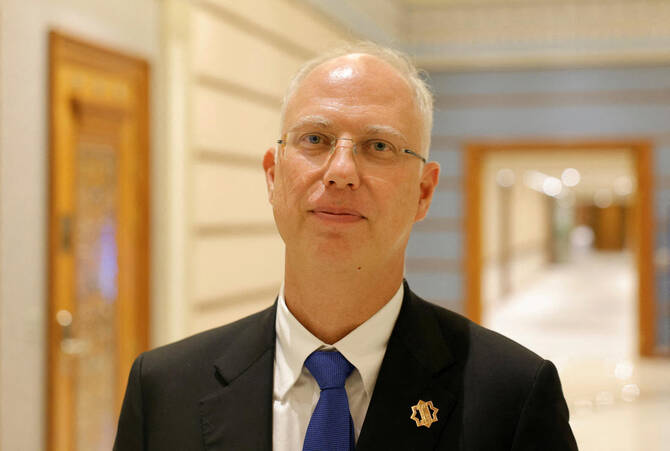
MOSCOW: The Kremlin on Wednesday said that its negotiator Kirill Dmitriev could visit the United States this week, as US media reported he is expected in Washington to meet Donald Trump’s envoy Steve Witkoff.
Dmitriev took part in Russia-US talks in Saudi Arabia in February and his visit would be the first of a senior Russian official to the United States since Moscow launched its offensive on Ukraine in February 2022.
“Yes, I confirm. This visit may be possible. We are continuing to talk to the Americans. I will not give more concrete (details),” Kremlin spokesman Dmitry Peskov told reporters when asked about media reports on the visit.
President Vladimir Putin appointed Dmitriev as the Kremlin’s international economy envoy in February as Moscow seeks to warm ties with Washington during Donald Trump’s presidency.
Russia is hoping for an easing of massive sanctions on its economy under Trump.
His visit to the United States would come as both Russia and Ukraine have accused each other of violating agreements brokered by Washington officials in Saudi Arabia in March.
Citing sources, CNN reported that the United States temporarily lifted sanctions against Dmitriev to allow his visit.
Writing on social media, Dmitriev said “maybe” in a post in which he shared a link to the CNN report.
Witkoff has previously traveled to Russia to meet Putin.
Europe and Kyiv fear the Trump administration could strike a deal with Moscow on Ukraine or lift sanctions on the Russian economy in a bid to force a ceasefire on terms favorable to Russia.

Kremlin says visit of senior Russian negotiator to US this week ‘possible’
https://arab.news/zt6f7
Kremlin says visit of senior Russian negotiator to US this week ‘possible’
- Kirill Dmitriev took part in Russia-US talks in Saudi Arabia in February
- President Vladimir Putin appointed Dmitriev as the Kremlin’s international economy envoy in February
Philippines signs free trade pact with UAE
- UAE deal is Philippines’ fourth free trade pact, after South Korea, Japan, and EFTA
- Business body warns of uneven gains if domestic safeguard mechanisms insufficient
MANILLA: The Philippines signed on Tuesday a comprehensive economic partnership agreement with the UAE, its first such deal with a Middle Eastern nation.
The Philippines and the UAE first agreed to explore a free trade pact in February 2022 and formalized the process with terms of reference in late 2023. Negotiations started in May 2024 and were finalized in 2025.
The CEPA signing was witnessed by President Ferdinand R. Marcos Jr. who led the Philippine delegation to Abu Dhabi.
“The CEPA is the Philippines’ first free trade pact with a Middle Eastern country, marking a milestone in expanding the nation’s global trade footprint,” Marcos’s office said.
“The agreement aims to reduce tariffs, enhance market access for goods and services, increase investment flows, and create new opportunities for Filipino professionals and service providers in the UAE.”
The UAE is home to some 700,000 Filipinos, the second-largest Filipino diaspora after Saudi Arabia.
With bilateral trade worth about $1.8 billion, it is also a key trading partner of the Philippines in the Middle East, and accounted for almost 39 percent of Philippine exports to the region in 2024.
The Philippine Department of Trade and Industry earlier estimated it would lead to at least 90 percent liberalization in tariffs and give the Philippines wider access to the GCC region.
“Preliminary studies indicate the CEPA could boost Philippine exports to the UAE by 9.13 percent, generate consumer savings, and strengthen overall trade linkages with the Gulf region,” Marcos’s office said.
The Philippine Chamber of Commerce and Industry-Makati expects the pact to bring stronger trade flows, capital and technology for renewable energy, infrastructure, food, and water security projects as long as domestic policy supports it.
“CEPA can serve as a trade accelerator and investment catalyst for the Philippines,” Nunnatus Cortez, the chamber’s chairman, told Arab News.
The pact could result in “expanding exports, attracting capital, diversifying economic partners, upgrading industries, and supporting long-term growth — provided the country actively supports exporters and converts provisions into concrete commercial outcomes,” said Cortez.
“The main downside risk of CEPA lies in domestic readiness. Without strong industrial policy, MSME (Micro, Small and Medium Enterprises) support, safeguard mechanisms, and export development, CEPA could lead to import dominance, uneven gains, fiscal pressure, and limited structural transformation.”
The deal with the UAE is the Philippines’ fourth bilateral free trade pact, following agreements with South Korea, Japan, and the European Free Trade Association, which comprises Iceland, Liechtenstein, Norway, and Switzerland.


