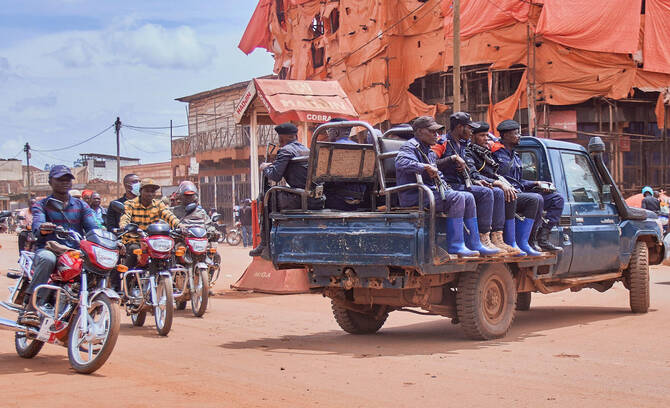
KINSHASA: The death sentences of three US citizens convicted for their role in a failed coup in Democratic Republic of Congo last year have been commuted to life imprisonment, the presidency said, ahead of a visit by the new US senior adviser for Africa.
The Americans were among some 50 people, including US, British, Canadian, Belgian and Congolese citizens, who stood trial last year following the botched attempt to overthrow the government in May.
A total of 37 defendants were sentenced to death by a military court in September, including US citizens Marcel Malanga, Tyler Thompson and Benjamin Zalman-Polun.
All three were found guilty of criminal conspiracy, terrorism and other charges.
They denied any wrongdoing and unsuccessfully appealed against the verdict. But Congo’s justice ministry then proposed a pardon, which the public prosecutor requested from the presidency.
President Felix Tshisekedi on Tuesday signed three orders to commute their sentences to life in prison, his spokesperson Tina Salama said on national television.
“This presidential pardon is a first step that promises major changes in the future,” one of Malanga’s lawyers, Ckiness Ciamba, said by telephone.
Relatives of Malanga and a lawyer for Zalman-Polun did not immediately respond to requests for comment. Thompson’s parents declined to speak on the record.
Marcel Malanga is the son of US-based Congolese politician Christian Malanga, who led the armed men who briefly occupied an office of the presidency in the capital Kinshasa on May 19 before security forces killed him.
Thompson is a friend of Marcel Malanga who played high school football with him in Utah. Both are in their 20s. Zalman-Polun was a business associate of Christian Malanga.
Their sentences were commuted ahead of a trip to Congo by the newly appointed US senior adviser for Africa, Massad Boulos.
Boulos, the father-in-law of US President Donald Trump’s daughter Tiffany, will travel to Congo, Rwanda, Kenya and Uganda from April 3, the State Department said in a statement on Tuesday.
He will seek to advance efforts for peace in east Congo, where a Rwanda-backed rebellion is raging, and promote US private sector investment in the region.


Congo commutes death sentences for US citizens in failed coup
https://arab.news/bf3cy
Congo commutes death sentences for US citizens in failed coup

- The Americans were among some 50 people who stood trial last year
- A total of 37 defendants were sentenced to death by a military court in September


Mystery of CIA’s lost nuclear device haunts Himalayan villagers 60 years on
- Plutonium-fueled spy system was meant to monitor China’s nuclear activity after 1964 atomic tests
- Porter who took part in Nanda Devi mission warned family of ‘danger buried in snow’
NEW DELHI: Porters who helped American intelligence officers carry a nuclear spy system up the precarious slopes of Nanda Devi, India’s second-highest peak, returned home with stories that sent shockwaves through nearby villages, leaving many in fear that still holds six decades later.
A CIA team, working with India’s Intelligence Bureau, planned to install the device in the remote part of the Himalayas to monitor China, but a blizzard forced them to abandon the system before reaching the summit.
When they returned, the device was gone.
The spy system contained a large quantity of highly radioactive plutonium-238 — roughly a third of the amount used in the atomic bomb dropped by the US on the Japanese city of Nagasaki in the closing stages of the Second World War.
“The workers and porters who went with the CIA team in 1965 would tell the story of the nuclear device, and the villagers have been living in fear ever since,” said Narendra Rana from the Lata village near Nanda Devi’s peak.
His father, Dhan Singh Rana, was one of the porters who carried the device during the CIA’s mission in 1965.
“He told me there was a danger buried in the snow,” Rana said. “The villagers fear that as long as the device is buried in the snow, they are safe, but if it bursts, it will contaminate the air and water, and no one will be safe after that.”
During the Sino-Indian tensions in the 1960s, India cooperated with the US in surveillance after China conducted its first nuclear tests in 1964. The Nanda Devi mission was part of this cooperation and was classified for years. It only came under public scrutiny in 1978, when the story was broken by Outsider magazine.
The article caused an uproar in India, with lawmakers demanding the location of the nuclear device be revealed and calling for political accountability. The same year, then Prime Minister Morarji Desai set up a committee to assess whether nuclear material in the area near Nanda Devi could pollute the Ganges River, which originates there.
The Ganges is one of the world’s most crucial freshwater sources, with about 655 million people in India, Nepal, and Bangladesh depending on it for their essential needs.
The committee, chaired by prominent scientists, submitted its report a few months later, dismissing any cause for concerns, and establishing that even in the worst-case scenario of the device’s rupture, the river’s water would not be contaminated.
But for the villagers, the fear that the shell containing radioactive plutonium could break apart never goes away, and peace may only come once it is found.
Many believe the device, trapped within the glacier’s shifting ice, may have moved downhill over time.
Rana’s father told him that the device felt hot when it was carried, and he believed it might have melted its way into the glacier, remaining buried deep inside.
An imposing mass of rock and ice, Nanda Devi at 7,816 m is the second-highest mountain in India after Kangchenjunga.
When a glacier near the mountain burst in 2021, claiming over 200 lives, scientists explained that the disaster was due to global warming, but in nearby villages the incident was initially blamed on a nuclear explosion.
“They feared the device had burst. Those rescuing people were afraid they might die from radiation,” Rana said. “If any noise is heard, if any smoke appears in the sky, we start fearing a leak from the nuclear device.”
The latent fear surfaces whenever natural disasters strike or media coverage puts the missing device back in the spotlight. Most recently, a New York Times article on the CIA mission’s 60th anniversary reignited the unease.
“The apprehensions are genuine. After 1965, Americans came twice to search for the device. The villagers accompanied them, but it could not be found, which remains a concern for the local community,” said Atul Soti, an environmentalist in Joshimath, Uttarakhand, about 50 km from Nanda Devi.
“People are worried. They have repeatedly sought answers from the government, but no clear response has been provided so far. Periodically, the villagers voice their concerns, and they need a definitive government statement on this issue.”
Despite repeated queries whenever media attention arises, Indian officials have not released detailed updates since the Desai-appointed committee submitted its findings.
“The government should issue a white paper to address people’s concerns. The white paper will make it clear about the status of the device, and whether leakage from the device could pollute the Ganges River,” Soti told Arab News.
“The government should be clear. If the government is not reacting, then it further reinforces the fear.”


