

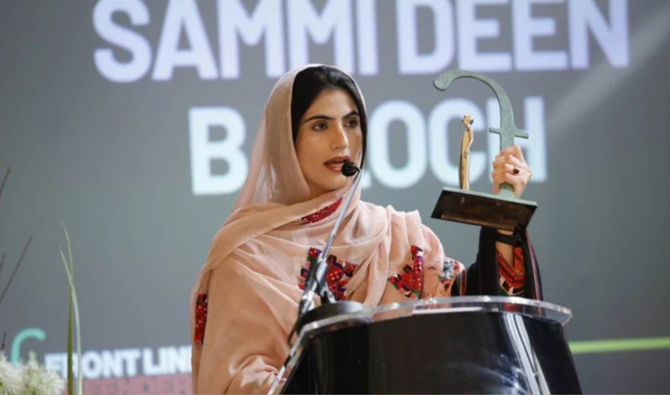
Pakistan province releases prominent Baloch rights activist following outcry

An undated file photo of prominent Pakistani rights defender Sammi Deen Baloch. (X/@SammiBaluch)
Short Url
Updated 02 April 2025
Follow

Pakistan province releases prominent Baloch rights activist following outcry

  • Sammi Deen Baloch was detained by Sindh government for 30 days last week after protesting in Karachi 
  • Over a dozen independent UN experts last week urged Sindh government to release Baloch rights activists

KARACHI: The government in Pakistan’s southern Sindh province this week released prominent rights defender Sammi Deen Baloch, a notification from the provincial home department said, following criticism from members of the civil society and human rights activists. 

Baloch and several others from the Baloch Yakjehti Committee (BYC) group were arrested by Sindh Police last Monday evening and charged with violating a ban imposed on public gatherings after they held a demonstration outside the Karachi Press Club. After a judicial magistrate ordered her release, the Sindh Home Department issued an order detaining her for 30 days under the Maintenance of Public Order (PMO) ordinance, alleging that her presence in public can cause a “grave threat” to people’s safety.

The BYC was protesting against the detention of its leader, Dr. Mahrang Baloch, and some other members who were arrested last month at a protest camp in Quetta, the capital of Pakistan’s southwestern Balochistan province. Three persons had died following clashes between police and protesters, leading both sides to blame each other for the deaths.

“In partial modification to this department’s order of even number dated 25.03.2025 regarding detention under section 3 (1) of the Sindh Maintenance of Public Order Ordinance, 1960, the name of Ms. Semi Din Baloch D/o. Dr. Din Muhammad Baloch is hereby withdrawn with immediate effect,” the home department said in a notification on Tuesday. 

“The Senior Superintendent, Central Prison Karachi is hereby directed to release the above-named detainee if she is not required in any other case or otherwise.”

Baloch’s sister, Mehlab Deen Baloch, confirmed her release in a post on social media platform X on Tuesday. 

“My sister, Sammi Deen, has finally been released, and I cannot express my gratitude enough,” she wrote on X, thanking rights activists, members of the civil society and others for demanding her release. 

Days following her arrest, over a dozen independent UN experts called on the government to release Baloch rights activists. 

The BYC and other Baloch rights activists have organized several large protests in Balochistan and led marches to, and sit-ins in, the Pakistani federal capital, Islamabad, mainly against what they describe as a surge in enforced disappearances and extrajudicial killings in Balochistan. They blame the army and other security forces operating in the province for the alleged crimes. Officials deny the accusations.

Balochistan has also been plagued by enforced disappearances for decades. Families say men are picked up by security forces, disappear often for years, and are sometimes found dead, with no official explanation. Government and security officials deny involvement and say they are working for the uplift of the province through development projects.

Pakistan’s military has a huge presence in the rugged, impoverished region bordering Afghanistan and Iran, where insurgent groups have been fighting for a separate homeland for decades to win a larger share of benefits for the resource-rich province. The military has long run intelligence-based operations against insurgent groups, who have escalated attacks in recent months on the military and nationals from longtime ally China, which is building key projects in the region, including a port at Gwadar.

International rights bodies like Amnesty International and Human Rights Watch as well as opposition political parties have also long highlighted enforced disappearances targeting students, activists, journalists and human rights defenders in Balochistan. The army says many of Balochistan’s so-called disappeared have links to separatists.

Military spokespersons have also variously accused rights movements like the BYC of being “terrorist proxies.”


Pakistan turns to immersive technology to reimagine ancient Gandhara

Updated 12 sec ago
Follow

Pakistan turns to immersive technology to reimagine ancient Gandhara

  • New gallery uses artificial intelligence and 3D visuals to present Buddhist heritage
  • Visitors can explore archaeological sites digitally rather than through static displays

ISLAMABAD: At the Islamabad Museum, history no longer sits quietly behind glass.

In September 2025, the museum introduced Pakistan’s first Digital Immersive Gallery, an experiment in how ancient civilizations can be narrated in the age of artificial intelligence, 3D projection and virtual environments. Developed in collaboration with the Korea Heritage Agency, Pakistan’s Department of Archaeology and the National Heritage and Culture Division, the gallery marks a shift from object-centered displays to experience-based storytelling.

Rather than beginning with labels and timelines, the gallery opens with movement, sound and light. Visitors are invited to step into a reconstructed visual world shaped around Gandhara, one of South Asia’s most influential yet often under-explained civilizations that developed across what is now northwestern Pakistan and parts of eastern Afghanistan and later played a foundational role in the spread of Buddhism beyond the subcontinent.

“We have shown here in our Immersive Gallery how Buddhism flourished here, how it was introduced, how it declined and how it shifted to China, Korea and Japan from here,” Dr. Abdul Ghafoor, Deputy Director at the Department of Archaeology and Museums, told Arab News.

“In order to make it, the content developed by Korea has fully used AI and IT,” he continued. “AI and IT are common in Korea and other developed countries, but we have done it for the first time in Pakistan.”

A picture taken on December 30, 2025, shows women watching Gandhara history at the Digital Immersive Gallery in Islamabad, Pakistan. (AN photo)

Gandhara flourished between the first century BCE and the fifth century CE in this region, which served as a cultural crossroads, shaped by Greek, Central Asian, Persian and South Asian influences.

It was here that artists first began depicting the Buddha in human form, a visual language that later traveled along trade routes to Central Asia, China, Korea and Japan. This transmission of ideas, beliefs and artistic styles forms the core narrative of the immersive gallery.

“Inside the gallery, visitors are drawn into a world of interactive experiences, heritage documentaries they can zoom in and out of, Gandhara artifacts explored up close and photo zones where they can capture themselves against Pakistan’s most iconic sites,” Muhammad Azeem, Project Director at the Department of Archaeology and Museums, said.

A picture taken on December 30, 2025, shows map of Gandhara civilization at the Digital Immersive Gallery in Islamabad, Pakistan. (AN photo)

While Gandhara anchors the gallery, the experience expands outward to place it within a longer and wider historical arc. One section is dedicated to Pakistan’s six UNESCO World Heritage Sites, offering visitors a compressed journey across centuries and regions.

“The main hall takes it further with a fully immersive 3D journey,” Azeem added. “Each seven-minute segment transports audiences to treasures like Mohenjo-Daro, Makli Necropolis, Lahore’s Shalimar Gardens and Sheesh Mahal, and the historic landscapes of Taxila and Takht-i-Bahi, making the past feel vivid, unforgettable and alive.”

For many visitors, the gallery’s appeal lies in how it lowers the barrier to understanding. Instead of long explanatory panels, history is introduced through visuals, motion and guided narrative.

“I saw different historical sites on big screens which was very exciting for me,” Fatima Nawaz, a government employee, said. “After that, I watched a complete documentary in the gallery, which was about 20 minutes long, and in which different historical sites related to Gandhara were highlighted.”

“Overall, it was a very good experience,” she added.

A picture taken on December 30, 2025, shows visitors watching Gandhara history at the Digital Immersive Gallery in Islamabad, Pakistan. (AN photo)

Researchers see the initiative as part of a broader global shift in how museums function.

“My topic is Cultural Heritage Museum, and with this research, I am studying and visiting museums,” Abdul Khaliq, an M.Phil. student at Quaid-e-Azam University, said. “One thing I have not seen in Pakistan before is the shift toward virtual reality.”

He added that it was a good step while calling the immersive gallery “very educational and gives us a lot to learn.”

For the officials involved in the project, the gallery is a starting point rather than a finished model.

“The response we have received from the public in Islamabad makes me feel that this should be done in all the museums, in all four provinces of Pakistan,” Dr. Ghafoor, the senior archaeology department official, said. “This is because it can make it easier to follow history.”

“I think such immersive galleries should be there in all the museums,” he added.