Algeria downs drone near its border with Mali as tensions between them simmer

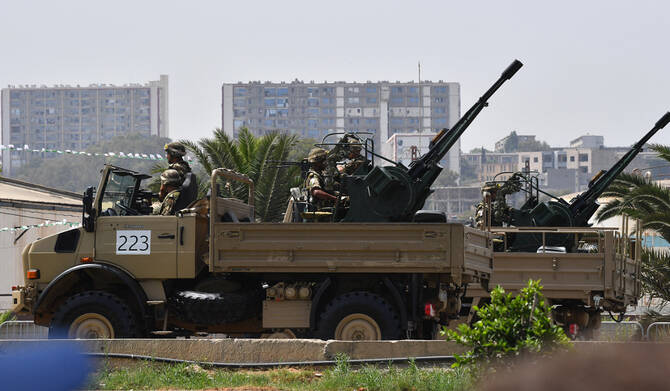
Algerian soldiers take part in a parade in the capital Algiers on July 5, 2022. (AFP)
Short Url
Updated 02 April 2025
Follow

Algeria downs drone near its border with Mali as tensions between them simmer

  • Algeria has denounced the direction that Mali’s new government has taken and its expanded efforts to quash rebellion in historically volatile parts of northern Mali
  • Algeria once served as a key mediator during more than a decade of conflict between Mali’s government and Tuareg rebels

BAMAKO, Mali: Algeria said Tuesday it shot down a military drone near the country’s border with Mali in the first incident of its kind during growing tensions between the two countries governing a vast portion of the Sahara.
The country’s army said in a statement that the armed reconnaissance drone had entered Algerian airspace Monday near Tin Zaouatine, a border town and stronghold for Tuareg separatists opposed to Mali’s government. Mali’s army acknowledged that one of its drones had crashed in the area, but did not confirm whether it was shot down by Algeria.
Rida Lyammouri, a Sahel expert at the Morocco-based Policy Center for the New South, said the shooting down of the drone — rather than issuing a warning — reflected simmering frustrations.
It “confirms the serious tensions between the countries and unwillingness and zero tolerance by Algeria to allow the use of its airspace and territory by Malian forces,” he said.
The incident comes as tensions rise between Algeria and its southern neighbors, including Mali.
Algeria once served as a key mediator during more than a decade of conflict between Mali’s government and Tuareg rebels. But the two countries have grown apart since a military junta staged coups in 2020 and 2021, putting military personnel in charge of the country’s key institutions.
Algeria has denounced the direction that Mali’s new government has taken and its expanded efforts to quash rebellion in historically volatile parts of northern Mali. Afraid of conflict spilling over the border, Algerian officials have denounced Mali’s use of Russian mercenaries and armed drones near Tin Zaouatine, which is divided by the border separating the two countries.
But failures to curb instability in northern Mali have led to the downfall of previous governments and Mali’s Prime Minister Abdoulaye Maiga addressed the issue in a speech at the United Nations General Assembly last year, promising to respond swiftly to violence in the north.
Algeria has one of Africa’s largest militaries and has long considered itself a regional power but military leaders in neighboring Mali and Niger have distanced themselves as they’ve championed autonomy and sought new alliances, including with Russia.
Algeria did not specify who the drone it intercepted belonged to. A spokesperson for Mali’s army declined to comment when asked about Algeria’s alleging that an armed drone had crossed its border, but said the crash didn’t hurt anyone or cause property damage.
Unverified video circulating on social media showed images of an Akinci drone manufactured by Baykar downed in Tin Zaouatine. Mali purchased at least two from the Turkish company last year and has used them against armed separatists as well as fighters linked to Al-Qaeda and the Daesh group.


US military transfers first 150 Daesh detainees from Syria to Iraq

Updated 3 sec ago
Follow

US military transfers first 150 Daesh detainees from Syria to Iraq

  • Transfer follows Syrian government forces taking control of Al-Hol camp from SDF
  • US Central Command says up to 7,000 detainees could be transferred to Iraqi-controlled facilities
AL-HOL, Syria: The US military said Wednesday it has started transferring detainees from the Daesh group being held in northeastern Syria to secure facilities in Iraq.
The move came after Syrian government forces took control of a sprawling camp, housing thousands of mostly women and children, from the US-backed Syrian Democratic Forces, or SDF, which withdrew as part of a ceasefire. Troops on Monday seized a prison in the northeastern town of Shaddadeh, where some Daesh detainees escaped and many were recaptured, state media reported.
The Kurdish-led SDF still controls more than a dozen detention facilities holding around 9,000 Daesh members.
US Central Command said the first transfer involved 150 Daesh members, who were taken from Syria’s northeastern province of Hassakah to “secure locations” in Iraq. The statement said that up to 7,000 detainees could be transferred to Iraqi-controlled facilities.
“Facilitating the orderly and secure transfer of Daesh detainees is critical to preventing a breakout that would pose a direct threat to the United States and regional security,” said Adm. Brad Cooper, CENTCOM commander. He said the transfer was in coordination with regional partners, including Iraq.
US troops and their partner forces detained more than 300 Daesh operatives in Syria and killed over 20 last year, the US military said. An ambush last month by Daesh militants killed two US soldiers and one American civilian interpreter in Syria.
An Iraqi intelligence general told The Associated Press that an agreement was reached with the US to transfer 7,000 detainees from Syria to Iraq. He said that Iraqi authorities received the first batch of 144 detainees Wednesday night, after which they will be transferred in stages by aircraft to Iraqi prisons.
The general, who spoke on condition of anonymity because he was not authorized to speak to the media, said the Daesh members who will be transferred to Iraq are of different nationalities. He said they include around 240 Tunisians, in addition to others from countries including Tajikistan and Kazakhstan and some Syrians.
“They will be interrogated and then put on trial. All of them are commanders in Daesh and are considered highly dangerous,” the general said. He added that in previous years, 3,194 Iraqi detainees and 47 French citizens have been transferred to Iraq.

Regional threat despite battle setbacks

The Daesh group was defeated in Iraq in 2017, and in Syria two years later, but the group’s sleeper cells still carry out deadly attacks in both countries. The SDF played a major role in defeating Daesh.
Tom Barrack, the US envoy to Syria, said in a statement on Tuesday that the SDF’s role as the primary anti-Daesh force “has largely expired, as Damascus is now both willing and positioned to take over security responsibilities.”
He added that the “recent developments show the US actively facilitating this transition, rather than prolonging a separate SDF role.”
Syria’s Foreign Ministry welcomed the transfer of detainees, calling it “an important step to strengthen security and stability.”
Earlier on Wednesday, a convoy of armored vehicles with government forces moved into the Al-Hol camp following two weeks of clashes with the SDF, which appeared closer to merging into the Syrian military, in accordance with government demands.
At its peak in 2019, some 73,000 people were living at Al-Hol. Their number has since declined with some countries repatriating their citizens.
The camp is still home to some 24,000, most of them women and children. They include about 14,500 Syrians and nearly 3,000 Iraqis. Some 6,500 others, many of them loyal Daesh supporters who came from around the world to join the extremist group, are separately held in a highly secured section of the camp.
The Syrian government and the SDF announced a new four-day truce on late Tuesday after a previous ceasefire broke down.