ISLAMABAD: Pakistan saw the highest number of militant attacks during the Muslim holy month of Ramadan in a decade, a think tank reported Monday.
Some militant groups previously paused hostilities for Ramadan, but the country has seen an overall increase in violence in recent years.
The Pak Institute for Peace Studies reported at least 84 attacks during Ramadan, which ended Sunday in Pakistan. It reported 26 attacks during last year’s Ramadan.
The Pakistani Taliban unilaterally ended a ceasefire with the government in November 2022, while the Baloch Liberation Army has developed its capabilities to stage elaborate attacks. Both have contributed to the rise in violence.
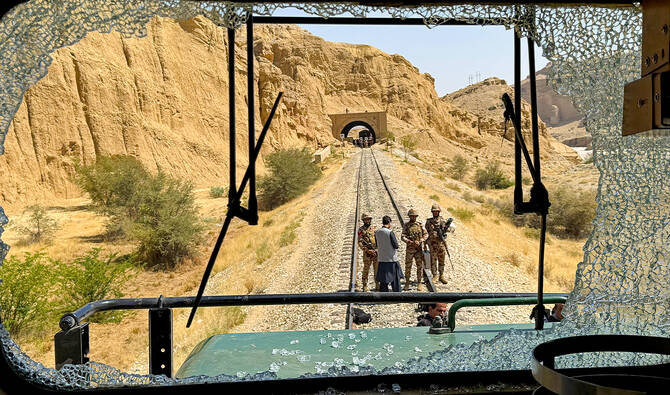
The outlawed BLA was behind a train hijacking on March 11 in the southwest province of Balochistan that killed at least 25 people.
Another think tank, the Pakistan Institute for Conflict and Security Studies, recorded 61 attacks in the first three weeks of Ramadan. There were 60 total attacks in the previous Ramadan, it said.
It also said this was the deadliest Ramadan in a decade for security personnel, with 56 killed between March 2 and March 20.
Abdullah Khan, managing director of the Pakistan Institute for Conflict and Security Studies, cited an overall escalation in militant activity.
“There has been a unification of different groups,” Khan said. “Baloch factions are joining hands. In some areas (of the northwest), the Hafiz Gul Bahadur faction is more lethal than the Pakistani Taliban, it is competing with them.”
He said there was also a revival of banned organizations like Lashkar-e-Islam, which operates from the northwest province of Khyber Pakhtunkhwa.
Pakistan accuses the Taliban government in neighboring Afghanistan of giving haven to such groups, saying militants have thrived since the Taliban returned to power in 2021. Kabul rejects that.
Khan also pointed to intelligence failures, including those that led to the train hijack in Balochistan, and the widening trust gap between the state and the population: “It’s important to get back public support. The public is the first line of defense.”


![]()

Pakistan saw highest number of militant attacks during Ramadan in a decade
Short Url
https://arab.news/5sfbn
Pakistan saw highest number of militant attacks during Ramadan in a decade
- The Pak Institute for Peace Studies reported at least 84 attacks during Ramadan, which ended Sunday in Pakistan
- Some militant groups previously paused hostilities for Ramadan, but overall violence has increased in recent years
Latest updates




© 2026 SAUDI RESEARCH & PUBLISHING COMPANY, All Rights Reserved And subject to Terms of Use Agreement.