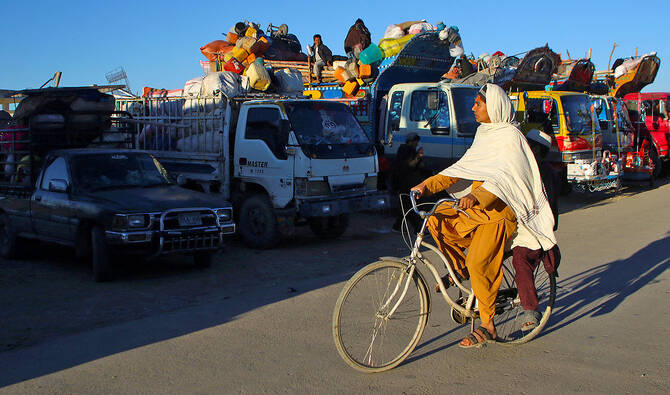
PESHAWAR: Pakistan plans to expel 3 million Afghans from the country this year, as a deadline for them to voluntarily leave the capital and surrounding areas expired on Monday.
It’s the latest phase of a nationwide crackdown launched in October 2023 to expel foreigners living in Pakistan illegally, mostly Afghans. The campaign has drawn fire from rights groups, the Taliban government, and the UN
Arrests and deportations were due to begin April 1 but were pushed back to April 10 because of the Eid Al-Fitr holidays marking the end of Ramadan, according to government documents seen by The Associated Press.
About 845,000 Afghans have left Pakistan over the past 18 months, figures from the International Organization for Migration show.
Pakistan says 3 million Afghans remain. Of these, 1,344,584 hold Proof of Registration cards, while 807,402 have Afghan Citizen Cards. There are a further 1 million Afghans who are in the country illegally because they have no paperwork.
Pakistan said it will make sure that Afghans do not return once deported.
Authorities wanted Afghan Citizen cardholders to leave the capital Islamabad and Rawalpindi city by March 31 and return to Afghanistan voluntarily or be deported.
Those with Proof of Registration can stay in Pakistan until June 30, while Afghans bound for third-country resettlement must also leave Islamabad and Rawalpindi by March 31.
Authorities have said they will work with foreign diplomatic missions to resettle Afghans, failing which they will also be deported from Pakistan.
Tens of thousands of Afghans fled after the Taliban takeover in 2021. They were approved for resettlement in the US through a program that helps people at risk because of their work with the American government, media, aid agencies, and rights groups.
However, President Donald Trump paused US refugee programs in January and 20,000 Afghans are now in limbo.
The Taliban want Afghan refugees to return with dignity
“No Afghan officials to be made part of any committee or formal decision-making process,” one of the documents said about the expulsion plans.
A spokesman for Afghanistan’s Refugee Ministry, Abdul Mutalib Haqqani, told The Associated Press that Pakistan was taking decisions arbitrarily, without involving the UN refugee agency or the Taliban government.
“We have shared our problems with them, stating that unilaterally expelling refugees is neither in their interest nor ours,” said Haqqani. “It is not in their interest because expelling them in this way raises hatred against Pakistan.
“For us, it is natural that managing so many Afghans coming back is a challenge. We have requested they should be deported through a mechanism and mutual understanding so they can return with dignity.”
Two transit stations will be set up in the northwest province of Khyber Pakhtunkhwa to help with deportations. One will be in Nasir Bagh, an area in the Peshawar suburbs. The second will be in the border town of Landi Kotal, some 7 kilometers from the Torkham crossing.
Afghans are unsure of their future in a country they don’t know
It is not clear what will happen to children born in Pakistan to Afghan parents, Afghan couples with different document types, and families where one parent is a Pakistani citizen and the other is Afghan. But officials indicated to the AP that social welfare staff will be on hand to help with such cases.
Omaid Khan, 30, has an Afghan Citizen Card while his wife has Proof of Registration. According to Pakistani government policy, he has to leave but his wife can stay until June 30. Their two children have no documents, including passports or identity cards from either country.
“I am from Paktia province but I have never been there and I am not sure about my future,” he said.
Nazir Ahmed was born in the southwest Pakistani city of Quetta and has never been to Afghanistan. His only connection to the country was through his father, who died in Quetta four years ago.
“How can we go there?” said Ahmed, who is 21. “Few people know us. All our relatives live in Quetta. What will we do if we go there? We appeal to the Pakistani government to give us some time so we can go and find out, at least get some employment.”


![]()

Pakistan plans to expel 3 million Afghans from the country this year
Short Url
https://arab.news/wv2su
Pakistan plans to expel 3 million Afghans from the country this year
- It’s the latest phase of a nationwide crackdown launched to expel foreigners living in Pakistan illegally
- The expulsion campaign has drawn fire from rights groups, the Taliban government and the United Nations
Latest updates


Recommended


© 2026 SAUDI RESEARCH & PUBLISHING COMPANY, All Rights Reserved And subject to Terms of Use Agreement.