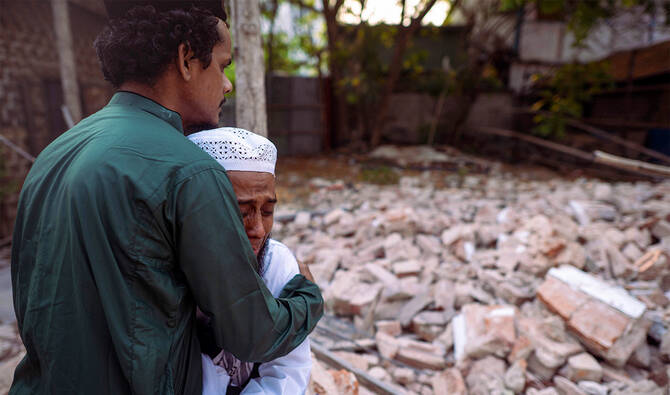
Mandalay: Hundreds of grieving Muslims gathered for Eid prayers in the street in Mandalay on Monday, the death and destruction of Myanmar’s huge earthquake casting a pall of anguish over the occasion.
The watching women were the first to weep. A tear, a sniffle, a cry. The emotion spread among hundreds of men lined up in the street outside two mosques where 20 of their fellow believers died.
Sobs and sighs haunted the air in the gentle morning light. Finally the imam’s voice broke as he prayed for the souls of the dead.
“May Allah grant us all peace,” he intoned. “May all the brothers be free from danger.”
The Muslims of Mandalay gathered for a somber first prayer of the Eid Al-Fitr festival, marking the end of the fasting month of Ramadan, three days after a devastating 7.7-magnitude earthquake struck during Friday prayers.
The minaret of the Sajja South mosque in the Muslim neighborhood of Mawyagiwah crashed to the ground in the quake, killing 14 children and two adults, locals said.
Four more people were killed at the neighboring Sajja North mosque when its tower came down.
Many of the dead were from Win Thiri Aung’s family, close and extended.
“In normal times, it is full of joy when it is Eid,” the 26-year-old told AFP.
“Our hearts are light. This year, we are not like that. All of our minds are with the dead children. I see their faces in my eyes.
“We believe the souls of children and everyone we know who died have reached Paradise. We believe they were blessed deaths,” she said, breaking down.
“It is a test from Allah. It is a reminder from him that we need to turn toward him. So we need to pray more.”
Outside the alley leading to the mosques, the Eid worshippers, many wearing the new clothes that are the traditional gift for the festival, lined up on plastic sheeting laid on the road, held in place by bricks.
A plastic bucket served for ritual washing.
“We have to pray on the road, feeling sadness and loss,” said Aung Myint Hussein, chief administrator of the Sajja North mosque.
“The situation is so dire that it’s hard to express what is happening.
“We were terrified when we saw the destruction. It feels as if our entire lives have been shattered by this series of tremors and fears.”
The pattern of destruction in Myanmar’s second city is variable, with some buildings utterly devastated and a few areas of concentrated damage.
Down the street from the mosques, a resident said six people were killed when a dessert shop collapsed, as well as two people in a restaurant across the road.
But much of the city appeared unharmed, with traffic on the streets, some restaurants reopening and daytime life beginning to return to normal for many.
That is a distant prospect for those who have lost loved ones.
Sandar Aung’s 11-year-old son Htet Myet Aung was seriously injured at Friday prayers and died that evening in hospital.
“I am very sad, my son was very excited for Eid,” the 37-year-old said tearfully. “We got new clothes that we were going to wear together.
“We accept what Allah has planned,” she said. “Allah only does what’s good and what’s right and we have to accept that.”


![]()

Prayers and tears for Eid in Myanmar’s quake-hit Mandalay
Short Url
https://arab.news/c6vb9
Prayers and tears for Eid in Myanmar’s quake-hit Mandalay
- The Muslims of Mandalay gathered for a somber first prayer of the Eid Al-Fitr festival, three days after a devastating 7.7-magnitude earthquake
- The minaret of the Sajja South mosque in the Muslim neighborhood of Mawyagiwah crashed to the ground in the quake, killing 14 children and two adults
Latest updates


© 2026 SAUDI RESEARCH & PUBLISHING COMPANY, All Rights Reserved And subject to Terms of Use Agreement.