

A Venus flytrap wasp? Scientists uncover an ancient insect preserved in amber that snatched its prey

1 / 3
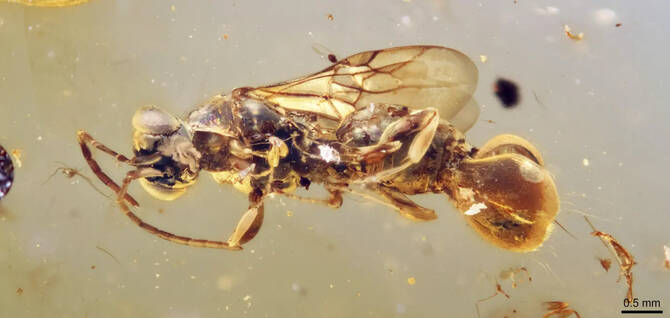
This photograph provided by Qiong Wu in March 2025 shows an ancient wasp, preserved in amber in Myanmar, whose backend resembles a Venus flytrap plant. (Qiong Wu via AP)
2 / 3
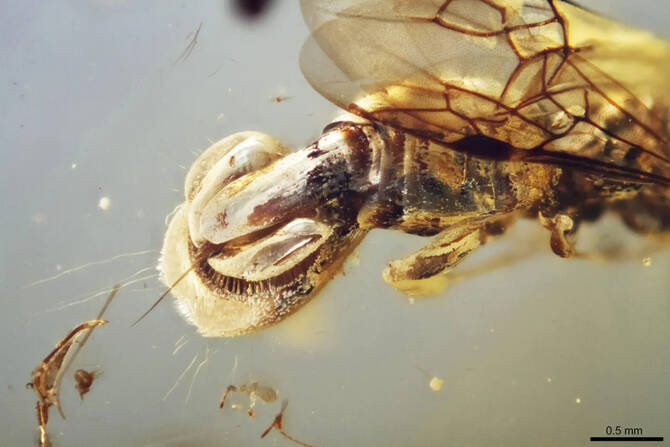
This photograph provided by Qiong Wu in March 2025 shows an ancient wasp, preserved in amber in Myanmar, whose backend resembles a Venus flytrap plant. (Qiong Wu via AP)
3 / 3
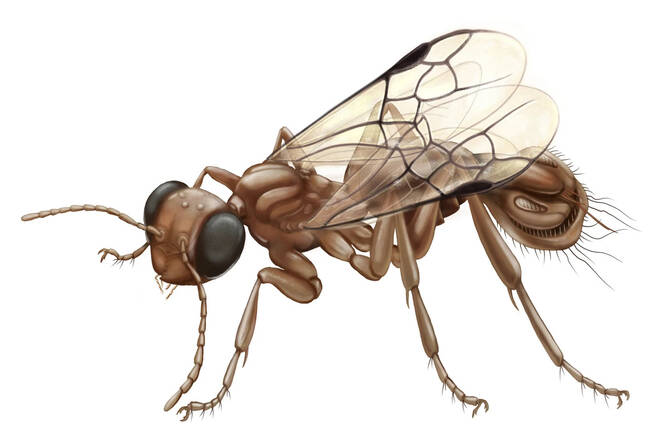
This photograph provided by Qiong Wu in March 2025 shows an ancient wasp, preserved in amber in Myanmar, whose backend resembles a Venus flytrap plant. (Qiong Wu via AP)
Short Url
Updated 31 March 2025
Follow

A Venus flytrap wasp? Scientists uncover an ancient insect preserved in amber that snatched its prey

  • Scientists uncovered over a dozen female wasps preserved in 99-million-year-old amber from the Kachin region in northern Myanmar
  • It’s a playbook adapted by many parasitic wasps, including modern-day cuckoo and bethylid wasps, to exploit insects

NEW YORK: An ancient wasp may have zipped among the dinosaurs, with a body like a Venus flytrap to seize and snatch its prey, a new study says.

The parasitic wasp’s abdomen boasts a set of flappy paddles lined with thin bristles, resembling “a small bear trap attached to the end of it,” said study co-author Lars Vilhelmsen from the Natural History Museum of Denmark.

Scientists uncovered over a dozen female wasps preserved in 99-million-year-old amber from the Kachin region in northern Myanmar. The wasp’s flaps and teeth-like hairs resemble the structure of the carnivorous Venus flytrap plant, which snaps shut to digest unsuspecting insects. But the design of the wasp’s getup made scientists think its trap was designed to cushion, not crush.

Instead, researchers suggested the flytrap-like structure was used to hold a wriggly insect still while the wasp laid an egg, depositing a baby wasp to feed on and drain its new host.

It’s a playbook adapted by many parasitic wasps, including modern-day cuckoo and bethylid wasps, to exploit insects. But no known wasp or any other insect does so with bizarre flaps quite like this one.

“I’ve seen a lot of strange insects, but this has to be one of the most peculiar-looking ones I’ve seen in a while,” said entomologist Lynn Kimsey from the University of California, Davis, who was not involved with the research.

Scientists named the new wasp Sirenobethylus charybdis, partly for the sea monster from Greek mythology that stirred up wild whirlpools by swallowing and expelling water.

The new study was published in the journal BMC Biology and included researchers from Capital Normal University and the Beijing Xiachong Amber Museum in China.

It’s unclear when the wasp went extinct. Studying unusual insects like this one can help scientists understand what insects are capable of and how different they can be.

“We tend to think that the cool things are only found today,” said Gabriel Melo, a wasp expert at the Federal University of Paraná in Brazil, who had no role in the study. “But when we have this opportunity, we see that many really exceptional, odd things already happened.”


Vietnam police find frozen tiger bodies, arrest two men

Updated 14 February 2026
Follow

Vietnam police find frozen tiger bodies, arrest two men

Vietnamese police have found two dead tigers inside freezers in a man’s basement, arresting him and another for illicit trade in the endangered animal, the force said Saturday.
The Southeast Asian country is a consumption hub and popular trading route for illegal animal products, including tiger bones which are used in traditional medicine.
Police in Thanh Hoa province, south of the capital Hanoi, said they had found the frozen bodies ot two adult tigers, weighing about 400 kilograms (882 pounds) in total, in the basement of 52-year-old man Hoang Dinh Dat.
In a statement posted online, police said the man told officers he had bought the animals for two billion dong ($77,000), identifying the seller as 31-year-old Nguyen Doan Son.
Both had been arrested earlier this week, police said.
According to the statement, the buyer had equipment to produce so-called tiger bone glue, a sticky substance believed to heal skeletal ailments.
Tigers used to roam Vietnam’s forests, but have now disappeared almost entirely.