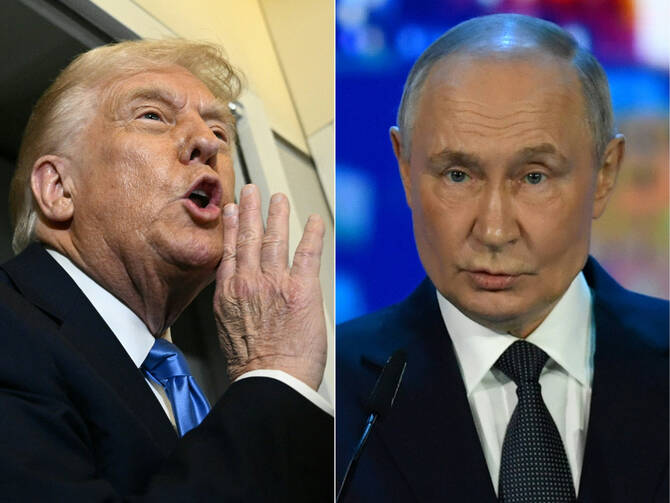

ABOARD AIR FORCE ONE: US President Donald Trump said on Sunday he was “pissed off” at Russian President Vladimir Putin and will impose secondary tariffs of 25 percent to 50 percent on buyers of Russian oil if he feels Moscow is blocking his efforts to end the war in Ukraine.
Trump told NBC News he was very angry after Putin last week criticized the credibility of Ukrainian President Volodymyr Zelensky’s leadership, the television network reported, citing a telephone interview early on Sunday.
Since taking office in January, Trump has adopted a more conciliatory stance toward Russia that has left Western allies wary as he tries to broker an end to Moscow’s three-year-old war in Ukraine.
His sharp comments about Putin on Sunday reflect his growing frustration about the lack of movement on a ceasefire.
“If Russia and I are unable to make a deal on stopping the bloodshed in Ukraine, and if I think it was Russia’s fault ... I am going to put secondary tariffs on oil, on all oil coming out of Russia,” Trump said.
“That would be, that if you buy oil from Russia, you can’t do business in the United States,” Trump said. “There will be a 25 percent tariff on all oil, a 25- to 50-point tariff on all oil.”
Trump later reiterated to reporters he was disappointed with Putin but added: “I think we are making progress, step by step.”
Trump said he could impose the new trade measures within a month.
There was no immediate reaction from Moscow. Russia has called numerous Western sanctions and restrictions “illegal” and designed for the West to take economic advantage in its rivalry with Russia.
Trump, who spent the weekend at his estate in Palm Beach, Florida, told NBC News he planned to speak with Putin this week. The two leaders have had two publicly announced telephone calls in recent months but may have had more contacts, the Kremlin said in video footage last week.
The White House had no immediate comment on when the call would take place, or if Trump would also speak with Zelensky.
Trump has focused heavily on ending what he calls a “ridiculous” war, which began when Russia invaded Ukraine in February 2022, but has made little progress.
Putin on Friday suggested Ukraine could be placed under a form of temporary administration to allow for new elections that could push out Zelensky.
Trump, who himself has called for new elections in Ukraine and denounced Zelensky as a dictator, said Putin knows he is angry with him. But Trump added he had “a very good relationship with him” and “the anger dissipates quickly ... if he does the right thing.”
Growing pressure to end war
Trump’s comments followed a day of meetings and golf with Finnish President Alexander Stubb on Saturday, during Stubb’s surprise visit to Florida.
Stubb’s office on Sunday said he told Trump a deadline needs to be set for establishing a Russia-Ukraine ceasefire to make it happen and suggested April 20 since Trump would have been in office then for three months.
US officials have been separately pushing Kyiv to accept a critical minerals agreement, a summary of which suggested the US was demanding all Ukraine’s natural resources income for years. Zelensky has said Kyiv’s lawyers need to review the draft before he can say more about the US offer.
Trump told reporters on Air Force One he thought Zelensky was “trying to back out of the rare earth deal.... if he’s looking to renegotiate the deal, he’s got big problems.” Trump also told reporters that Ukraine would never be part of NATO.
Trump’s latest tariff threats would add to the pain already facing China, India and other countries through trade measures imposed during his first two months in office, including duties on steel, aluminum and cars. More duties on imports from the countries with the largest trade surpluses are slated to be announced on Wednesday.
William Reinsch, a former senior Commerce Department official now at the Center for Strategic and International Studies, said the haphazard way Trump was announcing and threatening tariffs leaves many questions unanswered, including how US officials could trace and prove which countries were buying Russian oil.
Trump set the stage for Sunday’s news with a 25 percent secondary tariff imposed last week on US imports from any country buying oil or gas from Venezuela.
His remarks to NBC suggest he could take similar action against US imports from countries that buy oil from Russia, a move that could hit China and India particularly hard.
The US has not imported any Russian barrels of crude oil since April 2022, according to US government data. Before that, US refiners bought inconsistent volumes of Russian oil, with a high of 98.1 million barrels in 2010 and low of 6.6 million in 2014, according to a review of EIA data since 2000.
India has surpassed China to become the biggest buyer of seaborne Russian crude, which comprised about 35 percent of India’s total crude imports in 2024.
Trump on Sunday also said he could hit buyers of Iranian oil with secondary sanctions if Tehran did not reach an agreement to end their nuclear weapons program.