Moscow and Washington have started talks on joint rare earth metals and other projects in Russia, Russia’s special envoy on international economic and investment cooperation told the Izvestia media outlet in remarks published on Monday.
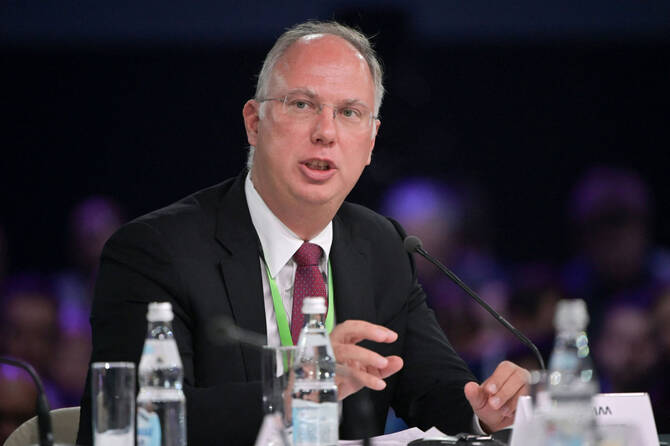
“Rare earth metals are an important area for cooperation, and, of course, we have begun discussions on various rare earth metals and (other) projects in Russia,” Kirill Dmitriev, who is also the CEO of the Russian Direct Investment Fund, told Izvestia.
Putin, following negotiations between the US and Ukraine over a draft minerals deal, has offered the US, under a future economic deal, to jointly explore Russia’s rare earth metal deposits.
Dmitriev, who was part of Russia’s negotiating team at talks with US officials in Saudi Arabia in February, said some companies have already shown interest in the projects. He did not name any companies and did not reveal further details.
Izvestia reported the cooperation may be further discussed at the next round of Russia-US talks that may take place in mid-April in Saudi Arabia.
Rare earths and other critical metals, essential for high-tech industries, have gained global attention in recent months as US President Donald Trump spurred efforts to counter China’s dominance in the sector.

Russia, US start talks on rare earth metals projects in Russia, RIA agency reports
Short Url
https://arab.news/jtsxb
Russia, US start talks on rare earth metals projects in Russia, RIA agency reports
Mistrial declared in the case of Stanford students charged after pro-Palestinian protests in 2024
SAN FRANCISCO, US: A judge declared a mistrial Friday in the case of five current and former Stanford University students charged after pro-Palestinian protests in 2024, when they barricaded themselves inside the university president and provost executive offices.
The trial in Santa Clara County was a rare instance of demonstrators facing felony charges from protests over the Israel-Hamas war that roiled campuses across the country. The two sides argued over free speech, lawful dissent and crime during the three-week proceedings.
The jury voted 9 to 3 to convict on a felony charge of vandalism and 8 to 4 to convict on a felony charge of conspiracy to trespass. After deliberating for five days, jurors said they could not reach a verdict.
Judge Hanley Chew asked each one if more time deliberating would help break the impasse, and all answered, “No.”
“It appears that this jury is hopelessly deadlocked, and I’m now declaring a mistrial in counts one and two,” Chen said. He then dismissed the jurors.
Demonstrators barricaded themselves inside the offices for several hours on June 5, 2024, the last day of spring classes at the university.
Prosecutors said the defendants spray-painted the building, broke windows and furniture, disabled security cameras and splattered a red liquid described as fake blood on items throughout the offices.
Defense attorneys said the protest was protected speech and there was insufficient evidence of an intent to damage the property. They also said the students wore protective gear and barricaded the offices out of fear of being injured by police and campus security.
If convicted, the defendants would have faced up to three years in prison and been obligated to pay restitution of over $300,000.
Santa Clara County District Attorney Jeff Rosen said he would pursue a new trial.
“This case is about a group of people who destroyed someone else’s property and caused hundreds of thousands of dollars in damage,” Rosen said in a statement. “That is against the law and that is why we will retry the case.”
As the mistrial was announced, the students, some wearing kaffiyehs, sat on a bench in the courtroom and did not show a visible reaction.
“The District Attorney’s Office had Stanford University supporting them and other multibillion-dollar institutions behind them, and even then the district attorney was unable to convict us,” Germán González, who was a sophomore at Stanford when he was arrested, told The Associated Press by phone later. “No matter what happens, we will continue to fight tooth and nail for as long as possible, because at the end of the day, this is for Palestine.”
Authorities initially arrested and charged 12 people in the case, but one pleaded no contest under an agreement that allows some young people to have their cases dismissed and records sealed if they successfully complete probation.
He testified for the prosecution, leading to a grand jury indictment of the others in October of the others. Six of those accepted pretrial plea deals or diversion programs, and the remaining five pleaded not guilty and sought a jury trial.
Protests sprung up on campuses across the country over the Israel-Hamas conflict, with students setting up camps and demanding their universities stop doing business with Israel or companies that support its war efforts against Hamas.
About 3,200 people were arrested in 2024 nationwide. While some colleges ended demonstrations by striking deals with students or simply waited them out, others called in police. Most criminal charges were ultimately dismissed.
The trial in Santa Clara County was a rare instance of demonstrators facing felony charges from protests over the Israel-Hamas war that roiled campuses across the country. The two sides argued over free speech, lawful dissent and crime during the three-week proceedings.
The jury voted 9 to 3 to convict on a felony charge of vandalism and 8 to 4 to convict on a felony charge of conspiracy to trespass. After deliberating for five days, jurors said they could not reach a verdict.
Judge Hanley Chew asked each one if more time deliberating would help break the impasse, and all answered, “No.”
“It appears that this jury is hopelessly deadlocked, and I’m now declaring a mistrial in counts one and two,” Chen said. He then dismissed the jurors.
Demonstrators barricaded themselves inside the offices for several hours on June 5, 2024, the last day of spring classes at the university.
Prosecutors said the defendants spray-painted the building, broke windows and furniture, disabled security cameras and splattered a red liquid described as fake blood on items throughout the offices.
Defense attorneys said the protest was protected speech and there was insufficient evidence of an intent to damage the property. They also said the students wore protective gear and barricaded the offices out of fear of being injured by police and campus security.
If convicted, the defendants would have faced up to three years in prison and been obligated to pay restitution of over $300,000.
Santa Clara County District Attorney Jeff Rosen said he would pursue a new trial.
“This case is about a group of people who destroyed someone else’s property and caused hundreds of thousands of dollars in damage,” Rosen said in a statement. “That is against the law and that is why we will retry the case.”
As the mistrial was announced, the students, some wearing kaffiyehs, sat on a bench in the courtroom and did not show a visible reaction.
“The District Attorney’s Office had Stanford University supporting them and other multibillion-dollar institutions behind them, and even then the district attorney was unable to convict us,” Germán González, who was a sophomore at Stanford when he was arrested, told The Associated Press by phone later. “No matter what happens, we will continue to fight tooth and nail for as long as possible, because at the end of the day, this is for Palestine.”
Authorities initially arrested and charged 12 people in the case, but one pleaded no contest under an agreement that allows some young people to have their cases dismissed and records sealed if they successfully complete probation.
He testified for the prosecution, leading to a grand jury indictment of the others in October of the others. Six of those accepted pretrial plea deals or diversion programs, and the remaining five pleaded not guilty and sought a jury trial.
Protests sprung up on campuses across the country over the Israel-Hamas conflict, with students setting up camps and demanding their universities stop doing business with Israel or companies that support its war efforts against Hamas.
About 3,200 people were arrested in 2024 nationwide. While some colleges ended demonstrations by striking deals with students or simply waited them out, others called in police. Most criminal charges were ultimately dismissed.
© 2026 SAUDI RESEARCH & PUBLISHING COMPANY, All Rights Reserved And subject to Terms of Use Agreement.


