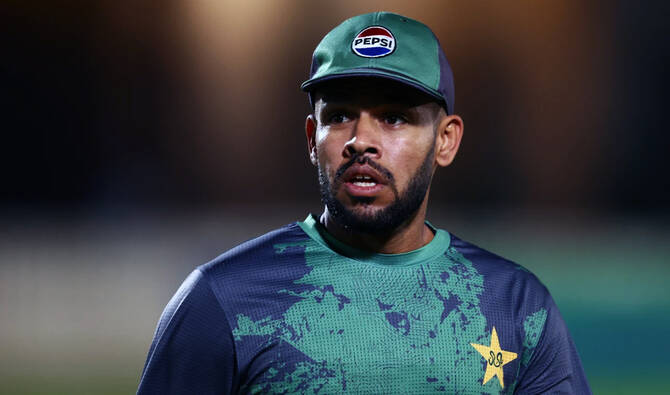
ISLAMABAD: Pakistan have ruled out opener Usman Khan from the second one-day international (ODI) against New Zealand owing to a hamstring injury, the Pakistan Cricket Board (PCB) said on Sunday.
The 29-year-old opening batter sustained the injury while fielding during his side’s first ODI against New Zealand at the Mclean Park in Napier on Friday.
“The MRI scan confirmed a Low-Grade tear, making Usman unavailable for second ODI scheduled on 2 April at Seddon Park in Hamilton,” the PCB said.
New Zealand eased to a 73-run win over Pakistan in the first ODI after Mark Chapman struck a sublime century and Nathan Smith claimed four wickets.
The recalled Babar Azam top-scored for Pakistan with 78 off 83 balls but it was his dismissal that started the rot.
Both teams feature numerous changes to those who played out a five-match T20 series, won 4-1 by New Zealand.

Pakistan’s Usman Khan ruled out of second ODI against New Zealand
https://arab.news/rvwy9
Pakistan’s Usman Khan ruled out of second ODI against New Zealand
- The 29-year-old opening batter sustained a hamstring injury while fielding in the first match against New Zealand on Friday
- New Zealand eased to a 73-run win over Pakistan after Mark Chapman struck a sublime century, Nathan Smith claimed four wickets
Pakistan Airports Authority reports ‘historic’ twin-engine aircraft landing in Lahore
- Twin-engine aircraft are usually larger, heavier and require better airport infrastructure, navigation systems to land
- Pakistan Airports Authority says landing reflects its commitment to enhance aviation sector, strengthen infrastructure
ISLAMABAD: The Pakistan Airports Authority (PAA) announced on Saturday that the New General Aviation Aerodrome achieved a significant milestone when it handled the landing of a twin-engine aircraft.
A twin-engine aircraft has two engines that provide it redundancy and increased performance compared to single-engine counterparts. These aircraft range from small twin-engine propeller planes to large commercial jetliners. The presence of multiple engines enhances safety by allowing the aircraft to continue flying in the event of an engine failure.
However, twin-engine aircraft are usually larger, heavier and more complex than single-engine planes. They require advanced airport infrastructure such as better runways, navigation systems and air traffic coordination.
“The New General Aviation Aerodrome, Lahore achieved another significant operational milestone today with the successful landing of a twin-engine aircraft, following the recent arrival of a single-engine aircraft,” the PAA said in a statement.
It said the flight was also boarded by Air Vice Marshal Zeeshan Saeed, the director general of the PAA. The move reflected “strong institutional confidence” in the aerodrome’s safety standards, operational capability, and overall readiness, it added.
“The landing was conducted with exceptional precision and professionalism, demonstrating the aerodrome’s robust operational framework, technical preparedness, and effective airside coordination in accordance with contemporary aviation requirements,” the PAA said.
It said the landing represented a “major advancement” in Pakistan’s general aviation sector and underscores the PAA’s commitment to enhancing regional aviation capacity, strengthening infrastructure and promoting excellence in aviation development.


