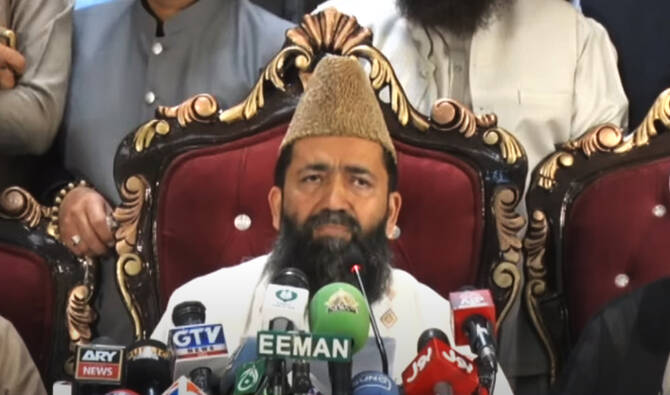
ISLAMABAD: The crescent for the month of Shawwal was sighted in Pakistan on Sunday and consequently, Eid Al-Fitr will be celebrated on Monday, March 31, the Central Ruet-e-Hilal Committee announced.
The three-day Eid Al-Fitr festival starts on the first day of the month of Shawwal in the Islamic lunar calendar. The festival marks the end of the holy fasting month of Ramadan.
The Central Ruet-e-Hilal Committee, the country’s apex moon-sighting body, met in Islamabad under the chairmanship of Maulana Abdul Khabir Azad for the sighting of the Shawwal crescent.
“[We] received testimonies of the sighting of the Shawwal moon from various areas of Pakistan today, which include Lahore, Bahawalpur, Islamabad, Sheikhupura, Kasur and other areas,” Maulana Azad announced at a press conference.
“Hence, it was decided with consensus that the first of Shawwal will be on March 31, Monday.”
Pakistan’s government this week announced a three-day holiday from Mar. 31 till Apr. 2 on account of the Muslim festival of Eid Al-Fitr.
The Shawwal moon was sighted in Saudi Arabia on Saturday, marking the end of the month of Ramadan. Eid Al-Fitr is being celebrated in the Kingdom, United Arab Emirates and other Middle Eastern countries today.

Shawwal crescent sighted, Pakistan to mark Eid Al-Fitr today
https://arab.news/9sn9j
Shawwal crescent sighted, Pakistan to mark Eid Al-Fitr today
- Eid Al-Fitr begins on the first day of the month of Shawwal in the Islamic lunar calendar
- It is one of two major Muslim festivals that marks end of holy fasting month of Ramadan
EU, Pakistan sign €60 million loan agreement for clean drinking water in Karachi
- Project will finance rehabilitation, construction of water treatment facilities in Karachi city, says European Investment Bank
- As per a report in 2023, 90 percent of water samples collected from various places in city was deemed unfit for drinking
ISLAMABAD: The European Investment Bank (EIB) and Pakistan’s government on Wednesday signed a €60 million loan agreement, the first between the two sides in a decade, to support the delivery of clean drinking water in Karachi, the EU said in a statement.
The Karachi Water Infrastructure Framework, approved in August this year by the EIB, will finance the rehabilitation and construction of water treatment facilities in Pakistan’s most populous city of Karachi to increase safe water supply and improve water security.
The agreement was signed between the two sides at the sidelines of the 15th Pak-EU Joint Commission in Brussels, state broadcaster Radio Pakistan reported.
“Today, the @EIB signed its first loan agreement with Pakistan in a decade: a €60 million loan supporting the delivery of clean drinking water for #Karachi,” the EU said on social media platform X.
Radio Pakistan said the agreement reflects Pakistan’s commitment to modernize essential urban services and promote climate-resilient infrastructure.
“The declaration demonstrates the continued momentum in Pakistan-EU cooperation and highlights shared priorities in sustainable development, public service delivery, and climate and environmental resilience,” it said.
Karachi has a chronic clean drinking water problem. As per a Karachi Water and Sewerage Corporation (KWSC) study conducted in 2023, 90 percent of water from samples collected from various places in the city was deemed unsafe for drinking purposes, contaminated with E. coli, coliform bacteria, and other harmful pathogens.
The problem has forced most residents of the city to get their water through drilled motor-operated wells (known as ‘bores’), even as groundwater in the coastal city tends to be salty and unfit for human consumption.
Other options for residents include either buying unfiltered water from private water tanker operators, who fill up at a network of legal and illegal water hydrants across the city, or buying it from reverse osmosis plants that they visit to fill up bottles or have delivered to their homes.
The EU provides Pakistan about €100 million annually in grants for development and cooperation. This includes efforts to achieve green inclusive growth, increase education and employment skills, promote good governance, human rights, rule of law and ensure sustainable management of natural resources.