

Pakistan’s Punjab to deploy over 47,000 police personnel for security on Eid Al-Fitr

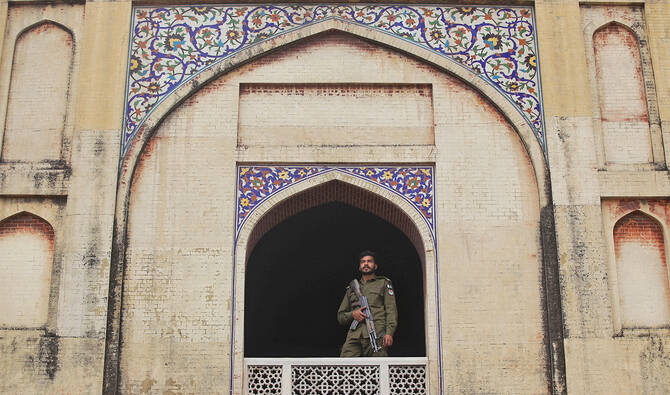
A police officer stands guard from the window of the Mughal era Wazir Khan mosque, as people attend Friday prayers during the fasting month of Ramadan in Lahore, Pakistan on May 17, 2019. (REUTERS/File)
Short Url
Updated 30 March 2025
Follow

Pakistan’s Punjab to deploy over 47,000 police personnel for security on Eid Al-Fitr

  • Eid-Al-Fitr is widely expected to take place in Pakistan on Monday, subject to sighting of the moon
  • Attacks during Eid are rare in Pakistan, however, country has seen surge in militant attacks recently 

ISLAMABAD: Over 47,000 police personnel will be deployed across Pakistan’s eastern Punjab province during the Eid Al-Fitr holidays to ensure security for its citizens, a statement from the provincial police said on Sunday. 

Eid Al-Fitr is widely expected to take place in Pakistan on Monday, subject to the sighting of the moon. The three-day holiday marks the end of Ramadan, Islam’s holy month of fasting.

Though attacks during Eid are rare in Pakistan, the country has seen a surge in militant attacks in its western provinces of Khyber Pakhtunkhwa and Balochistan that border Afghanistan in recent months. 

“More than 47,000 officers and personnel will be deployed for more than 29,000 Eid gatherings across the province on Eid-Al-Fitr,” Punjab Police wrote on social media platform X. 

“Mosques, imambargahs, markets and important places will be continuously monitored with CCTV cameras,” it added. 

It said over 21,000 officers and personnel, including women cops, will be deployed at markets and important places across the province on the eve of Eid. 

The statement said regional police officers (RPOs) and district police officers (DPOs) will monitor security arrangements during the three-day Muslim holiday. 

“Strict action will be taken against miscreants harassing women and families,” Punjab Police warned. “One-wheeling, aerial firing, hooliganism and kite flying are not allowed.”

Separately, Islamabad Police said it would deploy over 3,500 police personnel in the capital during Eid Al-Fitr for security arrangements. 

It said over 500 traffic officials will manage the smooth flow of traffic in the city during the holidays. 


Pakistan has ruled out military operation in northwestern Tirah Valley

Updated 4 sec ago
Follow

Pakistan has ruled out military operation in northwestern Tirah Valley

  • Residents in northwestern Tirah Valley fled their homes this month fearing a military operation against militants
  • Defense minister says army conducting intelligence-based operations in area, residents’ migration “routine” practice

Islamabad: Defense Minister Khawaja Asif on Tuesday clarified that the military was not conducting a military operation in the northwestern Tirah Valley, saying that the ongoing residents’ migration from the area was a routine practice that has been going on for several years. 

The defense minister’s clarification came as residents of Tirah Valley in Pakistan’s northwestern Khyber Pakhtunkhwa (KP) province bordering Afghanistan fled their homes this month, fearing a planned military operation by the army against militants, particularly the Tehreek-e-Taliban Pakistan (TTP) group. 

Pakistan’s information ministry on Sunday issued a clarification that the armed forces were not involved in the “depopulation” of the valley. It pointed to a notification from the provincial Khyber Pakhtunkhwa Relief, Rehabilitation and Resettlement Department in December which demanded the release of funds, reportedly Rs4 billion [$14.24 million], for the voluntary movement of people from Tirah Valley. 

Speaking to reporters at a news conference alongside Information Minister Attaullah Tarar and Special Assistant to the PM for Information and KP Affairs Ikhtiar Wali Khan, Asif said the last military operation in the area was conducted several years ago. He said the military had decided that intelligence-based operations (IBOs) were more effective than military operations as they resulted in lower civilian casualties. 

“So over a long period of time, the army gave up [military] operation in favor of IBOs,” Asif said. “For many years this practice has been continuing. Hence, there is no question of an operation there.”

The defense minister described the migration of residents from Tirah Valley as a “routine” practice due to the harsh cold. 

He criticized the provincial government, led by the Pakistan Tehreek-e-Insaf (PTI) party for not serving the people of the area, accusing it of not building any schools, hospitals, or police stations in Tirah Valley.

Asif said around 400-500 TTP members lived in the valley with their families, alleging that hemp was being harvested there on over 12,000 acres of land. He said that while hemp is also used for medicinal and construction purposes, its dividends were going to militants and politicians. 

“All of this hemp is harvested there and the dividends from it either go to the people associated with politics or the TTP,” the minister said.

“We have initiated the process to stop this so that the people benefit from this harvest and so that schools and hospitals are constructed there.”

The minister said that a district-level jirga or tribal council met representatives of the KP government on Dec. 11, 24 and 31 to decide matters related to the residents’ migration in the area. 

Holding up the KP Relief, Rehabilitation and Resettlement Department notification, Asif said:

“In the presence of this notification, in the presence of this tribal council and in the presence of all of these things, where do you see the army?“

The minister accused the provincial government of deflecting its “failures” in the province to the armed forces or to a military operation that did not exist. 

The migration has exposed tensions between the provincial government and the military establishment over the use of force in the region.

KP Law Minister Aftab Alam Afridi said earlier this month that the provincial government will not allow a military operation to take place in the area, arguing that past military campaigns had failed to deliver lasting stability.
