The science behind the powerful earthquake in Myanmar and Thailand

Short Url
Updated 30 March 2025
Follow

The science behind the powerful earthquake in Myanmar and Thailand

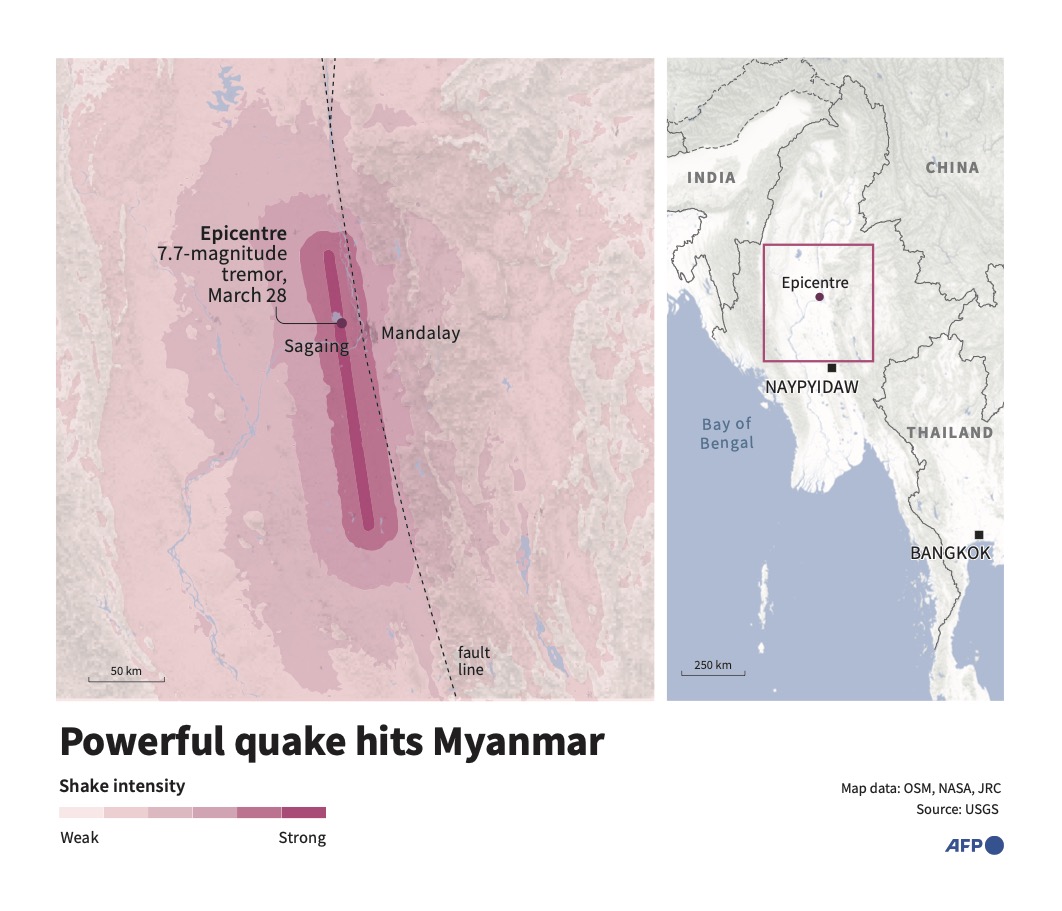
SINGAPORE: A powerful earthquake of magnitude 7.7 centered in the Sagaing region near the Myanmar city of Mandalay caused extensive damage in that country and also shook neighboring Thailand on Friday.

How vulnerable is Myanmar to earthquakes?

Myanmar lies on the boundary between two tectonic plates and is one of the world’s most seismically active countries, although large and destructive earthquakes have been relatively rare in the Sagaing region.

“The plate boundary between the India Plate and Eurasia Plate runs approximately north-south, cutting through the middle of the country,” said Joanna Faure Walker, a professor and earthquake expert at University College London.
She said the plates move past each other horizontally at different speeds. While this causes “strike slip” quakes that are normally less powerful than those seen in “subduction zones” like Sumatra, where one plate slides under another, they can still reach magnitudes of 7 to 8.
Why was Friday’s quake so damaging?
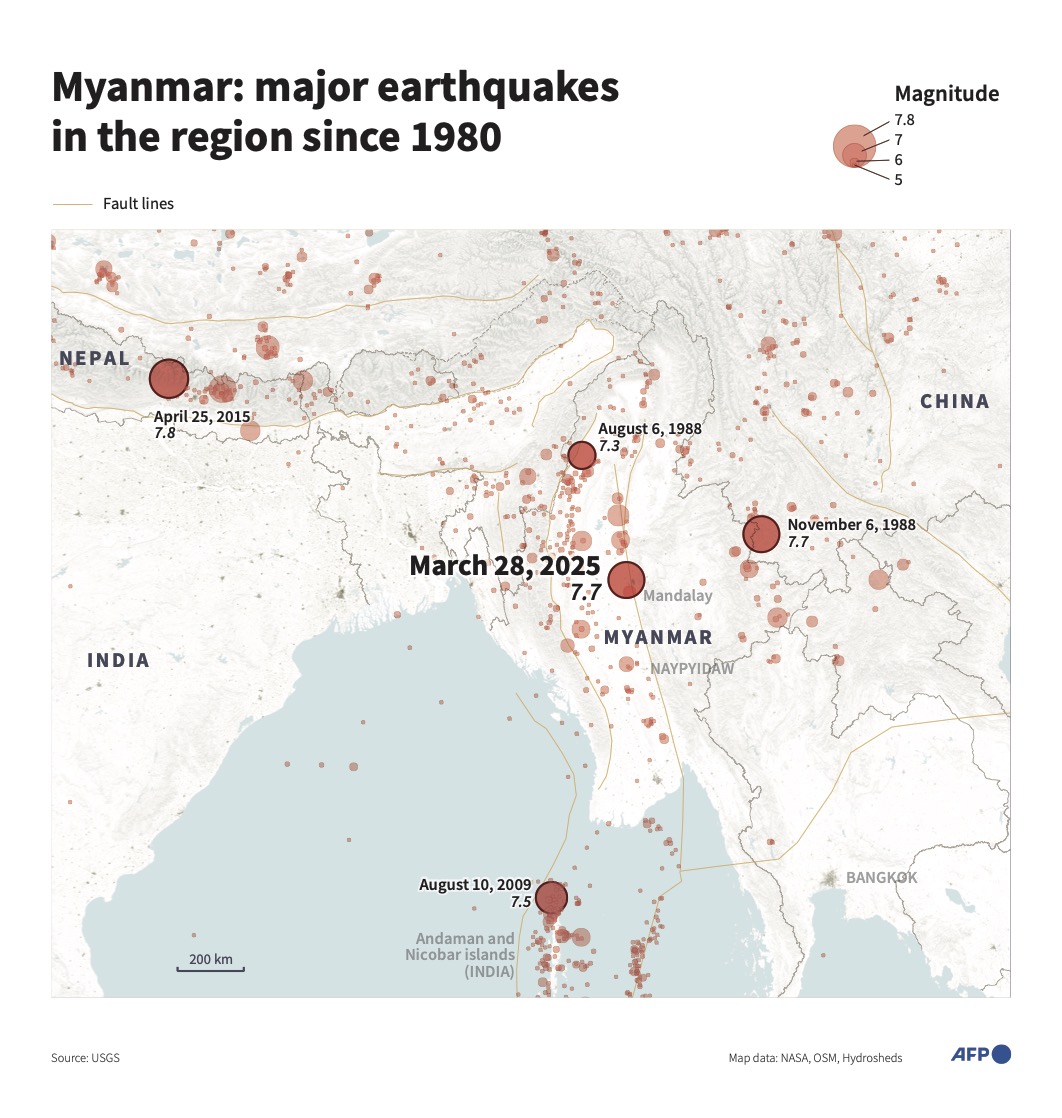
Sagaing has been hit by several quakes in recent years, with a 6.8 magnitude event causing at least 26 deaths and dozens of injuries in late 2012.
But Friday’s event was “probably the biggest” to hit Myanmar’s mainland in three quarters of a century, said Bill McGuire, another earthquake expert at UCL.
Roger Musson, honorary research fellow at the British Geological Survey, told Reuters that the shallow depth of the quake meant the damage would be more severe. The quake’s epicenter was at a depth of just 10 km (6.2 miles), according to the United States Geological Survey.
“This is very damaging because it has occurred at a shallow depth, so the shockwaves are not dissipated as they go from the focus of the earthquake up to the surface. The buildings received the full force of the shaking.”
“It’s important not to be focused on epicenters because the seismic waves don’t radiate out from the epicenter — they radiate out from the whole line of the fault,” he added.
How prepared was Myanmar?

The USGS Earthquake Hazards Program said on Friday that fatalities could be between 10,000 and 100,000 people, and the economic impact could be as high as 70 percent of Myanmar’s GDP.
Musson said such forecasts are based on data from past earthquakes and on Myanmar’s size, location and overall quake readiness.
The relative rarity of large seismic events in the Sagaing region — which is close to heavily populated Mandalay — means that infrastructure had not been built to withstand them. That means the damage could end up being far worse.
Musson said that the last major quake to hit the region was in 1956, and homes are unlikely to have been built to withstand seismic forces as powerful as those that hit on Friday.
“Most of the seismicity in Myanmar is further to the west whereas this is running down the center of the country,” he said.


94 million need cataract surgery, but access lacking: WHO

A Somali patient undergoes free cataract surgery at Al Nuur eye Hospital in Mogadishu, on February 16, 2015. (AFP)
Updated 6 sec ago
Follow

94 million need cataract surgery, but access lacking: WHO

  • Of the 94 million affected, fewer than 20 percent are blind, while the rest suffer from impaired vision

GENEVA: More than 94 million people suffer from cataracts, but half of them do not have access to the surgery needed to fix it, the World Health Organization said Wednesday.
Cataracts — the clouding of the eye’s lens that causes blurred vision and can lead to blindness — are on the rise as populations get older, with age being the main risk factor.
“Cataract surgery — a simple, 15-minute procedure — is one of the most cost-effective medical procedures, providing immediate and lasting restoration of sight,” the WHO said.
It is one of the most frequently performed surgeries undertaken in high-income countries.
However, “half of the world’s population in need of cataract surgery don’t have access to it,” said Stuart Keel, the UN health agency’s technical lead for eye care.
The situation is worst in the WHO’s Africa region, where three in four people needing cataract surgery remain untreated.
In Kenya, at the current rate, 77 percent of people needing cataract surgery are likely to die with their cataract blindness or vision impairment, said Keel.
Across all regions, women consistently experience lower access to care than men.
Of the 94 million affected, fewer than 20 percent are blind, while the rest suffer from impaired vision.

- 2030 vision -

The WHO said that over the past two decades, global cataract surgery coverage had increased by 15 percent.

In 2021, WHO member states set a target of a 30-percent increase by 2030.
However, current modelling predicts that cataract surgery coverage will rise by only about 8.4 percent this decade.
To close the gap, the WHO urged countries to integrate eye examinations into primary health care and invest in the required surgical equipment.
States should also expand the eye-care workforce, training surgeons in a standardised manner and then distributing them throughout the country, notably outside major cities.
The WHO was on Wednesday launching new guidance for countries on how to provide quality cataract surgery services.
It will also issue guidance to help support workforce development.
Keel said the main issue was capacity and financing.
“We do need money invested to get rid of this backlog, which is nearly 100 million people,” he told a press conference.
While age is the primary risk factor for cataracts, others include prolonged UV-B light exposure, tobacco use, prolonged corticosteroid use and diabetes.
Keel urged people to keep up regular eye checks as they get older, with most problems able to be either prevented or diagnosed and treated.
The cost of the new lens that goes inside the eye can be under $100.
However, out-of-pocket costs can be higher when not covered by health insurance.
“Cataract surgery is one of the most powerful tools we have to restore vision and transform lives,” said Devora Kestel, head of the WHO’s noncommunicable diseases and mental health department.
“When people regain their sight, they regain independence, dignity, and opportunity.”