KOFORIDUA: Charles Owusu Aseku has traveled across Ghana and beyond in search of care for the large growth of tissue called a keloid on his neck since 2002. The 46-year-old was growing increasingly frustrated after two unsuccessful surgeries and a trip to South Africa that ended with just a consultation.
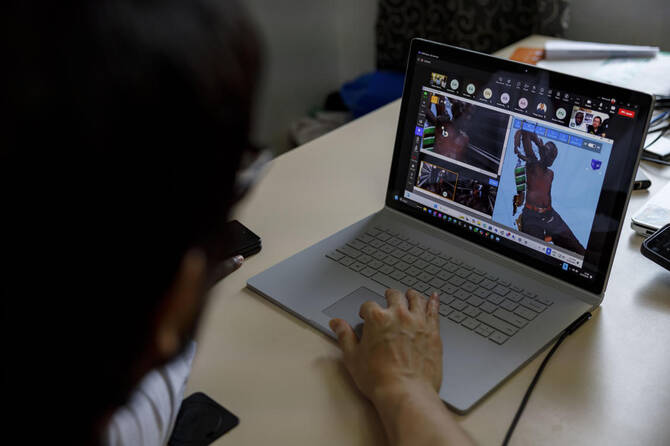
Aseku was preparing for yet another medical trip until late February when he joined others in the first trial of 3D telemedicine technology in Ghana powered through computer screens in the back of a van.
Those behind the initiative, developed by Microsoft’s research team in partnership with local doctors and researchers, say the remote assessment will help provide medical consultations for patients awaiting surgery or after an operation, in a region where the doctor-to-patient ratio is among the lowest in the world.
The project builds on earlier trials in Scotland and now works as a portable system with enhanced lighting and camera upgrades.
Once inside the van, cameras will capture a 3D model of each patient and the image is then projected onto a large computer screen. Multiple doctors can join the consultation session online and manipulate the 3D model to assess the patient.
“The idea behind the van is to allow it to travel to those remote villages that don’t have specialized care ... to perform a pre or post-surgical consult,” said Spencer Fowers, principal software developer and 3D-telemedicine project lead at Microsoft Research.
The initiative also gives patients the opportunity to have multiple opinions. Aseku’s session had doctors from Rwanda, Scotland and Brazil, an experience that he said gave him hope.
“I see a lot of doctors here and I am very happy because experience will come from each of them and maybe they will find a solution to my problem,” the 46-year-old said.
Researchers hope the trial at the Koforidua Regional Hospital, in Ghana’s eastern region, is the start of a wider project that could expand the service and explore new use cases.
Recent years have seen growing use of telemedicine, especially since the COVID-19 pandemic. Experts say such digital tools can benefit patients in Africa the most because there are so few specialist doctors for the continent’s 1.4 billion people.
George Opoku, 68, was referred to the Korle-Bu Teaching Hospital in the capital Accra — nearly 100 kilometers away from the Koforidua hospital, which is much closer to his home — where he had first gone to seek care for sarcoma, a rare form of cancer that develops in the bones and soft tissues.
Upon hearing about the 3D telemedicine trial, his doctor decided to register him for the process, saving him the extra expenses and stress of long-distance travel.
“This time I had to sit in a van and to introduce myself and condition to not only one doctor but several of them. I was able to answer all their questions and I am hopeful that they will discuss and cure me of my condition,” Opku said. “I feel well already and I am hopeful.”
A key challenge for the project is the lack of stable Internet access, a common problem in remote parts of Africa.
At the Korle-Bu Teaching Hospital, the technology is helping patients in need of plastic surgery. An inadequate number of plastic surgeons means that patients often have to consult with different doctors during each visit.
Dr. Kwame Darko, consultant plastic surgeon at the hospital and one of the principal investigators on the project, said that 3D telemedicine could give patients the chance to be seen by multiple doctors during one session.
The 3D technology could make a difference if replicated in Ghana and elsewhere, according to Dr. Ahensan Dasebre, chief resident doctor at the National Reconstructive Plastic Surgery and Burns Center at Korle-Bu, who was not part of the project.
“We are already behind in terms of how many doctors are available to care for a certain number of the population,” he said.
“If somebody is in a remote part of town where he doesn’t have access to these specialized services, but needs it, the referring doctor could actually use this telemedicine thing to get access to the best of care.”

New 3D technology could soon bring surgeons closer to patients in Africa’s most remote regions
https://arab.news/248f4
New 3D technology could soon bring surgeons closer to patients in Africa’s most remote regions
- A groundbreaking initiative could soon be bringing surgeons closer to patients in Africa’s remote corners
- The way it works is patients enter the van where cameras capture their 3D image
Venezuela begins ‘large’ prisoner release amid US pressure
- The releases are the first since Maduro’s former deputy Delcy Rodriguez took over, with the backing of President Donald Trump
- The releases were announced by Rodriguez’s brother, parliament speaker Jorge Rodriguez
CARACAS: Venezuela on Thursday began releasing a “large number” of political prisoners, including several foreigners, in an apparent concession to the United States after its ouster of ruler Nicolas Maduro.
The releases are the first since Maduro’s former deputy Delcy Rodriguez took over, with the backing of President Donald Trump, who says he is content to let her govern as long as she gives Washington access to oil.
The White House credited Trump with securing the prisoners’ freedom.
“This is one example of how the president is using maximum leverage to do right by the American and Venezuelan people,” Deputy Press Secretary Anna Kelly said in a statement to AFP.
The releases were announced by Rodriguez’s brother, parliament speaker Jorge Rodriguez, a key figure in “chavismo,” the anti-US socialist movement founded by Maduro’s predecessor Hugo Chavez.
He said “a large number of Venezuelan and foreign nationals” were being immediately freed for the sake of “peaceful coexistence.”
He did not say which prisoners would be released, nor how many or from where.
Renowned Spanish-Venezuelan activist Rocio San Miguel, imprisoned since February 2024 over a purported plot to assassinate Maduro, was among five Spanish citizens freed, according to Spain’s foreign ministry.
Security was stepped up Thursday afternoon outside the notorious El Helicoide detention center in Caracas, used by the intelligence services to jail political and other prisoners.
Miguel was held in El Helicoide after her arrest.
Leading opposition figure Alfredo Diaz, who died in December in custody, was also held at the facility.
Families gathered outside on Thursday for news of their loved ones.
“I’m nervous. Please God may it be reality,” the mother of a detained activist from the party of opposition leader Maria Corina Machado told AFP.
On Tuesday, Trump had told Republican lawmakers that Rodriguez’s administration was closing a torture chamber “in the middle of Caracas” but gave no further details.
His remarks had sparked speculation that Venezuelan authorities had agreed to close El Helicoide.
Venezuelan rights NGO Foro Penal estimates over 800 political prisoners are languishing in the country’s jails.
It welcomed the government’s plans to liberate some of them but was still verifying releases.
As tensions with Washington climaxed in the past month Venezuela had already released dozens of dissenters in two phases.
- Trump rebuked by Senate -
Thursday’s move by Caracas came as Trump suggested the United States could run Venezuela and tap into its oil reserves for years.
Shortly after Maduro’s seizure in US airstrikes and a special forces raid that left 100 people dead, according to Caracas, Trump announced that the US would “run” the Caribbean country for a transitional period.
“Only time will tell” how long Washington will demand direct oversight of the country, he told The New York Times in an interview published Thursday.
When asked whether that meant three months, six months or a year, he replied: “I would say much longer.”
Meanwhile, the US Senate on Thursday took a major step toward passing a resolution to rein in military actions against Venezuela.
The Democratic-led legislation, expected to pass a vote next week, reflects widespread disquiet among lawmakers over Saturday’s secretive capture of Maduro, conducted without their express approval.
It is expected to face resistance in the Republican-dominated House, however.
- Millions of barrels of crude -
Oil has emerged as the key to US control over Venezuela, which has the world’s largest proven reserves.
Trump announced a plan earlier this week for the United States to sell between 30 million and 50 million barrels of Venezuelan crude, with Caracas then using the money to buy US-made products.
Delcy Rodriguez on Wednesday called the US attack to depose Maduro, who was taken to New York with his wife to face trial on drugs charges, a “stain” on relations with the United States.
But she also defended the planned oil sales to Washington.
On the streets of Caracas, opinions remain mixed about the plan.
“I feel we’ll have more opportunities if the oil is in the hands of the United States than in the hands of the government,” said Jose Antonio Blanco, 26.
The Wall Street Journal reported that Trump, who will meet oil executives on Friday, is also considering a plan for the US to exert control over Venezuela’s state oil company PDVSA.
Trump has warned Rodriguez she will pay “a very big price, probably bigger than Maduro” if she does not comply with his agenda.
“Her power comes from Washington, not from the internal structure. If Trump decides she’s no longer useful, she’ll go like Maduro,” Venezuela’s former information minister Andres Izarra told AFP in an email.


