ISLAMABAD: A Copenhagen-based multinational mining company, FLSmidth, will train 100 Pakistani engineers in mining, the Pakistani government said on Friday, amid Islamabad’s efforts to utilize the country’s vast mineral resources for economic gains.
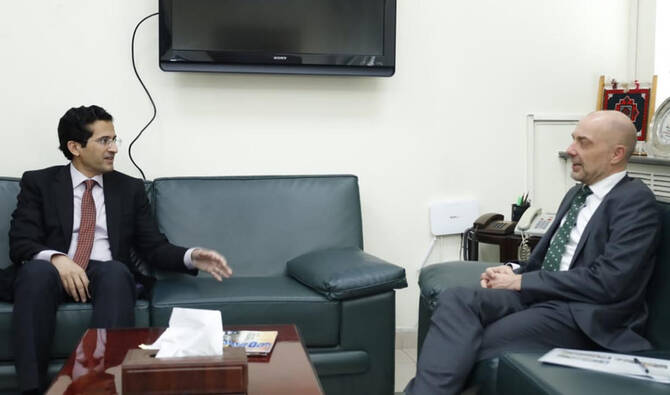
The statement by Pakistan’s Press Information Department (PID) came after Petroleum Minister Ali Pervaiz Malik’s meeting with Danish Ambassador to Pakistan Jakob Linulf in Islamabad that focused on bilateral cooperation in the energy sector, particularly in mining and technological collaboration.
Malik recognized that FLSmidth’s advanced solutions in cement production, mineral processing and decarbonization align with Pakistan’s goals of increasing efficiency and reducing environmental impact in its extractive industries, according to the PID.
He emphasized the Pakistani government’s commitment to creating an investor-friendly environment and invited Danish companies, including FLSmidth, to explore partnerships with Pakistani firms during the Pakistani Minerals Investment Forum on April 8-9.
“FLSmidth will be launching a training program named BRIMM (Bradshaw Research Initiative for Minerals and Mining) under which hundred Pakistani engineers will be provided training,” the PID said, citing the Danish ambassador.
“FLSmidth has already entered into 5 partnership agreements in minerals sector of Pakistan.”
Pakistan’s landscape is a treasure trove of diverse mineral deposits from huge coal reserves in the southern Sindh province to gold and copper deposits in the southwestern Balochistan province. The northwestern Khyber Pakhtunkhwa province is home to several gemstone mines, including emerald mines in Swat, Mardan’s pink topaz mines, and peridot mines in Kohistan.
The South Asian country is currently making efforts to utilize these vast mineral resources through foreign investment and collaboration to stabilize its $350 billion economy.
Petroleum Minister Malik expressed Pakistan’s keen interest in leveraging Danish technology and investment to optimize resource extraction and processing as the South Asian country has significant mineral reserves. He extended his full support and offered the government’s good offices to facilitate Danish investment and technology transfer in Pakistan’s growing mining sector, according to the statement.
The ambassador reaffirmed Denmark’s support for Pakistan’s energy transition and industrial growth, and said they were looking forward to Pakistan Minerals Investment Forum.
“He noted that Danish companies are eager to share their expertise in green mining solutions, automation, and digitalization to help Pakistan achieve its economic and environmental objectives,” the PID said.
The meeting concluded with an agreement to facilitate further engagement between Pakistani stakeholders and Danish technology providers, with FLSmidth playing a pivotal role in advancing modern mining practices in Pakistan.


![]()

Danish firm to train Pakistani engineers as Islamabad seeks to exploit mineral resources
Short Url
https://arab.news/rca23
Danish firm to train Pakistani engineers as Islamabad seeks to exploit mineral resources
- Pakistan’s landscape is a treasure trove of diverse mineral deposits from huge coal reserves to gold and copper deposits to gemstone
- The South Asian country is currently making efforts to utilize these vast mineral resources to stabilize its $350 billion fragile economy
Latest updates





© 2026 SAUDI RESEARCH & PUBLISHING COMPANY, All Rights Reserved And subject to Terms of Use Agreement.