

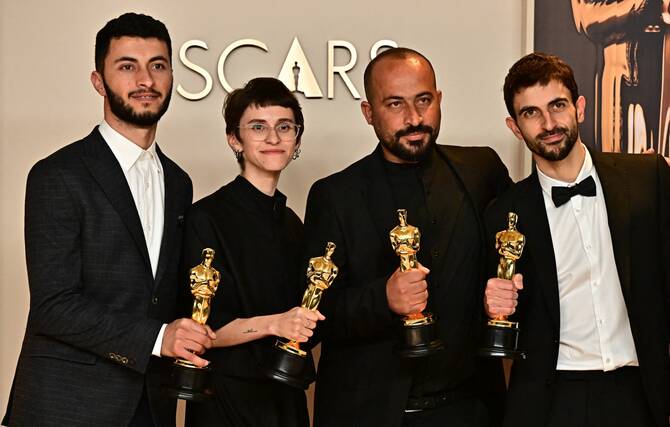
‘No Other Land’ co-director criticizes Oscars organizers for response to Hamdan Ballal assault

Ballal, one of the documentary’s four directors — two Israeli and two Palestinian — was released from Israeli detention on Tuesday. (AFP/File)
Short Url
Updated 29 March 2025
Follow

‘No Other Land’ co-director criticizes Oscars organizers for response to Hamdan Ballal assault

  • Yuval Abraham accuses academy of failing to directly acknowledge incident, mention Ballal by name
  • In a letter, the academy said that while it ‘condemns harming or suppressing artists for their work or their viewpoints,’ it does not publicly comment on ‘social, political, and economic events’

LONDON: “No Other Land” co-director Yuval Abraham has condemned the Academy of Motion Picture Arts and Sciences for its response to the violent attack on his Palestinian co-director, Hamdan Ballal.

The Israeli filmmaker and journalist accused the academy of failing to directly acknowledge the incident, noting that its statement did not mention Ballal by name.

This marks the second time this week that Abraham has publicly criticized the academy. Earlier, he denounced the institution for remaining silent on the attack, in which Israeli settlers assaulted Ballal before he was detained by Israeli forces in the West Bank on Monday.

“After our criticism, the academy’s leaders sent out this email to members explaining their silence on Hamdan’s assault: they need to respect ‘unique viewpoints,’” Abraham wrote on X.

The academy’s letter stated that while it “condemns harming or suppressing artists for their work or their viewpoints,” it does not publicly comment on “social, political, and economic events” despite frequent requests to do so. “In these instances, it is important to note that the Academy represents close to 11,000 global members with many unique viewpoints,” the statement read.

Abraham pointed out the contrast between this response and the academy’s past actions, specifically its strong condemnation of Iran’s detention of filmmakers such as Jafar Panahi in 2011. “Compare this,” he wrote, “which didn’t even name Hamdan, to the Academy’s rightfully strong position when it’s the Iranian government oppressing filmmakers.”

The academy has yet to issue a further response.

Ballal, one of the documentary’s four directors — two Israeli and two Palestinian — was released from Israeli detention on Tuesday.

In an interview with The Guardian, he described his ordeal, saying, “I thought I was going to die” when Israeli soldiers aided the settlers who attacked him outside his home in Susya, a village in the Masafer Yatta area of the West Bank.

He also claimed he was beaten while in detention, calling the assault “revenge for our movie.”

The global film community swiftly condemned the attack and arrest. The US-based International Documentary Association posted a message on Instagram demanding Ballal’s immediate release. The Berlin Film Festival, where “No Other Land” had its premiere and won the award for best documentary last year, called the incident “very distressing.”


Instagram users given new algorithm controls

Updated 31 sec ago
Follow

Instagram users given new algorithm controls

  • “Your Algorithm” shows users a summary of their top interests and lets them type in specific topics to customize their feed
  • The new feature, touted as giving users greater control, has launched in the US and will roll out globally soon
SAN FRANCISCO: Instagram on Wednesday unveiled a new AI-powered feature that lets users view and adjust the algorithm shaping their Reels feed, calling it a pioneering move toward greater user control.
The Meta-owned app is introducing “Your Algorithm,” accessible through an icon in the upper right corner of Reels — a user’s video feed — which displays the topics Instagram believes users are interested in based on their viewing history.
In a blog post, Meta said users can now directly tell the platform which subjects they want to see more or less of, with recommendations adjusting accordingly in real time.
Social media platforms have faced mounting pressure from regulators and users alike to provide greater transparency around algorithmic content curation, which critics say can create echo chambers or promote harmful content.
But companies also see algorithms as their platform’s ‘secret sauce’ for engaging users and have often resisted greater transparency.
“Instagram has always been a place to dive deep into your interests and connect with friends,” the company said in its blog. “As your interests evolve over time, we want to give you more meaningful ways to control what you see.”
The feature shows users a summary of their top interests and allows them to type in specific topics to fine-tune their feed.
Instagram said it is “leading the way” in offering such transparency and control, with plans to expand the feature beyond Reels to Explore and other sections of the app.
The tool launched Wednesday in the United States and will roll out globally in English “soon,” the company said.
The move came as Australia, in a world-first, banned people under age 16 from a raft of popular social media apps, including Instagram. The government said it aimed to “take back control” from tech giants and protect children from “predatory algorithms.”