



LAHORE: Set within the crumbling walls and narrow, meandering streets of Lahore’s old, Walled City is Bethak Sadequain.
Opened in February, the cafe is named after Syed Ahmed Sadequain Naqvi (1930-1987), known by the mononym Sadequain, one of the finest painters and calligraphers Pakistan has ever produced and among the most influential and important South Asian artists of the 20th century. Apart from paying homage to Sadequain, the space also aims to revive the spirit of the bethak — a traditional gathering space centered on conversation and connection. The venue, launched last month, has been drawing steady crowds this Ramadan with its curated iftar gatherings blending traditional cuisine and live music and presenting a glimpse into the history of a graceful and cultured city that stretches by some accounts back into the days of the epic Ramayana.
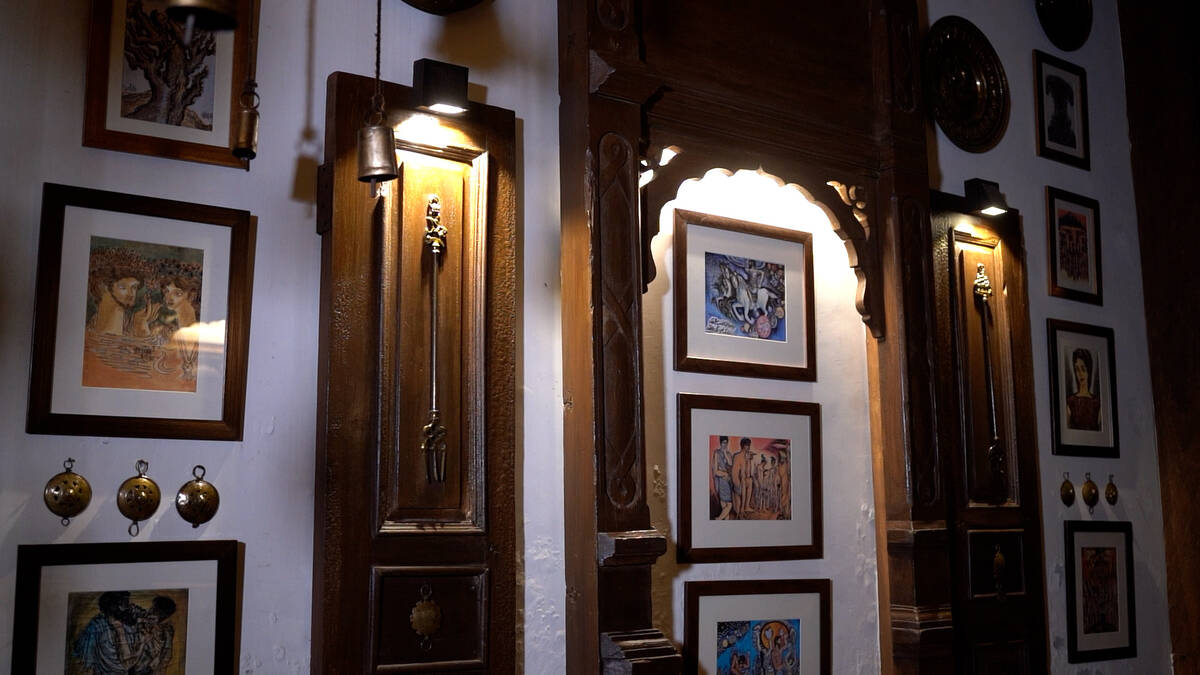
The photo taken on March 25, 2025, shows Pakistani artist Syed Ahmed Sadequain Naqvi's paintings displayed at a cafe named after him in Lahore's Walled City. (AN Photo)
Situated on Gali Surjan Singh, a compact but architecturally rich lane in the Delhi Gate area, Bethak Sadequain outsources its food due to limited space but focuses on delivering an immersive cultural experience through live performances, an old-city charm and a communal atmosphere. The aim is to create a true bethak, which was a typical feature of many Mughal-era havelis, palaces and mansions in the Indian Subcontinent.
“Iftar is an excuse to get together, a communal experience. A lot of families come together, a lot of colleagues and friends get together, so our restaurant is a good place, close to heritage, close to tradition,” the restaurant’s manager Bilal Sabir told Arab News.
“The guests who come here [for iftar], we tell them a little of our history of the Walled City, we entertain them, we give them guidelines on music, we play for them our traditional Pakistani classical music too.”
Sabir described the business venture as an effort “to keep Sadequain’s name alive” as the extraordinary painter and calligrapher’s work had not been given the due attention in Pakistan.
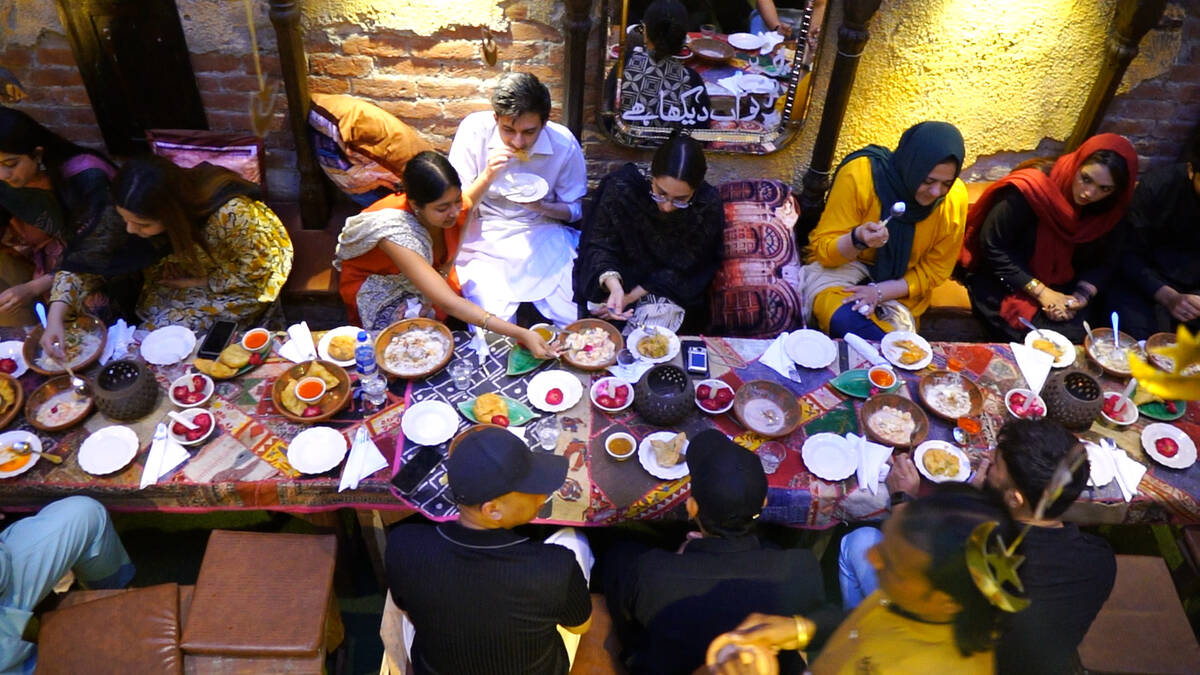
Visitors enjoy a curated iftar at Bethak Sadequain cafe in Lahore's Walled City on March 25, 2025. (AN Photo)
“We saw that in Lahore there is no activity related to Sadequain,” he said. “There is a Sadequain gallery, but it’s in Karachi, not in Lahore. So we wanted to promote this thing, to announce and introduce Sadequain to Lahore, so this is just a little effort.”
“INTRODUCING SADEQUAIN:”
While the iftar menu also provides an authentic Walled City experience — stuffed dates, samosas, signature tea, spiced biryani rice and shahi haleem stews — the success of the restaurant this Ramadan is still largely due to its ambiance and classical vibe.
Before iftar earlier one evening this week, Sabir sat on the floor and played the flute, a traditional wooden wind instrument, surrounded by Sadequain’s works, and interacted with the audience, sometimes asking them to guess the tune and also encouraging people to sing along.
Zeeshan Zia Raja, the restaurant’s owner, said she opened it as she wanted to do something meaningful during her retirement as well as create a space in the Walled City where women could sit comfortably and safely for hours.
Raja, also the owner of the American Lycetuff School System, represents the Sadequain Foundation USA.
“The new generation is missing a lot, many important things in their lives,” she said. “So, I thought we should introduce Sadequain. We, as a nation, have not done justice to him by recognizing his efforts for Pakistan and what he did for us.”
Sadequain, born in Amroha in 1930 to an educated North Indian Shia family in which calligraphy was a highly valued skill, rose to fame in 1955, when he exhibited a number of works at the residence of Prime Minister Huseyn Shaheed Suhrawardy, a liberal patron of the arts.
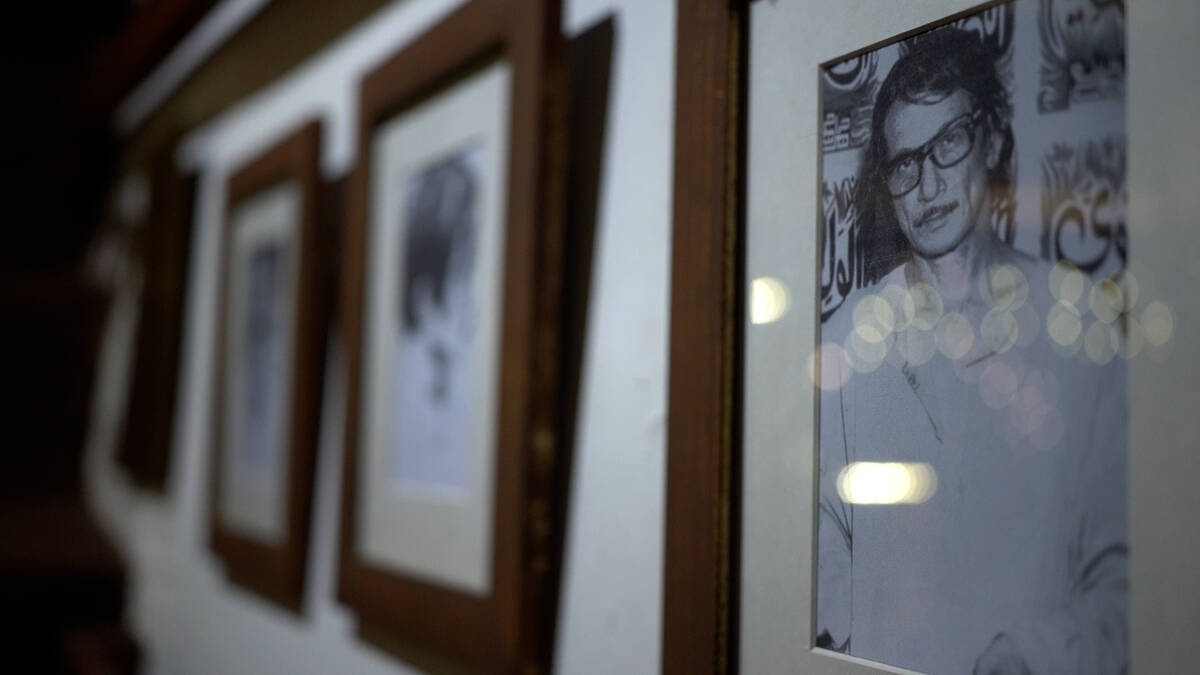
The photo taken on March 25, 2025, shows Pakistani artist Syed Ahmed Sadequain Naqvi's pictures displayed at a cafe named after him in Lahore's Walled City. (AN Photo)
Soon afterwards, Sadequain received a number of important governmental commissions for municipal murals, and held numerous solo exhibitions of his work. It was around this time that the influence of Picasso began to appear strongly in Sadequain’s paintings and sketches, according to his biography on the website of the Grosvenor Gallery in the UK where some of his works are displayed.
Sadequain won the Pakistan National prize for Painting in 1960, and left for Paris later that year at the invitation of the French Committee of the International Association of Plastic Arts.
“The following few years were to be some of the most important for the young artist in terms of his artistic development, and it was whilst in Paris that he began to achieve international critical acclaim,” the gallery wrote.
In September 1961 he was the laureate winner of the Paris Biennial’s ‘Artist under 35’ category, and was awarded a scholarship which allowed him to remain in Paris, and helped catapult him into the spotlight. During the early 1960s he traveled to Pakistan as well as throughout Europe and to the USA, and held numerous solo-exhibitions, including at the Commonwealth Institute Galleries and New Vision Center, London, and at Galerie Presbourg and Galerie Lambert in Paris.
In 1964 he was awarded the commission to illustrate a new edition of Albert Camus’ novel L’Etranger, published in 1966 by Les Bibliopholes de L’Automobile Club de France.
Sadequain returned to Pakistan in 1967 following his father’s ill health during a visit to France. His output for the next few years was prolific and in the early 1970s he published a huge volume of poetry. It was also during this period that he concerned himself mainly with calligraphy, as well as with state funded murals, including those at Mangla dam, The State Bank of Pakistan, and the ceiling of Frere Hall, Karachi.
Mukarram Zia Raja, who is Bethak Sadequain’s co-founder, recounted the history of Sadequain’s life and work and told Arab News the plan was always to make the venue all about the artist, as well as about art and music in general.
An entire floor of the restaurant is dedicated to Sadequain. With the blessings of the Sadequain Foundation, dozens of memorabilia from his life and work — official prints and private photos — are on display to make young people more curious and encouraged them to learn about the great artist.
“My mother grew up hearing about all these bethaks in the Walled City, lost to time, and she wanted to bring them back,” he said. “But when we got this place, it had just been a warehouse of dry food inventory for the past 60 years. So, she wanted to do something of cultural significance with it too.”
But in Ramadan, serving a good iftar was also key.
“Food culture and Lahori culture is so ingrained together that you can’t run a successful business if you are not doing good iftars during Ramadan,” Mukarram said.
“But we did not want to do a random cash grab for Ramadan, so even all the decor we did was very traditional … Even the choice of music was not random, curated to feature sufi kalaams and naats [spiritual poetry and devotional songs], given that it is Ramadan.”


