

IMF says Pakistan can cut power tariff by one rupee per unit to benefit ‘all consumers’

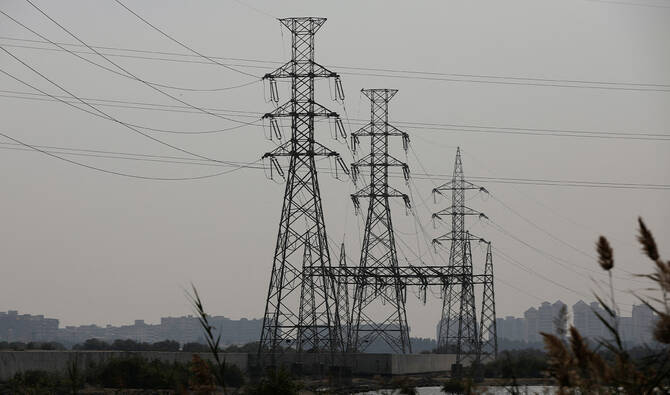
A power transmission tower is seen a day after a country-wide power breakdown in Karachi, Pakistan on January 24, 2023. (Reuters/File)
Short Url
Updated 28 March 2025
Follow

IMF says Pakistan can cut power tariff by one rupee per unit to benefit ‘all consumers’

  • IMF’s resident Pakistan representative, Mahir Binici, confirms power tariff reduction to Arab News
  • Binici said authorities can use revenues from captive power plants to cut prices by Rs1 per kilowatt

KARACHI: The International Monetary Fund (IMF) has allowed Pakistan to slash power tariffs by one rupee per kilowatt to provide relief to inflation-hit consumers, the IMF’s resident representative in Pakistan confirmed to Arab News on Friday. 

Pakistan can bring down the prices of electricity by using revenue from a Rs791 per unit grid levy the government recently imposed on the usage of gas by captive power plants for in-house power generation, Mahir Binici, the IMF’s resident representative, said. Captive power plants, also known as autoproducers or embedded generation, are electricity generation facilities owned and operated by an industrial or commercial entity solely for their own energy consumption, providing a localized power source.

“The price reduction would benefit all consumers,” Binici said.

Analysts see a modest impact of the one rupee relief over the promised Rs8 per unit cut.

“The benefit is modest, around Rs 200 per month, for the average domestic consumer,” said Muhammad Waqas Ghani, head of research at JS Global Capital Ltd. from Karachi. 

Financing the cut through a levy on captive power plants would naturally provide a short-term relief, he said. 

“For the government to provide any meaningful relief, it would have to work to address the underlying structural issues in Pakistan’s energy sector,” Ghani said.

The confirmation of the power tariff reduction comes days after IMF staff reached a deal with Pakistan for a new $1.3 billion arrangement and also agreed on the first review of the ongoing 37-month bailout program, the IMF said on Tuesday. Pending board approval, Pakistan can unlock the $1.3 billion under a new climate resilience loan program spanning 28 months. It will also free $1 billion for the South Asian nation under its ongoing $7 billion bailout program, which would bring those disbursements to $2 billion.

The IMF’s board of governors will meet in May and approve its next tranche for Pakistan, Prime Minister Shehbaz Sharif’s office said in a statement on Thursday.

The IMF’s nod for a reduction in Pakistan’s power tariffs is just one component of a larger package Sharif will be announcing after Eid, Zafar Yab Khan, a spokesperson at Pakistan’s power division, told Arab News.

“This should not be misunderstood as the only relief that is being considered by the government,” Khan said.

Under a special relief package, Sharif was expected to announce a reduction in the prices of electricity by as much as Rs8 per unit to provide some relief to Pakistanis who have had to face inflated energy and food prices in the last two years. Pakistan’s inflation peaked at 38% in May 2023 before gradually easing to 1.5% in February this year, the lowest in nearly a decade. The government expects it to remain within 1–3% in the coming months.

The debt-ridden country had to make its electricity costly by withdrawing fuel subsidies and increasing energy prices in compliance with conditions set by the IMF under a $3 billion loan that averted a sovereign debt default in 2023 but fueled record-high inflation and triggered protests in many parts of the country. 


Islamabad facilitating thousands of stranded Pakistanis in Gulf amid Iran conflict, FM says

Updated 4 sec ago
Follow

Islamabad facilitating thousands of stranded Pakistanis in Gulf amid Iran conflict, FM says

  • Pakistani religious pilgrims, visitors are being evacuated via land routes due to airspace shutdowns
  • Foreign Minister Ishaq Dar says ‘our consistent message is de-escalation, restraint and return to dialogue’

ISLAMABAD: Pakistan’s Foreign Minister Ishaq Dar on Tuesday said that Islamabad was working round the clock to assist thousands of Pakistanis stranded in Arab Gulf countries, reiterating his country’s readiness to facilitate diplomatic efforts to de-escalate tensions in the Middle East.

Tensions in the region heightened on Saturday following coordinated strikes by the US and Israel against Iran, diminishing prospects of a peaceful settlement of Tehran’s long-running dispute with Western countries and Tel Aviv over its nuclear program.

Tehran subsequently targeted American bases in Gulf states, including the UAE, Bahrain, Qatar, Kuwait and Jordan, prompting their governments to issue condemnations. The Saudi foreign ministry on Tuesday condemned Iran’s drone attack on the US embassy building in Riyadh.

Describing the Gulf situation as “very fluid,” Dar said regional airspace shutdowns had forced Pakistani religious pilgrims and visitors in Gulf states, also home to 4.5 million Pakistani expatriates, to mostly rely on land routes for their exit.

“The safety of Pakistanis abroad and the sovereignty of Pakistan remain our foremost priorities... Our crisis management unit is operational 24 hours to facilitate the stranded Pakistanis,” he said at a media briefing in Islamabad on Tuesday, adding that Pakistani missions in Tehran, Zahedan, Mashhad, Riyadh, Jeddah, Abu Dhabi, Dubai, Doha, Kuwait City and Manama were actively assisting nationals.

“If someone’s visa is expiring, as a visitor, they’re are getting fully cooperated. Similarly, if people are transiting from Saudi Arabia to other countries by road, then the other Gulf countries are also facilitating and helping them.”

Around 35,000 Pakistanis were currently in Iran and evacuation through Azerbaijan remained another viable option for those in northern Iran. So far, 64 Pakistanis have crossed into Azerbaijan, with dozens already flown onward, including 42 who reached Lahore on March 2, according to Dar.

Flights between Pakistan and Azerbaijan remain operational and Baku is providing visa-on-arrival and logistical support to stranded Pakistani nationals.

Dar said 4,543 Pakistani visitors were stranded in the UAE and around 1,400 in Qatar due to the conflict and airspace disruptions, adding that Saudi Arabia, home to more than 2 million Pakistani expatriates, remained relatively stable, with partial air operations continuing via Oman.

Land corridors between Saudi Arabia, Bahrain, UAE and Qatar were being widely used and travelers were being allowed to transit by road, he said, thanking authorities in these countries for facilitating Pakistani nationals.

ISLAMABAD’S DIPLOMATIC EFFORTS FOR PEACE

The foreign minister said he had been in contact with foreign ministers from Turkiye, Iran, Saudi Arabia, Qatar, UAE and Oman as well as European Union representatives over the past three days to help de-escalate the tensions.

“Our consistent message is de-escalation, restraint and return to dialogue,” he said.

Prime Minister Shehbaz Sharif is personally overseeing the situation and has convened Pakistani parliamentary leaders from all parties for a detailed briefing, he added.

In discussions involving US Secretary of State Marco Rubio prior to the US-Israeli strikes, Dar said, both Oman and Islamabad had been considered potential venues for US-Iran talks and Pakistan had conveyed that it was “fully ready” to host negotiations.

“Islamabad is available for any mediation or facilitation,” he said, adding that Pakistan’s policy did not support a regime change in Iran and focused solely on dialogue and regional stability.
