Pakistan stocks increase 4 percent month-on-month on IMF staff level deal — analysts 

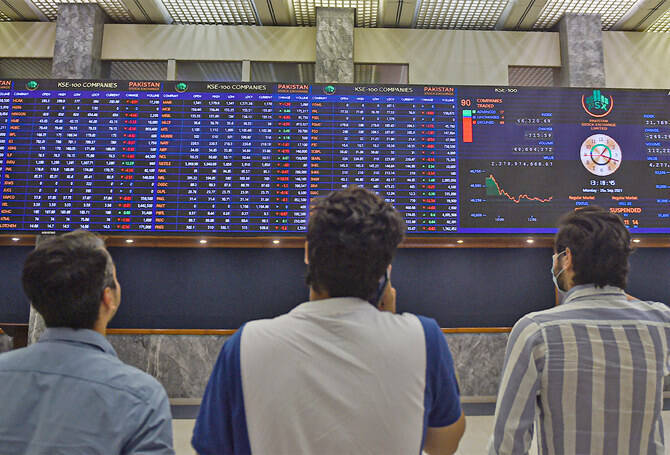
Stockbrokers watch an index board showing the latest share prices during a trading session at the Pakistan Stock Exchange (PSX) in Karachi, Pakistan, on September 20, 2021. (AFP/File)
Short Url
Updated 28 March 2025
Follow

Pakistan stocks increase 4 percent month-on-month on IMF staff level deal — analysts 

  • IMF this week reached deal for new $1.3 billion arrangement, first review of ongoing bailout program
  • Pakistan can unlock $1.3 billion under new climate resilience loan program spanning 28 months

ISLAMABAD: Pakistani stocks increased by 4 percent on a month-on-month basis on the back of a successful staff level agreement with the International Monetary Fund, among other factors, top brokerage house Topline Securities said in a monthly market review on Friday.

On Tuesday, IMF staff reached a deal with Pakistan for a new $1.3 billion arrangement and also agreed on the first review of the ongoing 37-month bailout program. Pending board approval, Pakistan can unlock the $1.3 billion under a new climate resilience loan program spanning 28 months. The IMF will also free $1 billion for the South Asian nation under its $7 billion bailout program, which would bring those disbursements to $2 billion.

The program, secured mid-year in 2024, has played a key role in stabilizing Pakistan’s economy and the government has said the country is on course for a long-term recovery.

“KSE 100 Index increased by 4 percent on MoM basis, this gain can be attributed to staff level agreement with IMF, circular debt resolution plan where news flow suggest that significant progress has been made and noise that government is working on plan to reduce the electricity prices,” Topline Securities said in its review. 

Plugging unresolved debt across the power sector is a top priority under the ongoing IMF bailout, which has helped Pakistan dig its way out of an economic crisis.

Pakistan’s government, the largest shareholder or owner of most power companies, faces a challenge in resolving debt due to fiscal constraints. To address this, Islamabad has raised energy prices, as recommended by the IMF, but still needs to settle the accumulated debt.

The government plans to reduce “circular debt” — public liabilities that build up in the power sector due to subsidies and unpaid bills — this year by eliminating government-guaranteed debt and moving to a revenue-based system.

This approach is expected to lower financing costs, enabling the government to pay off interest and service debt obligations, the power ministry said earlier this month. 

Other major developments during this month have been the inflation rate for February coming in at 1.5 percent, the lowest reading in nearly a decade. The monetary policy committee also kept the policy rate unchanged at 12 percent, while the remittance figure for the month of February 2025 clocked in at S$3.1 billion, up 39 percent YoY and 4 percent MoM.

Pakistan’s inflation is likely to remain steady in March, in the 1 percent to 1.5 percent range, the country’s finance ministry said in its monthly economic outlook, after slowing to its lowest level in almost a decade the previous month. 

Inflation in Pakistan has been declining for several months after it soared to around 40 percent in May 2023.

Pakistan says its $350 billion economy has stabilized under the $7 billion IMF bailout that had helped it stave off a default threat.

“While economic growth remains moderate, inflation has declined to its lowest level since 2015, financial conditions have improved, sovereign spreads have narrowed significantly, and external balances are stronger,” the IMF said about Pakistan. 


Afghan interior minister welcomes Pakistani scholars’ ‘positive’ remarks about Kabul

Updated 5 sec ago
Follow

Afghan interior minister welcomes Pakistani scholars’ ‘positive’ remarks about Kabul

  • Pakistani religious scholars on Dec. 23 called for easing tensions between Islamabad and Kabul, resumption of trade
  • Sirajuddin Haqqani says Afghanistan is committed to regional peace, Afghans have “no intentions to threaten anyone”

PESHAWAR: Afghanistan’s Interior Minister Sirajuddin Haqqani recently thanked Pakistan’s Deputy Prime Minister Ishaq Dar and religious scholars from the country for expressing positive statements for Kabul despite tensions between the two countries. 

A meeting of religious scholars in Pakistan on Dec. 23, attended by Jamiat Ulama-e-Pakistan political party head Maulana Fazl-ur-Rehman, called for easing tensions between the two states. The scholars also called for allowing resumption of trade and movement of people between Pakistan and Afghanistan. 

Pakistani news media outlets reported on Saturday that Dar, who is also Pakistan’s foreign minister, praised Haqqani’s earlier statement in which the Afghan minister stressed resolving tensions between Islamabad and Kabul through dialogue. 

In a video statement on Sunday, Haqqani said Afghanistan is committed to peace and stability in the country and the region, adding that Afghans have “no intentions to threaten anyone.” He appreciated Rehman and religious scholar Mufti Taqi Usmani for speaking in a “positive” manner about Afghanistan in the Dec. 23 meeting.

“We are thankful and grateful for their approach and views,” Haqqani said. 

“Similarly, we really appreciate the positive remarks by Foreign Minister Ishaq Dar, who spoke in a positive way about Afghanistan.” 

The Afghan minister’s statement comes in the backdrop of increased tensions between Afghanistan and Pakistan amid a surge in militant attacks in the latter’s territory. 

Pakistan blames Afghanistan’s government for facilitating attacks by the Pakistani Taliban or TTP group. Islamabad accuses Kabul of allowing TTP militants to take shelter in sanctuaries in Afghanistan from where they carry out attacks targeting Pakistan. 

Kabul denies the charges and says it cannot be held responsible for security lapses and challenges in Pakistan. 

The two countries engaged in fierce border clashes in October that led to the killings of dozens of soldiers and civilians on both sides. Pakistan and Afghanistan subsequently agreed to a temporary ceasefire and have held three rounds of peace talks that remained inconclusive. 

Tensions persist as Pakistan has vowed to go after militants even in Afghanistan that threaten the lives of its citizens. Afghan officials have warned Pakistan of retaliation if it attacks Afghanistan.