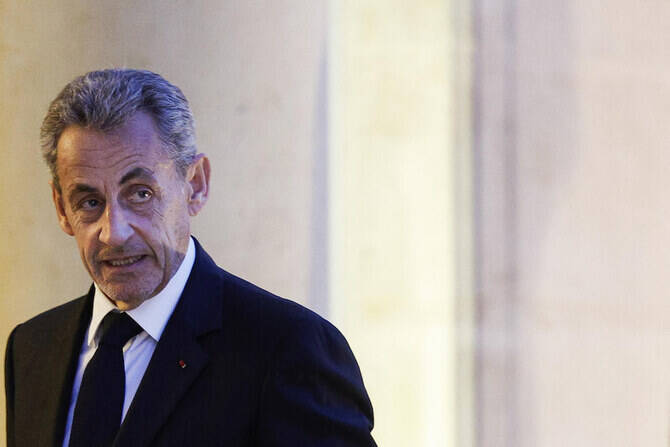
PARIS: French prosecutors on Thursday requested a seven-year prison sentence and a 300,000-euro (around $325,000) fine for former President Nicolas Sarkozy, in connection with allegations that his 2007 presidential campaign was illegally financed by former Libyan leader Moammar Gadhafi’s government.
The National Financial Prosecutor’s Office, known by its French acronym PNF, also called for a five-year ban on Sarkozy’s civic, civil and family rights — a measure that would bar him from holding elected office or serving in any public judicial role.
The case, which opened in January and is expected to conclude on April 10, is considered the most serious of the multiple legal scandals that have clouded Sarkozy’s post-presidency.
The 70-year-old Sarkozy, who led France from 2007 to 2012, faces charges of passive corruption, illegal campaign financing, concealment of embezzlement of public funds and criminal association. He has denied any wrongdoing.
The accusations trace back to 2011, when a Libyan news agency and Gadhafi himself said that the Libyan state had secretly funneled millions of euros into Sarkozy’s 2007 campaign.
In 2012, the French investigative outlet Mediapart published what it said was a Libyan intelligence memo referencing a 50 million-euro funding agreement. Sarkozy denounced the document as a forgery and sued for defamation.
French magistrates later said that the memo appeared to be authentic, though no conclusive evidence of a completed transaction has been presented.
Investigators also looked into a series of trips by Sarkozy’s associates to Libya between 2005 and 2007.
In 2016, Franco-Lebanese businessman Ziad Takieddine told Mediapart that he had delivered suitcases filled with cash from Tripoli to the French Interior Ministry under Sarkozy. He later retracted his statement. That reversal is now the focus of a separate investigation into possible witness tampering.
Sarkozy and his wife, Carla Bruni-Sarkozy, have both been placed under preliminary investigation in that case.
Sarkozy’s former ministers Claude Guéant, Brice Hortefeux, and Éric Woerth are also on trial, along with eight other defendants. But prosecutors have made clear the central figure is the former president himself — accused of knowingly benefiting from a “corruption pact” with a foreign dictatorship while campaigning to lead the French republic.
While Sarkozy has already been convicted in two other criminal cases, the Libya affair is widely seen as the most politically explosive — and the one most likely to shape his legacy.
In December 2024, France’s highest court upheld his conviction for corruption and influence peddling, sentencing him to one year of house arrest with an electronic bracelet. That case stemmed from tapped phone calls uncovered during the Libya investigation. In a separate ruling in February 2024, a Paris appeals court found him guilty of illegal campaign financing in his failed 2012 reelection bid.
Sarkozy has dismissed the Libya allegations as politically motivated and rooted in forged evidence. But if convicted, he would become the first former French president found guilty of accepting illegal foreign funds to win office.
A verdict is expected later this year.

French prosecutors seek 7-year sentence for Sarkozy in Libya campaign financing trial
https://arab.news/caksu
French prosecutors seek 7-year sentence for Sarkozy in Libya campaign financing trial
- The National Financial Prosecutor’s Office also called for a five-year ban on Sarkozy’s civic, civil and family rights
- The accusations trace back to 2011, when a Libyan news agency and Gadhafi himself said that the Libyan state had secretly funneled millions of euros into Sarkozy’s 2007 campaign
Le Pen appeal trial opens with French presidential bid at stake
- Le Pen, 57 entered the packed courtroom on Tuesday afternoon flanked by two lawyers
- If the court upholds the first ruling, Le Pen will be barred from running in the 2027 election
PARIS: The appeal trial of Marine Le Pen opened Tuesday, with the French far-right leader hoping to overthrow a graft conviction and save her 2027 run for president.
The appeal comes after a French court last year barred her from running for office for five years over a European Parliament fake jobs scam involving her and other officials from her National Rally party.
The three-time presidential candidate was also handed a four-year prison sentence, with two years suspended, and fined 100,000 euros ($116,000).
Le Pen, 57, who has always maintained her innocence, entered the packed courtroom on Tuesday afternoon flanked by two lawyers, in the hopes of clearing the way for a fourth bid to become president.
If the court upholds the first ruling, Le Pen will be barred from running in the 2027 election, widely seen as her best — and possibly last — chance to win the country’s top job.
She again risks the maximum sentence — 10 years in prison and a one-million-euro ($1.16 million) fine — if the appeal fails.
She could, however, still be a candidate if she is sentenced to a shorter ban and no time to serve under house arrest.
Earlier on Tuesday, Le Pen said she was hopeful the court would listen to her side of the story.
The hearing is expected to last a month, with a decision expected this summer.
Twelve of the accused, as well as the far-right party itself, have appealed against the verdict.
Another 12 people — including one of Le Pen’s sisters — have decided to accept their convictions without appealing. Another person sentenced has since died.
- Risk of reoffending -
The initial verdict dealt a heavy blow to Le Pen and the RN, which has surged in French politics in recent years.
The court found her guilty — along with 24 former European Parliament lawmakers, assistants and accountants as well as the party itself — of operating a “system” from 2004 to 2016 using European Parliament funds to employ RN staff in France.
Le Pen walked out of the courtroom during the sentencing, later slamming the verdict as a “political decision.”
The judges defended the decision to bar her from running, saying elected officials should not benefit from “preferential treatment” and citing the risk of reoffending.
The news sparked shock among Le Pen supporters in France, while the US President Donald Trump and the Kremlin expressed concern.
Former Trump adviser Steve Bannon said last week he hoped Le Pen could run for president despite her legal troubles so her election could help “break” the European Union.
- Bardella in the wings -
Le Pen took over the former National Front (FN) from her father Jean-Marie Le Pen in 2011 and has since sought to clean up the party’s image.
Her father, who died in January, was often accused of making racist and antisemitic comments.
After coming third in the 2012 presidential polls, Marine Le Pen made the run-off in 2017 and 2022 but was beaten by Emmanuel Macron on both occasions.
Yet 2027 could see a different outcome for the far right, with Macron barred from standing again under France’s constitution.
Some 42 percent of French people said they agreed with “ideas defended by the RN,” up from 29 percent before the 2022 vote, according to a poll by consultancy firm Verian for Le Monde published on Sunday.
If she cannot be a candidate, Le Pen has said her top lieutenant Jordan Bardella — the RN party’s president who is not a defendant in the trial — can run in her place.
“Bardella can win instead of me,” Le Pen said in December.
A poll in November predicted that Bardella would win the second round of the 2027 elections, no matter who stands against him.
But Bardella said on Monday that a ruling preventing Le Pen from running “would be deeply worrying for democracy” and insisted he was not so far a candidate for president but prime minister.


