TORONTO: Canadian Prime Minister Mark Carney said Wednesday that US President Donald Trump’s auto tariffs are a “direct attack” on his country and that the trade war is hurting Americans, noting that American consumer confidence is at a multi-year low.
Trump said earlier Wednesday that he was placing 25 percent tariffs on auto imports and, to underscore his intention, he stated “This is permanent.”
“This is a very direct attack,” Carney responded. “We will defend our workers. We will defend our companies. We will defend our country.”
Carney said he needs to see the details of Trump’s executive order before taking retaliatory measures. He called it unjustified and said he will leave the election campaign to go to Ottawa on Thursday to chair his special Cabinet committee on US relations.
Carney earlier announced a CA$2 billion ($1.4 billion) “strategic response fund” that will protect Canadian auto jobs affected by Trump’s tariffs.
Autos are Canada’s second largest export, and Carney noted it employs 125,000 Canadians directly and almost another 500,000 in related industries.
“Canada will be there for auto workers,” he said.
Trump previously granted a one-month exemption on his stiff new tariffs on imports from Mexico and Canada for US automakers.
The president has plunged the US into a global trade war — all while on-again, off-again new levies continue to escalate uncertainty.
The Conference Board reported Tuesday that its USconsumer confidence index fell 7.2 points in March to 92.9, the fourth straight monthly decline and its lowest reading since January of 2021.
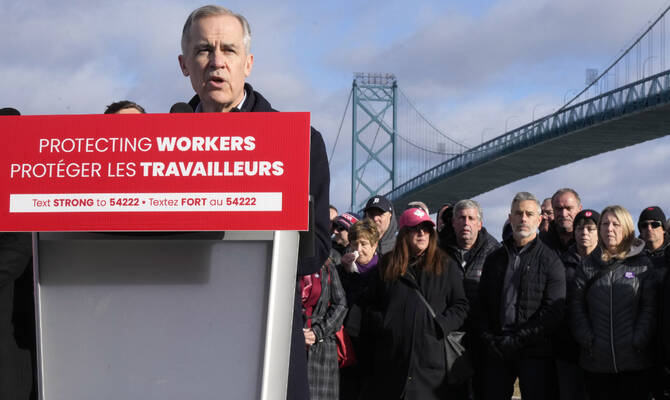
“His trade war is hurting American consumers and workers and it will hurt more. I see that American consumer confidence is at a multi-year low,” Carney said earlier while campaigning in Windsor, Ontario ahead of Canada’s April 28 election.
The tax hike on auto imports starting in April means automakers could face higher costs and lower sales.
Trump previously 25 percent tariffs on Canada’s steel and aluminum and is threatening sweeping tariffs on all Canadian products — as well as all of America’s trading partners — on April 2.
“He wants to break us so America can own us,” Carney said. “And it will never ever happen because we just don’t look out for ourselves we look out for each other.”
Carney, former two-time central banker, made the earlier comments while campaigning against the backdrop of the Ambassador Bridge, which is considered the busiest US-Canadian border crossing, carrying 25 percent of all trade between the two countries. It plays an especially important role in auto manufacturing.
Carney said the bridge carries $140 billion Canadian dollars ($98 billion) in goods every year and CA$400 million ($281 million) per day.
“Now those numbers and the jobs and the paychecks that depend on that are in question,” Carney said. “The relationship between Canada and the United States has changed. We did not change it.”
In the auto sector, parts can go back and forth across the Canada-US border several times before being fully assembled in Ontario or Michigan.
Ontario Premier Doug Ford said, whose province has the bulk of Canada’s auto industry, Ford said auto plants on both sides the border will shut simultaneously if the tariffs go ahead.
“President is calling it Liberation Day. I call it Termination Day for American workers. I know President Trump likes tell people ‘Your fired!” I didn’t think he meant US auto workers when he said it,” Ford said.
Trump has declared a trade war on his northern neighbor and continues to call for Canada to become the 51st state, a position that has infuriated Canadians.
Canadians booed Trump repeatedly at a Carney election rally in Kitchener, Ontario.
The new prime minister, sworn in March 14, still hasn’t had a phone call with Trump. It is unusual for a US president and Canadian prime minister to go so long without talking after a new leader takes office.
“It would be appropriate that the president and I speak given the action that he has taken. I’m sure that will happen soon,” Carney said.
Opposition Conservative leader Pierre Poilievre said the tariffs will damage American auto workers just as they will damage Canadian auto workers.
“The message to President Trump should be to knock it off,” Poilievre said. “He’s changed his mind before. He’s done this twice, puts them on, takes them off. We can suspect that may well happen again.”

Canadian Prime Minister Carney calls Trump’s auto tariffs a ‘direct attack’ on his country
Short Url
https://arab.news/na7h4
Canadian Prime Minister Carney calls Trump’s auto tariffs a ‘direct attack’ on his country
- Autos are Canada’s second largest export, and Carney noted it employs 125,000 Canadians directly and almost another 500,000 in related industries
- The tax hike on auto imports starting in April means automakers could face higher costs and lower sales
Australia Day protesters demand Indigenous rights
SYDNEY: Thousands of people rallied in cities across Australia demanding justice and rights for Indigenous peoples on Monday, a national holiday marking the 1788 arrival of a British fleet in Sydney Harbor.
Crowds took to the streets in Sydney, Melbourne, Canberra, Perth and other cities on Australia Day, many with banners proclaiming: “Always was, always will be Aboriginal land.”
In Sydney, police allowed the protests to go ahead despite new curbs introduced after gunmen opened fire on a Jewish Hanukkah festival on Bondi Beach on December 14, killing 15 people.
Millions of Australians celebrate the annual holiday with beers and backyard barbecues or a day by the sea, and this year a broad heatwave was forecast to push the temperature in South Australian capital Adelaide to 45C.
Shark sightings forced people out of the water at several beaches in and around Sydney, however, after a string of shark attacks in the region this month — including one that led to the death of a 12-year-old boy.
Many activists describe the January 26, 1788, British landing as “Invasion Day,” a moment that ushered in a period of oppression, lost lands, massacres and Indigenous children being removed from their families.
Aboriginal and Torres Strait Islander peoples make up about four percent of the population.
They still have a life expectancy eight years shorter than other Australians, higher rates of incarceration and deaths in custody, steeper youth unemployment and poorer education.
- Anti-immigration protests -
“Let’s celebrate on another day, because everyone loves this country and everyone wants to celebrate. But we don’t celebrate on a mourning day,” Indigenous man Kody Bardy, 44, told AFP in Sydney.
Another Indigenous protester in Sydney, 23-year-old Reeyah Dinah Lotoanie, called for people to recognize that a genocide happened in Australia.
“Ships still came to Sydney and decided to kill so many of our people,” she said.
Separately, thousands of people joined anti-immigration “March for Australia” protests in several cities, with police in Melbourne mobilizing to keep the two demonstrations apart.
In Sydney, “March for Australia” protesters chanted, “Send them back.” Some carried banners reading: “Stop importing terrorists” or “One flag, one country, one people.”
“There’s nowhere for people to live now, the hospitals are full, the roads are full, you’ve got people living on the streets,” said one demonstrator, 66-year-old Rick Conners.
Several also held aloft placards calling for the release of high-profile neo-Nazi Joel Davis, who is in custody after being arrested in November on allegations of threatening a federal lawmaker.
“There will be no tolerance for violence or hate speech on Sydney streets,” New South Wales Premier Chris Minns told reporters.
“We live in a beautiful, multicultural community with people from around the world, but we will not tolerate a situation where on Australia’s national day, it’s being pulled down by divisive language, hate speech or racism,” he said.
“Police are ready and willing to engage with people that breach those rules.”
Crowds took to the streets in Sydney, Melbourne, Canberra, Perth and other cities on Australia Day, many with banners proclaiming: “Always was, always will be Aboriginal land.”
In Sydney, police allowed the protests to go ahead despite new curbs introduced after gunmen opened fire on a Jewish Hanukkah festival on Bondi Beach on December 14, killing 15 people.
Millions of Australians celebrate the annual holiday with beers and backyard barbecues or a day by the sea, and this year a broad heatwave was forecast to push the temperature in South Australian capital Adelaide to 45C.
Shark sightings forced people out of the water at several beaches in and around Sydney, however, after a string of shark attacks in the region this month — including one that led to the death of a 12-year-old boy.
Many activists describe the January 26, 1788, British landing as “Invasion Day,” a moment that ushered in a period of oppression, lost lands, massacres and Indigenous children being removed from their families.
Aboriginal and Torres Strait Islander peoples make up about four percent of the population.
They still have a life expectancy eight years shorter than other Australians, higher rates of incarceration and deaths in custody, steeper youth unemployment and poorer education.
- Anti-immigration protests -
“Let’s celebrate on another day, because everyone loves this country and everyone wants to celebrate. But we don’t celebrate on a mourning day,” Indigenous man Kody Bardy, 44, told AFP in Sydney.
Another Indigenous protester in Sydney, 23-year-old Reeyah Dinah Lotoanie, called for people to recognize that a genocide happened in Australia.
“Ships still came to Sydney and decided to kill so many of our people,” she said.
Separately, thousands of people joined anti-immigration “March for Australia” protests in several cities, with police in Melbourne mobilizing to keep the two demonstrations apart.
In Sydney, “March for Australia” protesters chanted, “Send them back.” Some carried banners reading: “Stop importing terrorists” or “One flag, one country, one people.”
“There’s nowhere for people to live now, the hospitals are full, the roads are full, you’ve got people living on the streets,” said one demonstrator, 66-year-old Rick Conners.
Several also held aloft placards calling for the release of high-profile neo-Nazi Joel Davis, who is in custody after being arrested in November on allegations of threatening a federal lawmaker.
“There will be no tolerance for violence or hate speech on Sydney streets,” New South Wales Premier Chris Minns told reporters.
“We live in a beautiful, multicultural community with people from around the world, but we will not tolerate a situation where on Australia’s national day, it’s being pulled down by divisive language, hate speech or racism,” he said.
“Police are ready and willing to engage with people that breach those rules.”
© 2026 SAUDI RESEARCH & PUBLISHING COMPANY, All Rights Reserved And subject to Terms of Use Agreement.


