

Smart solutions make life easier for growing pilgrim numbers at Grand Mosque

1 / 4
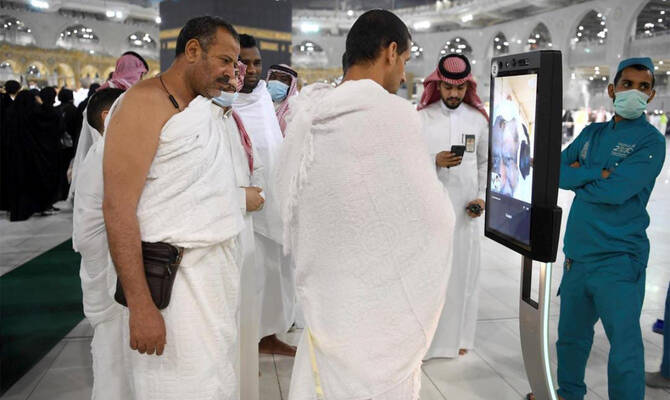
AI-powered robots in the Grand mosque offer information and guidance to pilgrims. (SPA)
2 / 4
AI-powered robots in the Grand mosque offer information and guidance to pilgrims. (SPA)
3 / 4
AI-powered robots in the Grand mosque offer information and guidance to pilgrims. (SPA)
4 / 4
AI-powered robots in the Grand mosque offer information and guidance to pilgrims. (SPA)
Short Url
Updated 26 March 2025
Follow

Smart solutions make life easier for growing pilgrim numbers at Grand Mosque

  • The system enables seamless crowd control during peak periods, facilitating smooth entry and exit processes

MAKKAH: The safety, comfort and experience of millions of pilgrims at the Grand Mosque will be better than ever, thanks to the General Authority for the Care of the Two Holy Mosques harnessing advanced technology and improving its strategic oversight.

At the heart of the transformation is a command center which gives the authority a comprehensive overview of operations. Advanced sensors at key entrances track pilgrim numbers in real time, enabling precise crowd monitoring and management in collaboration with relevant authorities.

A camera system captures real-time entry movements, providing instantaneous insights into pilgrim flows and pinpointing potential congestion risks. This dual-system approach has transformed crowd control within the mosque and is particularly effective in critical areas such as the Tawaf and Sa’i routes.

The system enables seamless crowd control during peak periods, facilitating smooth entry and exit processes. By leveraging precise and historical data, it ensures decision-makers can make swift, informed choices.

Over 200 digital panels have also been installed to improve spatial navigation, helping pilgrims move more efficiently through the mosque complex.

The number of electric golf carts has been expanded to 400, as well as custom-designed manual carts being available. This meets the diverse needs of pilgrims during the season, ensuring comfortable and seamless transportation that simplifies the performance of religious rituals.

A huge cooling infrastructure spans the sacred space, utilizing 155,000 tonnes of refrigeration to maintain perfect ambient temperatures across the Grand Mosque. Balanced lighting illuminates every corner, while a precision audio system ensures that calls to prayer and religious services resonate with clarity. A new luggage storage service also offers secure, QR-coded smart tags for easy tracking and retrieval of belongings.

The authority maintains rigorous standards and conducts periodic updates as part of efforts to maintain service efficiency and accommodate the growing number of pilgrims.


Rebuilding lives: Saudi initiative gives fresh hope to amputees

Updated 08 December 2025
Follow

Rebuilding lives: Saudi initiative gives fresh hope to amputees

  • Baitureh Health Association has provided life-changing support to more than 1,000 people
  • Prosthetic limbs can cost up to $76,000

MAKKAH: The Baitureh Health Association for the Care of Amputees has quickly become one of Saudi Arabia’s most impactful humanitarian initiatives, transforming support for people with lost limbs.

Established in 2020, the association deals with people’s physical, psychological and social needs and fills a long-standing gap in the national health system.

CEO Badr bin Alyan told Arab News that the initiative was created in response to a growing need, driven by amputations linked to accidents, blood disorders, occupational injuries and other causes.

Its operations were “based on service integration rather than fragmentation, enabling beneficiaries to return to their lives with confidence, ability and independence,” he said.

This holistic process covers everything from initial evaluations to psychological and physical rehabilitation, family support, prosthetic fitting and ongoing maintenance.

Its psychological support programs include group sessions led by certified mentors who have undergone similar experiences, as well as field visits to support patients before and after amputation.

More than 1,000 people across the Kingdom have so far benefitted from the association’s work, about 10 percent of them children, whom Alyan said were “the most sensitive and the most in need of intensive psychological and family support.”

Its specialist programs for children — My First Step and Therapeutic Entertainment — help young people adapt to prosthetics, overcome trauma and build confidence in a safe and supportive setting.

The association has completed more than 300 prosthetic fittings, including silicone cosmetic limbs, mechanical, hydraulic, electronic and 3D-printed models. 

Alyan said the type of prosthetic selected depended on a number of factors, such as age, lifestyle, type of amputation, activity level and psychological readiness.

Children also have to undergo frequent adjustments to their new limbs to account for their growth.

Each prosthetic cost between SR20,000 ($5,300) and SR285,000, Alyan said.

The association funds its work through sponsorships, community contributions and strategic partnerships.

Despite its success, Alyan said there were still challenges to be faced, including the lack of a consolidated base for the provision of psychological support and therapy services and prosthetics development and maintenance.

There was also a shortage of local experts, he said.

In response, the association set up a rehabilitation center, which Alyan said would help to localize prosthetics manufacturing, reduce costs and accelerate fitting processes and create opportunities for local experts to develop their knowledge and experience.

But providing prosthetics was only part of the association’s work, he said.

“Rebuilding a human life is the deeper goal.”