

Jordan eases entry regulations to boost tourism and investment
Jordan eases entry regulations to boost tourism and investment/node/2594826/middle-east
Jordan eases entry regulations to boost tourism and investment
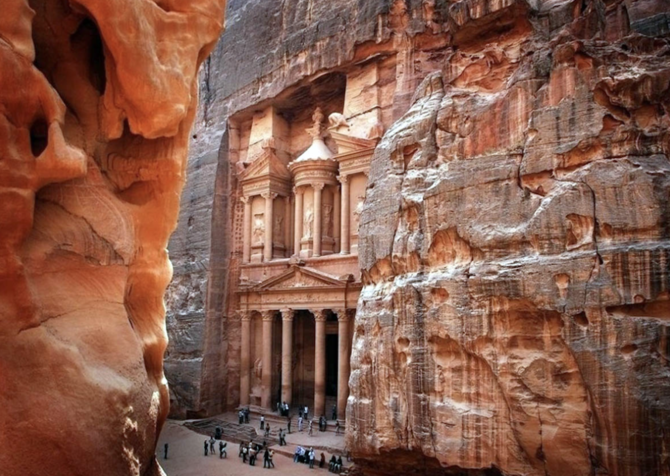
Jordan has introduced new regulations for entry to the country that are designed, officials said, to enhance the country’s appeal as a global tourism and investment hub. (Petra)
Jordan eases entry regulations to boost tourism and investment
New measures will grant easier access to the country for residents of Gulf nations, the US, Canada and European countries, among others
Entry eligibility for Syrian nationals also expanded; new rules for visitors from South Sudan and Libya in an effort to boost medical tourism
Updated 25 March 2025
Arab News
AMMAN: Jordan has introduced new regulations for entry to the country that are designed, officials said, to enhance the country’s appeal as a global tourism and investment hub.
The revised measures, part of Jordan’s Economic Modernization Vision, were announced on Tuesday by Tareq Majali, a spokesperson for the Ministry of Interior. He said the new policies simplify entry requirements for many foreign nationals, making it easier for visitors and investors to visit Jordan.
The updated regulations mean that residents of Gulf Cooperation Council countries, the US, Canada, Australia, Japan, South Korea and all European nations can now enter Jordan without prior approval, provided they hold residency permits in those countries valid for at least four months, the Jordan News Agency reported
The ministry has also expanded entry eligibility for Syrian nationals, allowing them to enter from all European countries rather than restricting them only to those that are members of the EU. In addition, citizens of South Sudan and Libya will no longer require prior approval to enter, in an attempt to bolster medical tourism and capitalize on the strong healthcare sector in Jordan.
In a further move to ease entry requirements, Jordan will permit foreign nationals who require prior approval to be assessed based on the entry conditions of their countries of residence, as long as they hold a residency permit valid for at least four months. Holders of Schengen and US visas will also be granted entry to Jordan, even if those visas have not been used previously.
A highlight of the new regulations is the introduction of a five-year, multiple-entry visa, issued at border crossings, that will allow holders to remain in Jordan for up to three months per visit without requiring them to report to security centers.
In a related move, domestic workers who accompany either Jordanian sponsors who reside in the Gulf or citizens of GCC countries will be eligible for a three-month temporary residency permit. This is designed to facilitate visits by Jordanian expatriates and their regional counterparts.
Majali encouraged travelers to make use of the electronic services provided by the ministry through its official website to streamline entry procedures.
UN experts say destruction by Sudan’s rebels in el-Fasher in October bears ‘hallmarks of genocide’
The fact-finding mission says the group inflicted mass killings and starvation-like siege conditions that targeted the Zaghawa and Fur people
UN officials say thousands of civilians were killed and many others disappeared after the city fell to RSF fighters in late October
Updated 13 sec ago
AP
A “campaign of destruction” in October by Sudanese rebels against non-Arab communities in and near a city in Sudan’s western region of Darfur shows “hallmarks of genocide,” UN-backed human rights experts reported Thursday, a dramatic finding in the country’s devastating war. The Rapid Support Forces carried out mass killings and other atrocities in el-Fasher after an 18-month siege during which they imposed conditions “calculated to bring about the physical destruction” of non-Arab communities, in particular the Zaghawa and the Fur communities, the independent fact-finding mission on Sudan reported. UN officials say several thousand civilians were killed in the RSF takeover of el-Fasher, the Sudanese army’s only remaining stronghold in the Darfur. Only 40 percent of the city’s 260,000 residents managed to flee the onslaught alive, thousands of whom were wounded, the officials said. The fate of the rest remains unknown. Sudan plunged into conflict in mid-April 2023, when long-simmering tensions between its military and paramilitary leaders broke out in the capital Khartoum and spread to other regions including Darfur. The devastating war has killed more than 40,000 people, according to UN figures, but aid groups say that is an undercount and the true number could be many times higher. The RSF and their allied Arab militias, known as Janjaweed, overran el-Fasher on Oct. 26 and rampaged through the city. The offensive was marked by widespread atrocities that included mass killings and summary executions, sexual violence, torture, and abductions for ransom, according to the UN Human Rights Office. They killed more than 6,000 people between Oct. 25 and Oct. 27 in the city, the office said. Ahead of the attack, the rebels ran riot in the Abu Shouk displacement camp, just outside of the city, and killed at least 300 people in two days, it said. The RSF did not respond to an emailed request for comment. The group’s commander, Gen. Mohammed Hamdan Dagalo, has previously acknowledged abuses by his fighters, but disputed the scale of atrocities. At least 3 criteria for genocide were met, team says An international convention known colloquially as the “Genocide Convention” — adopted in 1948, three years after the end of World War II and the Holocaust — sets out five criteria to assess whether genocide has taken place. They are: killing members of a group; causing its members serious bodily or mental harm; imposing measures aimed to prevent births in the group; deliberately inflicting conditions calculated to bring about the “physical destruction” of the group; and forcibly transferring its children to another group. The fact-finding team, which doesn’t have final say on the matter, said it found at least three of those five were met in the actions of the RSF. Under the convention, a genocide determination could be made even if only one of the five were met. The RSF acts in el-Fasher included killing members of a protected ethnic group; causing serious bodily and mental harm; and deliberately inflicting conditions of life calculated to bring about the group’s physical destruction in whole or in part — all core elements of the crime of genocide under international law, according to the fact-finding team. The report cited a systematic pattern of ethnically targeted killings, sexual violence and destruction and public statements explicitly calling for the elimination of non-Arab communities. ‘Not random’ excesses of war, chair says Team chair Mohamed Chande Othman, a former chief justice of Tanzania, said the RSF operation were not “random excesses of war” but pointed to a planned and organized operation that bore the characteristics of genocide. El-Fasher’s residents were “physically exhausted, malnourished, and in part unable to flee, leaving them defenseless against the extreme violence that followed,” the team’s report said. “Thousands of persons, particularly the Zaghawa, were killed, raped or disappeared during three days of absolute horror.” The fact-finding mission pointed to mass killings, widespread rape, sexual violence, torture and cruel treatment, arbitrary detention, extortion, and enforced disappearances during RSF’s takeover of el-Fasher in late October. The report documented cases of survivors quoting its fighters as saying things like: “Is there anyone Zaghawa among you? If we find Zaghawa, we will kill them all” and “We want to eliminate anything black from Darfur.” The report pointed to “selective targeting” of Zaghawa and Fur women and girls, “while women perceived as Arab were often spared.” A call for accountability The fact-finding team was created in 2023 by the Geneva-based Human Rights Council, the UN’s leading human rights body, which has 47 member countries drawn from membership in the world body. The team called for accountability for perpetrators and warned that protection of civilians is needed “more than ever” because the conflict is expanding to other regions in Sudan. Over the course of the conflict, the warring parties were accused of violating international law. But most of the atrocities were blamed on the RSF: The Biden administration, in one of its last decisions, said it committed genocide in Darfur. The RSF has been supported by the United Arab Emirates over the course of the war, according to UN experts and rights groups. The UAE has denied the allegations. The RSF grew out of the Janjaweed militias, who became notorious for atrocities in the early 2000s in a ruthless campaign against people identifying as East or Central African in Darfur. That campaign killed some 300,000 people and drove 2.7 million from their homes.