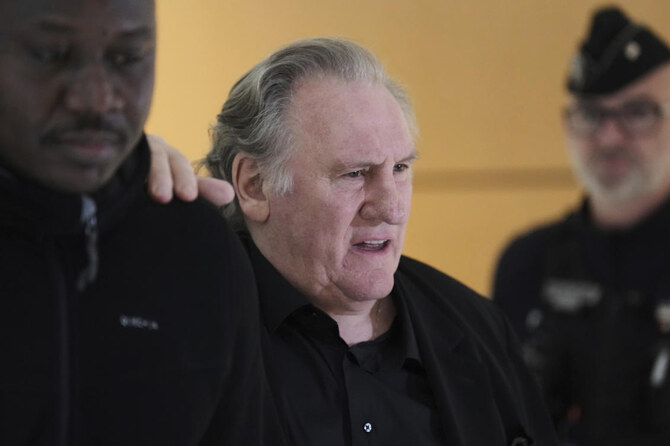
PARIS: French star actor Gerard Depardieu, on trial for sexual assault, told the Paris court Tuesday that he was not in the habit of “groping” women, and called the #MeToo movement a “reign of terror.”
“I don’t see why I would go around groping a woman,” he said in his first statement at the trial, in which he is charged with sexual assault on two women during the shooting of a film in 2021.
Depardieu said he was “not like that” in response to the accusations, adding that “there are vices that are alien to me.”
Depardieu, 76, who has acted in more than 200 films and television series, has been accused of improper behavior by around 20 women but this is the first case to come to trial.
“I deny all of it,” he told the court Tuesday.
He is the highest-profile figure to face accusations in French cinema’s response to the #MeToo movement, which he told the court Tuesday “will become a reign of terror.”
The trial relates to charges of sexual assault during the filming in 2021 of “Les Volets Verts” (“The Green Shutters“) by director Jean Becker.
Anouk Grinberg, a prominent actor who appeared in the film, has backed the two plaintiffs — a set dresser, 54, identified only as Amelie, and a 34-year-old assistant director. Both women allege sexual violence.
Giving his account of events during the shoot, Depardieu told the court that “it was a Friday, it was hot, it was humid. I weigh 150 kilos (331 pounds) and I was in a bad mood.”
He said that after a heated discussion with Amelie about choices on set, he grabbed her by the hips but only “so I wouldn’t slip.”
Amelie, testifying after Depardieu, said that Depardieu had actually behaved like a “wild animal” and “wasn’t at all the same man that you see here today.”
He was “constantly making remarks about women,” including on their attire, she said.
She reiterated her account, first reported in February last year, on how she had suffered sexual assault, harassment and sexist insults during the filming in September 2021.
She said Depardieu made “obscene remarks.”
Asked why she had not come forward immediately, Amelie said: “I didn’t want to talk about it, I felt humiliated. I was having a great run professionally and I knew that if I filed a police report, it would be the end of the film.”
Grinberg said previously that Depardieu constantly made “salacious remarks” during shooting, and told AFP that producers who hired him knew they were “hiring an abuser.”
But Depardieu challenged the accusation relating to the use of dirty language.
The trial, initially scheduled for October 2024, had been postponed due to the actor’s ill health.
His lawyer said back then that Depardieu had undergone a heart bypass operation and suffered from diabetes that was aggravated by the stress of the forthcoming trial.
Depardieu became a star in France from the 1980s with roles in “The Last Metro,” “Police” and “Cyrano de Bergerac,” before Peter Weir’s “Green Card” also made him a Hollywood celebrity.
He later acted in global productions including Kenneth Branagh’s “Hamlet,” Ang Lee’s “Life of Pi” and Netflix’s “Marseille” series.


![]()

Depardieu denies ‘groping’ women in France sex abuse trial
Short Url
https://arab.news/rxryr
Depardieu denies ‘groping’ women in France sex abuse trial
- Depardieu said he was “not like that” in response to the accusations, adding that “there are vices that are alien to me“
- “I deny all of it,” he told the court Tuesday


Latest updates



© 2026 SAUDI RESEARCH & PUBLISHING COMPANY, All Rights Reserved And subject to Terms of Use Agreement.