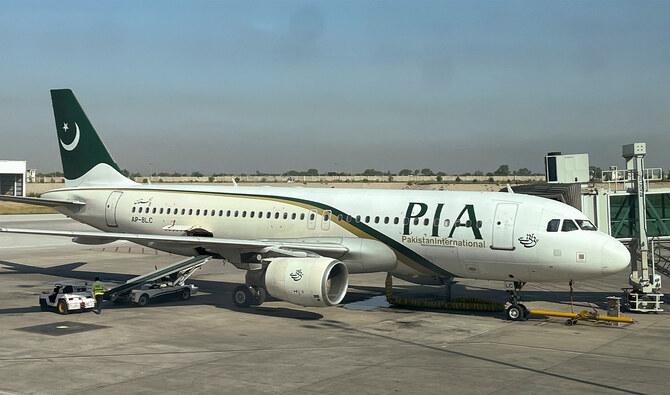
Pakistan approves fast-track plan to privatize loss-making national airline

View of a Pakistan International Airlines (PIA) passenger plane, taken through a glass panel, at Islamabad International Airport in Islamabad, Pakistan, on October 3, 2023. (REUTERS/File)
Short Url
Updated 25 March 2025
Follow

Pakistan approves fast-track plan to privatize loss-making national airline

  • Cash-strapped Pakistan wants to privatize debt-ridden PIA to reform state-owned enterprises
  • Pakistan hopes the restoration of PIA routes to Europe will boost the airline’s appeal to buyers

ISLAMABAD: The government has decided to endorse a plan to fast-track Pakistan International Airlines Corporation’s privatization, state media reported on Tuesday, while reiterating its resolve to offload loss-making public entities from the national exchequer.
Cash-strapped Pakistan is looking to privatize the debt-ridden PIA to raise funds and reform state-owned enterprises as envisaged under a $7 billion International Monetary Fund program secured last year.
The decision to endorse the new privatization plan follows Pakistan’s failed attempt last year to offload a 60 percent stake in the airline, which drew just a single offer that was well below the asking price.
The issue PIA privatization came under discussed at a meeting in Islamabad chaired by Deputy Prime Minister Senator Ishaq Dar.
“Cabinet Committee on Privatization (CCOP) on Tuesday approved a fast-tracked plan for the privatization of Pakistan International Airlines Corporation (PIACL), including the divestment of 51-100 percent share capital together with management control,” the Associated Press of Pakistan (APP) news agency reported.
“The deputy PM emphasized the government’s commitment to PIACL’s privatization to unlock its full potential and reduce financial burden on the national exchequer,” it added.
APP did not provide further details of the revised plan or explain how it would differ from the previous unsuccessful effort.
Earlier this month, the government appointed Muhammad Ali, formerly the special assistant to the prime minister on the power sector, as adviser for privatization.
Last year, PIA got permission to resume operations in Europe after a 2020 ban by the European Union Aviation Safety Agency (EASA), which had raised concerns about the ability of Pakistani authorities and the Civil Aviation Authority to ensure compliance with international aviation standards.
EASA and UK authorities had suspended PIA’s operations in the region after Pakistan launched a probe into pilot licensing irregularities following a 2020 crash that killed 97 people.
Pakistan hopes that the restoration of routes to Europe and anticipated approval for UK operations will boost the airline’s appeal to potential buyers.



Pakistan’s OGDC ramps up unconventional gas plans

Updated 05 December 2025
Follow

Pakistan’s OGDC ramps up unconventional gas plans

  • Pakistan has long been viewed as having potential in tight and shale gas but commercial output has yet to be proved
  • OGDC says has tripled tight-gas study area to 4,500 square km after new seismic, reservoir analysis indicates potential

ISLAMABAD: Pakistan’s state-run Oil & Gas Development Company is planning a major expansion of unconventional gas developments from early next year, aiming to boost production and reduce reliance on imported liquefied natural gas.

Pakistan has long been viewed as having potential in both tight and shale gas, which are trapped in rock and can only be released with specialized drilling, but commercial output has yet to be proved.

Managing Director Ahmed Lak told Reuters that OGDC had tripled its tight-gas study area to 4,500 square kilometers (1,737 square miles) after new seismic and reservoir analysis indicated larger potential. Phase two of a technical evaluation will finish by end-January, followed by full development plans.

The renewed push comes after US President Donald Trump said Pakistan held “massive” oil reserves in July, a statement analysts said lacked credible geological evidence, but which prompted Islamabad to underscore that it is pursuing its own efforts to unlock unconventional resources.

“We started with 85 wells, but the footprint has expanded massively,” Lak said, adding that OGDC’s next five-year plan would look “drastically different.”

Early results point to a “significant” resource across parts of Sindh and Balochistan, where multiple reservoirs show tight-gas characteristics, he said.

SHALE PILOT RAMPS UP

OGDC is also fast-tracking its shale program, shifting from a single test well to a five- to six-well plan in 2026–27, with expected flows of 3–4 million standard cubic feet per day (mmcfd) per well.

If successful, the development could scale to hundreds or even more than 1,000 wells, Lak said.

He said shale alone could eventually add 600 mmcfd to 1 billion standard cubic feet per day of incremental supply, though partners would be needed if the pilot proves viable.

The company is open to partners “on a reciprocal basis,” potentially exchanging acreage abroad for participation in Pakistan, he said.

A 2015 US Energy Information Administration study estimated Pakistan had 9.1 billion barrels of technically recoverable shale oil, the largest such resource outside China and the United States.

A 2022 assessment found parts of the Indus Basin geologically comparable to North American shale plays, though analysts say commercial viability still hinges on better geomechanical data, expanded fracking capacity and water availability.

OGDC plans to begin drilling a deep-water offshore well in the Indus Basin, known as the Deepal prospect, in the fourth quarter of 2026, Lak said. In October, Turkiye’s TPAO with PPL and its consortium partners, including OGDC, were awarded a block for offshore exploration.

A combination of weak gas demand, rising solar uptake and a rigid LNG import schedule has created a surplus of gas that forced OGDC to curb output and pushed Pakistan to divert cargoes from Italy’s ENI and seek revised terms with Qatar.