

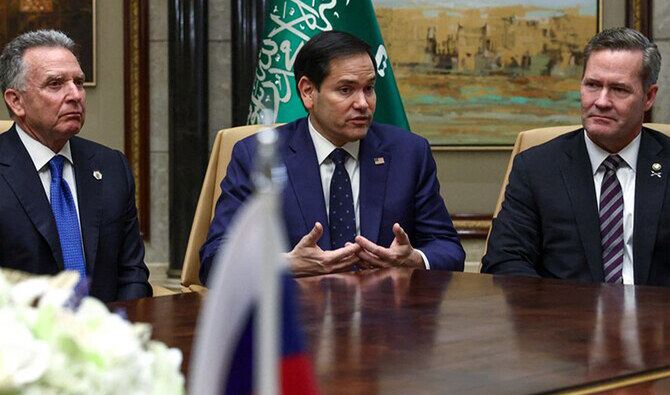
Russia-US talks in Saudi end after 12 hours of discussions

US Secretary of State Marco Rubio (C), US National Security Advisor Mike Waltz (R) and US Middle East envoy Steve Witkoff attend an interview after meeting with Russian Foreign Minister Sergei Lavrov and Russian President Vladimir Putin's foreign policy advisor Yuri Ushakov, at Diriyah Palace, in Riyadh, Saudi Arabia, on February 18, 2025. (File/AFP)
Short Url
Updated 25 March 2025
Follow

Russia-US talks in Saudi end after 12 hours of discussions

  • White House says aim was to reach maritime ceasefire in Black Sea, allow free flow of shipping
  • Talks take place as US President Trump intensifies his drive to end the three-year-old conflict

RIYADH: Talks between Russia and the US on Ukraine in Saudi Arabia on Monday have ended after around a dozen hours of negotiations, with a joint statement expected Tuesday, Russian news agencies reported.

The TASS news agency reported its source saying that the meeting had ended after “more than 12 hours of consultations” and that a “joint statement” on results will be published Tuesday.

The talks, which followed US talks with Ukraine on Sunday, came as US President Donald Trump intensifies his drive to end the three-year-old conflict after he last week spoke to both Ukrainian President Volodymyr Zelensky and Russian President Vladimir Putin.

A source briefed on the planning for the talks said the US side was being led by Andrew Peek, a senior director at the White House National Security Council, and Michael Anton, a senior State Department official.

The White House said the aim of the talks was to reach a maritime ceasefire in the Black Sea, allowing the free flow of shipping.

Russia will be represented by Grigory Karasin, a former diplomat who is now chair of the Federation Council’s Foreign Affairs Committee, and Sergei Beseda, an adviser to the director of the Federal Security Service. 

It has been a struggle to reach even a limited, 30-day ceasefire — which Moscow and Kyiv agreed to in principle last week — with both sides continuing to attack each other with drones and missiles.

One major sticking point is what targets would be off-limits to strike, even after US President Donald Trump spoke with the countries’ leaders, because the parties disagree.

While the White House said “energy and infrastructure” would be covered, the Kremlin declared that the agreement referred more narrowly to “energy infrastructure.” Ukrainian President Volodymyr Zelensky has said he would also like to see infrastructure like railways and ports protected.

Talks Monday in the Saudi capital of Riyadh were expected to address some of those differences, as well as a potential pause in attacks in the Black Sea to ensure the safety of commercial shipping. Russian state media reported late Monday local time that the talks had ended.

In an exchange with reporters at the White House, Trump said territorial lines and the potential for US ownership of a key nuclear power plant in southern Ukraine have been part of the talks.

* With AFP, AP and Reuters


Nobel laureate Machado says US helped her leave Venezuela, vows return

Updated 6 sec ago
Follow

Nobel laureate Machado says US helped her leave Venezuela, vows return

  • Machado emerged on a hotel balcony in Oslo to cheering supporters early Thursday
  • “We did get support from the United States government to get here,” Machado said

OSLO: Nobel Peace laureate Maria Corina Machado said on Thursday that the United States helped her get to Norway from hiding in Venezuela, expressing support for US military action against her country and vowing to return home.
Machado, who vanished in January after challenging the rule of President Nicolas Maduro, emerged on a hotel balcony in Oslo to cheering supporters early Thursday after several days of confusion over her whereabouts.
“We did get support from the United States government to get here,” Machado told a press conference when asked by AFP about whether Washington had helped.
The Wall Street Journal reported that she wore a wig and a disguise on the high-risk journey, leaving her hide-out in a Caracas suburb on Monday for a coastal fishing village, where she took a fishing skiff across the Caribbean Sea to Curacao.
The newspaper said the US military was informed to avoid the boat being targeted by airstrikes. Once on the island, she took a private jet to Oslo early on Wednesday.
Machado thanked those who “risked their lives” to get her to Norway but it was not immediately clear how or when she will return to Venezuela, which has said it would consider her a fugitive if she left.
“Of course, the risk of going back, perhaps it’s higher, but it’s always worthwhile. And I’ll be back in Venezuela, I have no doubt,” she added.
Machado has been hailed for her fight for democracy but also criticized for aligning herself with US President Donald Trump, to whom she has dedicated her Nobel, and for inviting foreign intervention in her country.

- Military build-up -

The United States has launched a military build-up in the Caribbean in recent weeks and deadly strikes on what Washington says are drug-smuggling boats.
“I believe every country has the right to defend themselves,” Machado told reporters Thursday.
“I believe that President Trump’s actions have been decisive to reach the point where we are right now, in which the regime is weaker than ever, because the regime previously thought that they could do anything,” she continued.
Late Wednesday, Trump said the United States had seized a “very large” oil tanker near Venezuela, which Caracas denounced as “blatant theft.”
Maduro maintains that US operations are aimed at toppling his government and seizing Venezuela’s oil reserves.
Machado first appeared on a balcony of the Grand Hotel in the middle of the night, waving and blowing kisses to supporters chanting “libertad” (“freedom“) below.
On the ground, she climbed over metal barriers to get closer to her supporters, many of whom hugged her and presented her with rosaries.
She said she has missed much of her children’s lives while hiding, including graduations and weddings.

- ‘ Political risk’ -

Machado won the Peace Prize for “her struggle to achieve a just and peaceful transition from dictatorship to democracy.”
She has accused Maduro of stealing Venezuela’s July 2024 election, from which she was banned — a claim backed by much of the international community.
She last appeared in public on January 9 in Caracas, where she protested Maduro’s inauguration for his third term.
The decision to leave Venezuela and join the Nobel festivities in Oslo comes at both personal and political risk.
“She risks being arrested if she returns even if the authorities have shown more restraint with her than with many others, because arresting her would have a very strong symbolic value,” said Benedicte Bull, a professor specializing in Latin America at the University of Oslo.
While Machado is the ” undisputed” leader of the opposition, “if she were to stay away in exile for a long time, I think that would change and she would gradually lose political influence,” Bull said.
In her acceptance speech read by one of her daughters Wednesday, Machado denounced kidnappings and torture under Maduro’s tenure, calling them “crimes against humanity” and “state terrorism, deployed to bury the will of the people.”
