

Saudi Architecture Characters Map begins implementation with digital tools and training

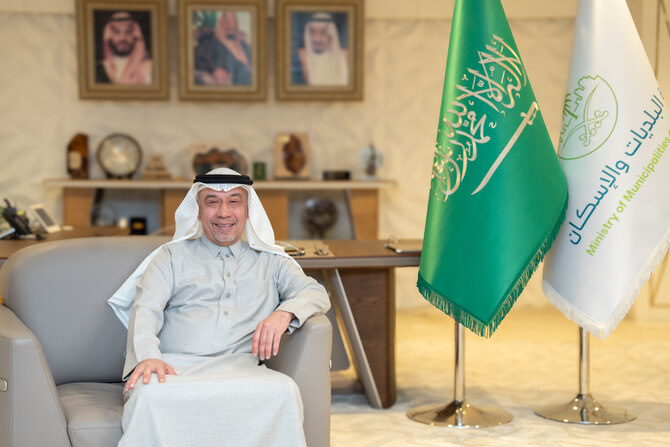
Vice Minister of Municipalities and Housing Ihab AlHashani. (AN photo by Huda Bashatah)
Short Url
Updated 25 March 2025
Follow

Saudi Architecture Characters Map begins implementation with digital tools and training

  • Initiative provides developers with guidelines for architectural styles
  • Guidelines inspired by regional identities, aiming to reflect Saudi Arabia’s cultural diversity

RIYADH: The Ministry of Municipalities and Housing has started the next phase of the Saudi Architecture Characters Map rollout in Taif, Al-Ahsa, Asir, and Makkah following its official launch earlier this month.

In an exclusive interview with Arab News, Vice Minister of Municipalities and Housing Ihab AlHashani detailed the next steps and outlined the robust coordination efforts underway to ensure the project’s success.

AlHashani emphasized the long preparation behind the initiative: “The architectural map of Saudi Arabia is really a project that has been in the (works) for over two years, led by Crown Prince Mohammed bin Salman.”

The ministry, he said, is concentrating on building awareness and preparing the industry for the upcoming rollout.

“The immediate step now that we have launched is really to kind of heighten awareness and start training some of the architects (to) launch in the four cities that were announced, at Taif, Al-Ahsa, Asir (and) Makkah.”

Saudi Architecture provides developers across the Kingdom with guidelines for building styles.

The Characters Map introduces 19 distinct architectural styles inspired by regional identities, aiming to reflect Saudi Arabia’s cultural diversity through its built environment.

The long-term vision of the project is to create more walkable and sustainable cities.

“We are working on broader strategy to kind of develop the five, 10, 15-minute cities in Saudi Arabia, where you can go to work, do your basic needs with a walkable distance,” he said.

AlHashani stressed that training architects is crucial for smooth implementation. He noted the extensive groundwork already laid out before the public launch.

“We have a massive program ongoing, starting with the communication that we are doing now … this has the training started way before the launch, so to make sure that we hit the ground running. The efforts are significant.”

He also highlighted the technical and digital support behind the initiative. “There (are) the digital tools in place that have been implemented already, part of the Balady platform. And of course, the ongoing communications with … the municipalities, and of course, our partners, the regional development authorities,” he added.

Addressing the evolution of design influences, AlHashani explained how previous examples have informed the current codes. He remarked on the role that pioneering projects played in shaping the national approach.

“Any successful example of (an) architectural design guideline was taken into account in developing these codes … our designs (are) inspired somewhat by Diriyah … but mostly it’s more covering the entire area of the central region.”

Looking ahead, he confirmed that implementation is already visible on the ground.

He added that the rollout is set to accelerate, with numerous examples expected in the near future: “There will be many examples in the coming 12 months … of these guidelines being implemented on the ground.”

To ensure a uniform application of the new design codes, the ministry has integrated the guidelines into its licensing process. AlHashani explained how digital enforcement plays a key role.

“Balady platform already has kind of a geospatial element in it, where each zone is already linked to the license that is issued. So, if you apply for a license in Taif, then the guidelines will come up as the requirements that you will have to (adhere to) in terms of design.”

Public engagement and outreach are also essential components of the initiative. AlHashani underscored the breadth of the ministry’s reach through its extensive municipal network.

“The municipal sector is the largest sector in Saudi Arabia … that has access and reach to the citizen.

“You deal with the with us on a daily basis, even without you knowing. We have for instance 285 (municipalities). We have 17 amanahs (administrative divisions). We are present everywhere in Saudi Arabia.”

He further emphasized the role of workshops and stakeholder meetings as vital tools for ensuring that all parties are aligned with the new standards.

“More importantly (are) the kind of the workshops that we have with key stakeholders in (these) structures such as the architectural firms, the big developers, and of course, the giga projects.”

Looking to the future, AlHashani touched on the broader strategic goals that underpin the initiative.

He explained that success will not only be measured by the immediate application of design guidelines but also by their impact on urban planning, with “major (key performance indicators).”

With integrated digital tools, targeted training, and extensive stakeholder engagement, the Saudi Architecture Characters Map aims to redefine urban development across the Kingdom while remaining rooted in its rich cultural heritage.


National program identifies 165 native plants for afforestation efforts in Asir

Updated 9 sec ago
Follow

National program identifies 165 native plants for afforestation efforts in Asir

  • The survey is part of broader plans focused on restoring degraded land, using native vegetation 

JEDDAH: Saudi Arabia’s National Afforestation Program has identified more than 165 species of native plants suitable for afforestation in the Asir region, highlighting the ecological diversity of one of the Kingdom’s most environmentally varied areas, the Saudi Press Agency reported.

The findings form part of broader national efforts to expand vegetation cover, address land degradation, and support sustainability goals linked to the Saudi Green Initiative and Vision 2030.

According to the program, the identified species are distributed across a wide range of natural environments in Asir, including mountainous terrain, highlands, slopes, valleys, plains, rocky landscapes, and coastal areas stretching from the Red Sea to Tihama.

The species belong to numerous plant families, including Fabaceae, Anacardiaceae, Burseraceae, Capparaceae, Ebenaceae, Euphorbiaceae, Malvaceae, Myrtaceae, Oleaceae, and Primulaceae, among others.

Plants suitable for afforestation range from large and small trees to perennial and annual shrubs, herbs, succulents, bulbs, and climbing plants. 

Among the most notable species identified are the grey mangrove, mastic tree, mooring or ben tree, juniper, sycamore fig, wild olive, henna, wild jasmine, hawthorn, and arak.

The Saudi Arabian Botanical Society described the announcement as an important step in protecting plant diversity and strengthening the ecosystem conservation in the Kingdom. 

Munirah bin Hamad Al-Hazani, founder and president of the society, said that prioritizing native species is central to sustainable afforestation.

“Focusing on the cultivation of native plants adapted to diverse environments forms the cornerstone of sustainable afforestation projects, as it plays a pivotal role in enhancing vegetation cover, combating land degradation, and conserving natural and financial resources,” she told Arab News.

Al-Hazani added that long-term success depends on cooperation between government bodies and the nonprofit sector, alongside community involvement and environmental awareness programs.

The National Afforestation Program has increasingly emphasized community participation, working with government agencies, private companies, and nonprofit organizations to support planting initiatives and environmental education. Its approach includes promoting volunteerism and discouraging harmful environmental practices, while focusing on the use of native plants adapted to local conditions.

Parallel efforts are underway in other regions of the Kingdom to support vegetation restoration through research and infrastructure development. In Jouf, often referred to as the Kingdom’s food basket, the King Salman bin Abdulaziz Royal Reserve Development Authority has established a Central Nursery and a Wild Seeds Research and Production Station to address the growing demand for reliable sources of native seeds and seedlings.

The project was launched in 2023 under the directive of Prince Abdulaziz bin Saud bin Naif, the minister of interior and chairman of the authority’s board of directors. 

Since then, the facilities has become a key component of vegetation restoration efforts within the reserve.

The authority has focused on building operational capacity by recruiting and training specialists to manage cultivation and research activities. The research and production station includes 14 mother-seed production fields containing over 400,000 trees and shrubs. 

Planting began in late 2024, with more than 30 native plant species represented, selected for their role in the reserve’s natural ecosystem. 

The facility also includes two seed storage units with a combined capacity of 3,000 kilograms. Seeds are collected annually from multiple sites within the reserve and used for seedling production habitat rehabilitation.

The Central Nursery spans 6,000 square meters and includes 30 greenhouses spanning 1,500 square meters, as well as two shade houses used during summer months. A plant hardening facility, designed to prepare seedlings for natural environmental conditions, covers 10,000 square meters and is divided into seven sections. The nursery’s annual production capacity reaches 1.5 million seedlings, representing more than 15 native plant species. 

Together, these initiatives underscore the growing role of native plant research and propagation in Saudi Arabia’s afforestation strategy, particularly as the Kingdom works to balance environmental restoration with long-term sustainability goals.