

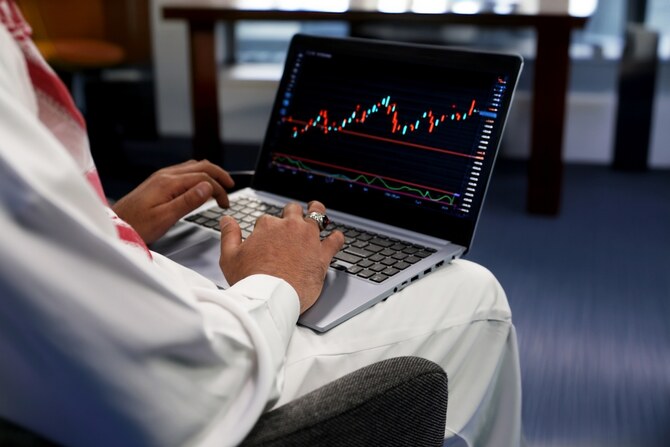

RIYADH: Arab financial markets showed a mixed performance in February, influenced by global economic uncertainties, geopolitical tensions, and fluctuating investor sentiment, according to a new report.
The latest monthly bulletin released by the Arab Monetary Fund revealed that the composite index for these exchanges remained flat at the end of February.
Arab stock markets did start 2025 on a strong note, buoyed by global gains, with the AMF’s January report citing improved investor sentiment and an international market rebound as driving a 0.97 percent increase in the composite index by month-end.
This momentum faltered in February, with seven exchanges recording losses, compared to just three the previous month.
Despite short-term volatility, the report indicated that investors remain cautiously optimistic about Arab markets.
The best-performing markets included Bahrain, which recorded a 4.3 percent increase, followed by Kuwait and Tunisia.
Meanwhile, Saudi Arabia and Palestine were among the worst-hit, registering losses of 2.45 percent and 2.37 percent, respectively.
Morocco’s Casablanca Stock Exchange and Egypt’s EGX30 also recorded gains.
On the downside, Qatar, Muscat, and Amman experienced declines, along with Iraq.
Saudi Stock Exchange was among those impacted by global economic trends. File
Abu Dhabi’s index dipped slightly by 0.11 percent, reflecting mixed sentiment among investors.
The report provided a detailed breakdown of market performance, trading volumes, sectoral trends, and the macroeconomic factors influencing Arab financial markets.
Market liquidity took a significant hit, with trading volumes plummeting by 26.73 percent across exchanges.
The overall market capitalization of Arab stock exchanges contracted by 1.53 percent, shedding approximately $67.56 billion by the end of February.
The Kingdom experienced the most significant setback, contributing a 1.66 percent decline to the overall market cap, while Bahrain led gains with a 4.27 percent increase.
The decline in trading volume was widespread, with eight exchanges experiencing reduced activity. The value of traded shares also dropped by 8.64 percent in February compared to January.
Notably, Bahrain and Muscat experienced significant increases in trading value at 6,888.38 percent and 211.39 percent.
Egypt and Saudi Arabia suffered major declines of 29.07 percent and 19.73 percent, with Palestine seeing the most drastic fall at 69.15 percent.
Global pressures weigh on performance
The underperformance of some Arab exchanges was largely aligned with global trends, as major international indices such as the Dow Jones, Nasdaq, and Japan’s Nikkei posted losses.
European markets saw mixed results, with the CAC 40 and FTSE 100 showing slight gains, while the MSCI Emerging Markets Index for Latin America and Asia declined.
Financial markets worldwide experienced volatility due to a combination of factors, including rising US tariffs, ongoing supply chain disruptions, and increasing trade tensions with China, Canada, and Mexico.
According to the report, the escalating geopolitical conflict between Russia and Ukraine further dampened investor sentiment. Concerns about slowing global economic growth and inflationary pressures also contributed to market instability.
Sectoral performance and economic policies
Sector-wise, financials, consumer services, and telecommunications were among the key drivers of gains in Kuwait, Dubai, and Egypt. The real estate and industrial sectors also performed well, supporting the upward momentum in select exchanges.
Conversely, energy and technology stocks struggled, especially in Saudi Arabia and Qatar, as oil price volatility persisted and investor uncertainty increased due to global supply concerns.
Oil prices remained under pressure due to increased supply and concerns over demand fluctuations, negatively impacting energy-linked equities in several Arab markets. Meanwhile, commodity markets also saw sharp fluctuations, impacting investor appetite for riskier assets.
Monetary policies in Arab economies also saw adjustments, with several central banks lowering interest rates to stimulate economic growth. Saudi Arabia, the UAE, and Qatar implemented minor rate cuts, reflecting a broader effort to maintain economic stability amid global headwinds.
Egypt raised its interest rate in an effort to curb inflationary pressures and stabilize its currency.
Interest rate shifts were also observed globally, with the US Federal Reserve maintaining a cautious stance, while Japan adjusted its rates upward slightly.
China, the eurozone, and India saw minor rate reductions to counter slowing economic momentum.
In contrast, Russia increased its interest rate in response to inflationary pressures, while Argentina and Turkiye made substantial cuts, bringing their rates down to 29 percent and 45 percent, respectively.
Cautious optimism amid risks
Easing inflationary pressures and expectations of a stabilization in oil prices could provide a more favorable environment in the coming months, according to the report.
External risks such as US monetary policy shifts, further trade restrictions, and geopolitical instability, however, will continue to influence market movements.
Market participants are closely monitoring fiscal policies and government spending initiatives in key Arab economies, as these factors will play a role in determining future investment flows and stock market performance. The trend of central banks adjusting monetary policies to counter inflation and economic slowdown is expected to continue shaping market sentiment.
The real estate and financial sectors remain a stronghold for investors, with banks showing resilience amid shifting interest rate policies.
The energy sector remains vulnerable to external pressures, however, particularly as oil supply concerns persist, the report stated.


