

EU top diplomat: Israel strikes on Syria, Lebanon ‘risk further escalation’

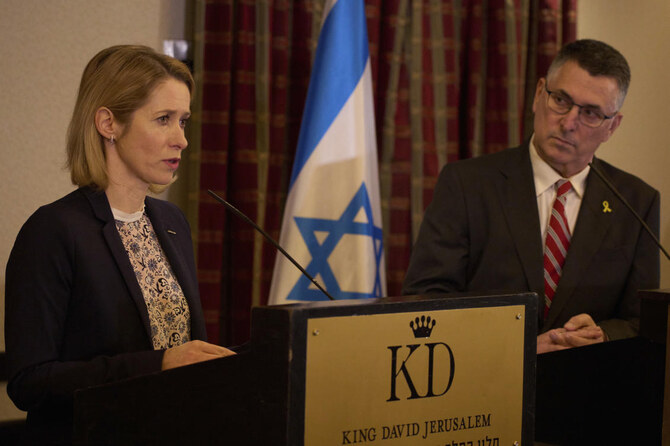
The EU High Representative for Foreign Affairs and Security Policy Kaja Kallas, left, speaks during a press conference with Israel's Foreign Minister Gideon Sa'ar after a meeting in Jerusalem, Monday, March 24, 2025. (AP)
Short Url
Updated 24 March 2025
Follow

EU top diplomat: Israel strikes on Syria, Lebanon ‘risk further escalation’

  • Despite the ceasefire, Israel has continued to carry out strikes on Lebanon
  • In Syria, Israel has launched hundreds of strikes on military sites since Islamist-led rebels overthrew strongman Bashar Assad

JERUSALEM: EU foreign policy chief Kaja Kallas warned on Monday during a visit to Jerusalem that Israeli strikes on Syria and Lebanon threatened to worsen the situation.
The most intense escalation since a November ceasefire, which ended the war between Israel and the Iran-backed militant group Hezbollah in Lebanon, occurred on Saturday.
Lebanon’s health ministry said seven people were killed, with Israel saying it attacked in response to rocket fire, which Hezbollah denied responsibility for.
Despite the ceasefire, Israel has continued to carry out strikes on Lebanon, and both sides have repeatedly accused the other of violating the truce.
“Military actions must be proportionate, and Israeli strikes into Syria and Lebanon risk further escalation,” Kallas said at a joint news conference with Israeli Foreign Minister Gideon Saar.
In Syria, Israel has launched hundreds of strikes on military sites since Islamist-led rebels overthrew strongman Bashar Assad in December. Israel says it wants to prevent weapons from falling into the hands of the new authorities it considers jihadists.

Opinion

This section contains relevant reference points, placed in (Opinion field)

“We feel that these things are unnecessary because Syria is right now not attacking Israel and that feeds more radicalization that is also against Israel, which we don’t want to see,” Kallas told journalists.
The Israeli military has also deployed to the UN-patrolled buffer zone on the Golan Heights, separating the Israeli-occupied part of the Golan from that still controlled by Syria.
Israeli Prime Minister Benjamin Netanyahu has demanded the demilitarization of southern Syria and said his country will not tolerate the presence of forces from the new authorities south of Damascus.
Syria’s foreign ministry has accused Israel of waging a campaign against “the stability of the country.”
Kallas will hold talks with Palestinian prime minister Mohammad Mustafa in the occupied West Bank later on Monday.


Syria’s growth accelerates as sanctions ease, refugees return

Updated 06 December 2025
Follow

Syria’s growth accelerates as sanctions ease, refugees return

  • Economy grows much faster than World Bank’s 1% estimate, fueling plans for currency’s relaunch

NEW YORK: Syria’s economy is growing much faster than the World Bank’s 1 percent estimate for 2025 as refugees flow back after the end of a 14-year civil war, fueling plans for the relaunch of the country’s currency and efforts to build a new Middle East financial hub, central bank Governor AbdulKader Husrieh has said.

Speaking via video link at a conference in New York, Husrieh also said he welcomed a deal with Visa to establish digital payment systems and added that the country is working with the International Monetary Fund to develop methods to accurately measure economic data to reflect the resurgence. 

The Syrian central bank chief, who is helping guide the war-torn country’s reintegration into the global economy after the fall of Bashar Assad’s regime about a year ago, described the repeal of many US sanctions against Syria as “a miracle.”

The US Treasury on Nov. 10 announced a 180-day extension of the suspension of the so-called Caesar sanctions against Syria; lifting them entirely requires approval by the US Congress. 

Husrieh said that based on discussions with US lawmakers, he expects the sanctions to be repealed by the end of 2025, ending “the last episode of the sanctions.”

“Once this happens, this will give comfort to our potential correspondent banks about dealing with Syria,” he said.

Husrieh also said that Syria was working to revamp regulations aimed at combating money laundering and the financing of terrorism, which he said would provide further assurances to international lenders. 

Syria’s central bank has recently organized workshops with banks from the US, Turkiye, Jordan and Australia to discuss due diligence in reviewing transactions, he added.

Husrieh said that Syria is preparing to launch a new currency in eight note denominations and confirmed plans to remove two zeroes from them in a bid to restore confidence in the battered pound.

“The new currency will be a signal and symbol for this financial liberation,” Husrieh said. “We are glad that we are working with Visa and Mastercard,” Husrieh said.